
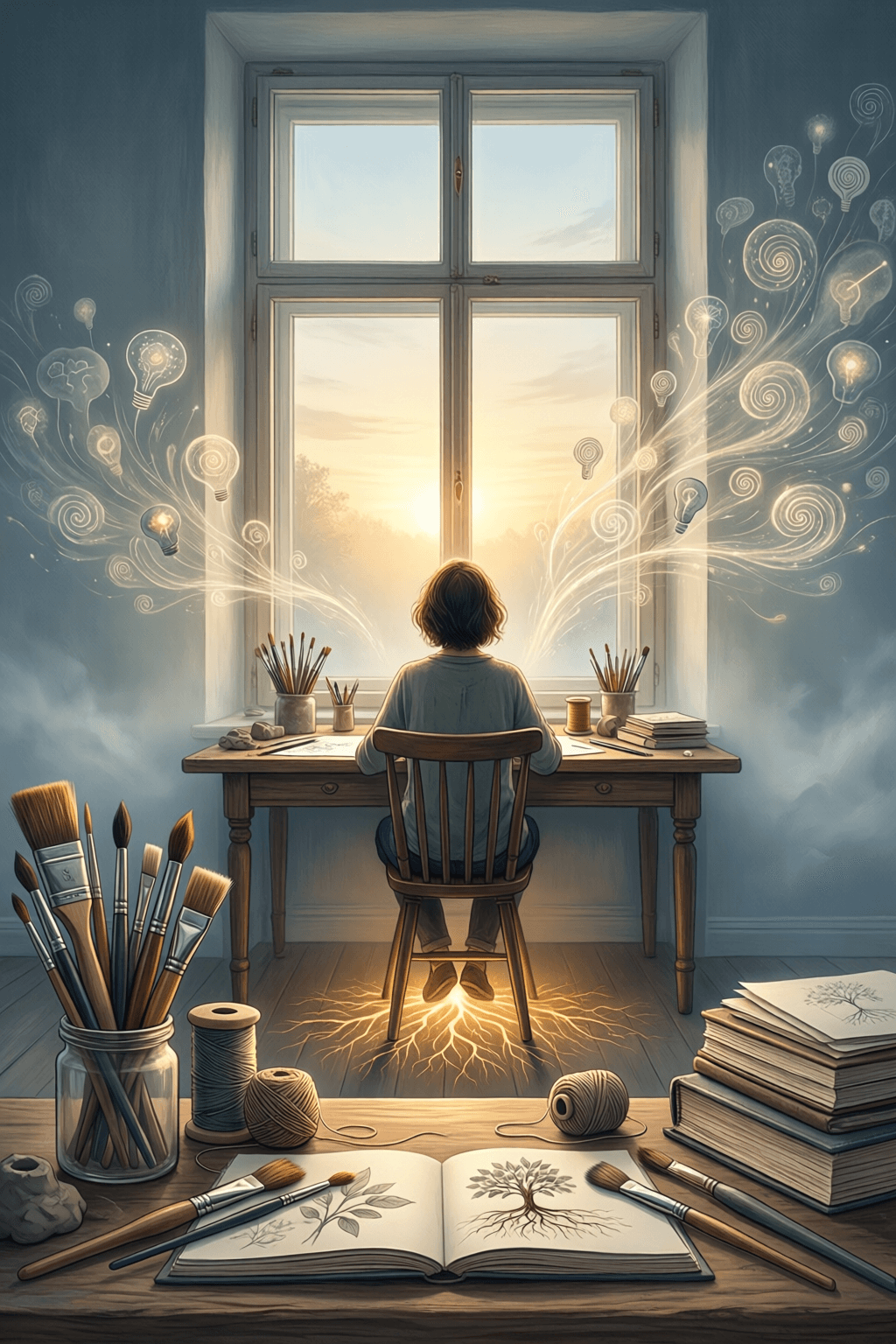
The creative process pulls me out of myself and into what I'm doing—while helping me stay firmly anchored in myself. — Anne Lamott
—What lingers after this line?
The Paradox at the Heart of Making
Anne Lamott’s reflection captures a striking paradox: creativity can carry a person beyond self-consciousness while also returning them to a deeper self. In the act of writing, painting, or composing, attention shifts away from anxiety, ego, and rumination toward the work itself. Yet this very surrender often clarifies what one truly feels, believes, and fears. In that sense, the creative process is not a flight from identity but a route back to it. Lamott, whose Bird by Bird (1994) frequently explores the emotional realities of writing, suggests that immersion in art can feel both liberating and stabilizing. What appears to be self-forgetting becomes, almost paradoxically, a form of self-recovery.
Losing the Self to Find Focus
From this starting point, the quote also speaks to the experience psychologists often call flow. Mihaly Csikszentmihalyi’s Flow (1990) describes moments of total absorption in an activity, when time seems to disappear and the usual chatter of the mind grows quiet. Creative work often produces precisely this state, allowing people to step outside habitual worry and enter concentrated presence. However, Lamott adds something richer than mere efficiency. The goal is not just heightened focus but meaningful engagement. By being drawn fully into the task, the creator is briefly released from the burden of constant self-monitoring, and that release can feel restorative rather than evasive.
Art as a Form of Grounding
At the same time, Lamott insists that creativity anchors rather than scatters the self. This is important, because intense artistic immersion is sometimes imagined as chaotic or destabilizing. Her phrasing counters that idea: making something can provide structure, rhythm, and a place to stand, especially when inner life feels fragmented. This grounding function appears in many artistic traditions. Julia Cameron’s The Artist’s Way (1992), for instance, treats regular creative practice as a means of reconnecting with one’s authentic center. Thus, even when art draws attention outward toward the work, it quietly gathers the self inward, giving shape to emotion and coherence to experience.
Why Expression Creates Stability
Building on that, creativity often steadies people because it transforms vague feeling into tangible form. Anxieties that remain shapeless can feel overwhelming, but once they become words on a page or color on a canvas, they become something one can examine. The act of making does not erase pain; instead, it gives pain boundaries and language. This insight echoes psychoanalytic and literary traditions alike. Donald Winnicott’s Playing and Reality (1971) argues that creative living helps individuals experience the world as real and manageable. In Lamott’s terms, then, the artist becomes anchored not by controlling every emotion, but by giving those emotions a container through craft.
The Discipline Hidden Inside Inspiration
Moreover, Lamott’s quote quietly honors the discipline of creativity. Being pulled into the work is not only a mystical moment of inspiration; it often arises from showing up repeatedly, even imperfectly. Lamott is especially known for defending messy first drafts in Bird by Bird (1994), reminding writers that honest work begins in vulnerability rather than polish. Consequently, the anchoring she describes is not abstract. It comes from practice, routine, and attention. Creativity becomes dependable not because it always feels easy, but because returning to the page or studio teaches the self how to remain present through uncertainty.
A Wider Lesson About Human Attention
Finally, the quote reaches beyond artists and speaks to a broader human need: to be absorbed by something meaningful without becoming lost. In a culture saturated with distraction and performance, Lamott offers an alternative vision of attention—one in which devotion to a task can both quiet the ego and strengthen the inner life. For that reason, her insight resonates with anyone who has felt steadier after cooking, gardening, building, or journaling. The creative process becomes a model for healthy engagement with the world: we leave the cramped confines of self-preoccupation, and precisely through that outward movement, we come home to ourselves.
Recommended Reading
As an Amazon Associate, we earn from qualifying purchases.
One-minute reflection
Where does this idea show up in your life right now?
Related Quotes
6 selectedCreativity takes courage. — Henri Matisse
Henri Matisse
This quote highlights that being creative often involves exposing one's inner thoughts and feelings, which requires a significant amount of courage as it makes one vulnerable to criticism and judgment.
Read full interpretation →Getting sober is a radically creative act. — Meredith Bell
Meredith Bell
At first glance, Meredith Bell’s statement reframes sobriety in a striking way: it is not merely the removal of alcohol or drugs, but the invention of a new way to live. Calling it a “radically creative act” shifts the f...
Read full interpretation →The comfort zone is the great enemy to creativity; moving beyond it necessitates intuition, which in turn configures new perspectives and conquers fears. — Bruce Lee
Bruce Lee
Bruce Lee begins with a blunt diagnosis: comfort can quietly become the enemy of invention. Familiar routines feel safe because they reduce uncertainty, yet that same predictability often narrows perception and dulls exp...
Read full interpretation →The future is uncertain… but this uncertainty is at the very heart of human creativity. — Ilya Prigogine
Ilya Prigogine
At first glance, uncertainty seems like a condition to resist, since people often associate it with instability, fear, and loss of control. Yet Ilya Prigogine turns that assumption inside out, arguing that uncertainty is...
Read full interpretation →To be creative is to participate in the great process of creation — and participating in creativity is participating in life. — Rajneesh
Rajneesh
Rajneesh frames creativity not as a rare talent but as an act of joining something larger than oneself. At once, the quote shifts attention away from finished masterpieces and toward participation in an ongoing process o...
Read full interpretation →Art is not a thing; it is a way. — Elbert Hubbard
Elbert Hubbard
Elbert Hubbard’s line immediately shifts attention away from paintings, sculptures, or books as isolated products. Instead, he suggests that art lives in the manner of seeing, choosing, and shaping experience.
Read full interpretation →More From Author
More from Anne Lamott →Slow down. You are not a machine designed for constant output; you are a human meant for intentional being. — Anne Lamott
Anne Lamott’s line begins as a gentle interruption, yet it lands like a critique of modern life. By saying, “Slow down,” she challenges a culture that rewards constant motion and treats rest as weakness.
Read full interpretation →In the middle of all the mess, there's a quiet kind of magic waiting for you. — Anne Lamott
At first glance, Anne Lamott’s line suggests a contradiction: how can ‘magic’ exist in the middle of a mess? Yet that tension is precisely the point.
Read full interpretation →By choosing to be yourself, you have already won the most important battle. — Anne Lamott
At its core, Anne Lamott’s statement reframes victory in deeply personal terms. Rather than measuring success by status, approval, or comparison, she suggests that the most important win happens the moment a person stops...
Read full interpretation →Give your heart the space it needs to breathe; you do not have to carry everything all at once. — Anne Lamott
Anne Lamott’s line begins with a gentle permission: the heart, like the body, needs space, rhythm, and rest. Rather than treating emotional strength as endless endurance, she reframes care as breathing room—something nec...
Read full interpretation →