
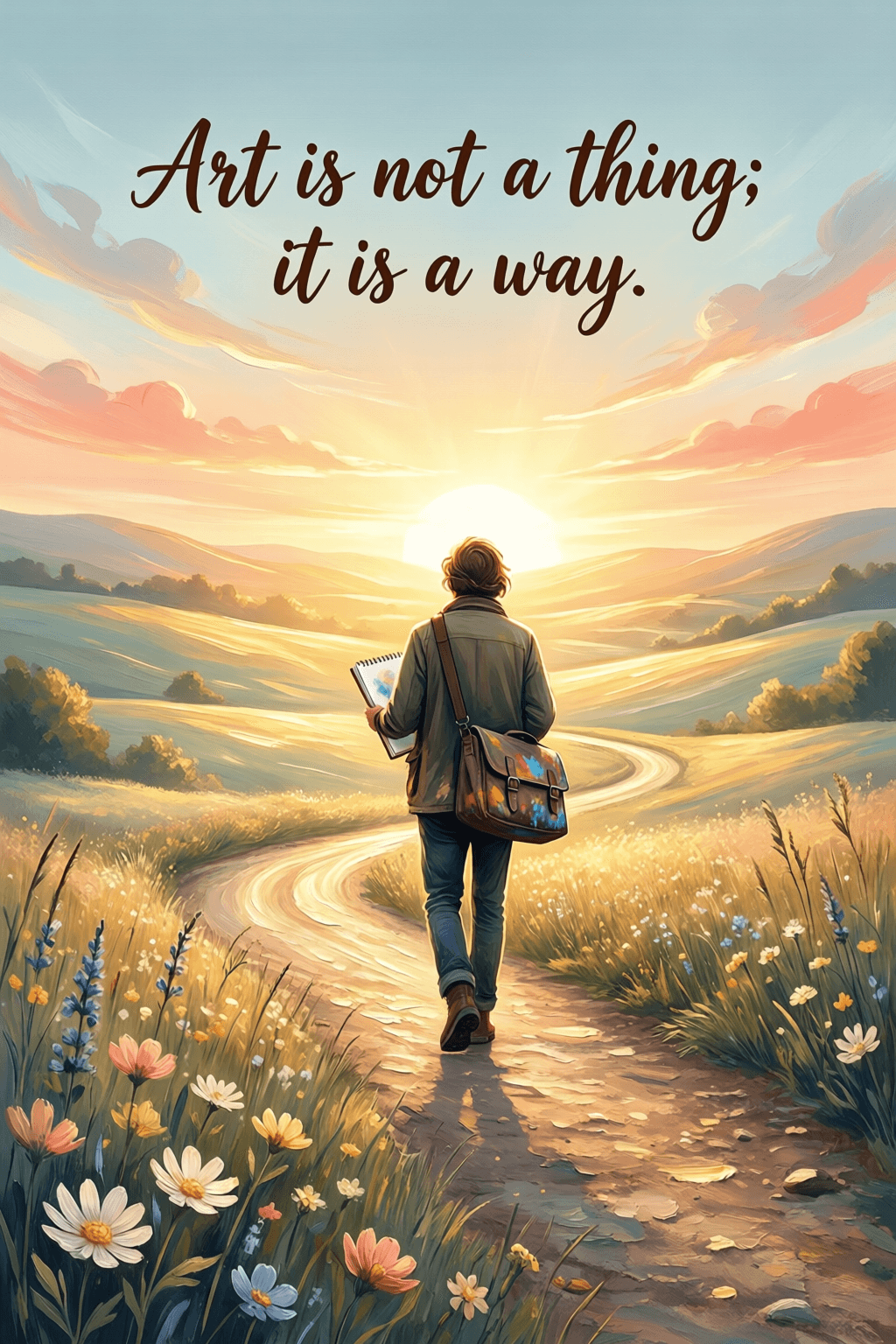
Art is not a thing; it is a way. — Elbert Hubbard
—What lingers after this line?
Beyond the Finished Object
Elbert Hubbard’s line immediately shifts attention away from paintings, sculptures, or books as isolated products. Instead, he suggests that art lives in the manner of seeing, choosing, and shaping experience. In this sense, a work of art is only the visible trace of something deeper: a cultivated way of moving through the world with sensitivity and intention. From that starting point, the quote resists the common habit of treating art as a luxury item or collectible thing. Hubbard, a founder of the Roycroft artisan community in the early 1900s, often connected beauty with daily labor, implying that art begins not at the gallery wall but in the habits of perception that give form to ordinary life.
Art as a Practice of Perception
If art is a way, then its first domain is perception. The artist notices textures, rhythms, tensions, and fleeting moods that others may overlook. A rainy street becomes a study in reflection; a quiet kitchen becomes an arrangement of light and memory. Thus, art begins before making anything at all: it starts in learning how to pay attention. This idea echoes John Dewey’s Art as Experience (1934), which argues that art emerges from intensified, meaningful engagement with life rather than from detached objects alone. Consequently, Hubbard’s statement broadens the role of art from specialized production to a disciplined openness to the richness of everyday experience.
The Craft of Everyday Living
Once perception changes, behavior follows. A person who treats art as a way may write a letter with care, arrange a room thoughtfully, cook with balance and color, or speak with a sense of rhythm. In other words, artistry enters conduct itself, turning ordinary acts into expressions of form, care, and character. Here Hubbard’s thought aligns with William Morris, whose lectures such as “The Beauty of Life” (1880) argued that beauty belongs in common life, not only in elite institutions. The anecdote of the Arts and Crafts movement—designing furniture, books, and homes with integrity—illustrates the same principle: art is not merely displayed; it is lived.
A Rejection of Passive Consumption
At the same time, the quote challenges a passive relationship to culture. If art were simply a thing, people could possess it without being changed by it. But if it is a way, then art asks for participation. One must engage, interpret, respond, and perhaps even reorder one’s habits under its influence. This transition matters because it turns the admirer into a maker, even in small ways. Plato’s Ion and later aesthetic traditions often wrestled with artistic inspiration, yet Hubbard’s formulation is more democratic: one need not be a genius to live artfully. The creative life begins whenever a person refuses mere routine and chooses conscious expression instead.
Style, Character, and Inner Form
Seen more deeply, Hubbard’s remark also links art with character. A way of living reflects inner form—values, discipline, courage, and taste made visible in action. Just as a painter’s brushwork reveals temperament, a person’s daily choices reveal whether life is being lived mechanically or imaginatively. For that reason, the quote carries an ethical undertone. It suggests that beauty is not separate from the self but radiates from how one meets work, relationships, and difficulty. In a similar spirit, Nietzsche in The Gay Science (1882) urged readers to “give style” to their character, implying that the artistic task may ultimately be the shaping of one’s own life.
Why the Quote Still Resonates
Finally, Hubbard’s statement remains powerful because modern life often reduces art to content, product, or market value. Against that pressure, his words restore art to process, sensibility, and presence. They remind us that creativity is not confined to rare masterpieces but woven into how we observe, arrange, and respond to the world. As a result, the quote offers both liberation and responsibility. Anyone can begin living artistically, yet doing so requires attention, courage, and care. Art, then, is less a possession than a posture: a continual practice of making life more thoughtful, more expressive, and more fully awake.
One-minute reflection
Why might this line matter today, not tomorrow?
Related Quotes
6 selectedCreativity takes courage. — Henri Matisse
Henri Matisse
This quote highlights that being creative often involves exposing one's inner thoughts and feelings, which requires a significant amount of courage as it makes one vulnerable to criticism and judgment.
Read full interpretation →Don't think. Thinking is the enemy of creativity. It's self-conscious, and anything self-conscious is lousy. — Ray Bradbury
Ray Bradbury
At first glance, Ray Bradbury’s line sounds almost rebellious: “Don’t think. Thinking is the enemy of creativity.” Yet his target is not intelligence itself, but the paralyzing kind of self-awareness that makes an artist...
Read full interpretation →You can be cautious or you can be creative, but there's no such thing as a cautious creative. — George Lois
George Lois
George Lois draws a sharp line between two mindsets: caution protects what already exists, while creativity risks making something new. At first glance, the statement sounds absolute, yet that severity is exactly its poi...
Read full interpretation →Almost always, the creative dedicated minority has made the world better. — Martin Luther King, Jr.
Martin Luther King Jr.
Martin Luther King, Jr. distills a sweeping historical truth into a single sentence: progress is often driven not by the passive majority but by a small, committed group willing to imagine a better order.
Read full interpretation →What keeps life fascinating is the constant creativity of the soul. — Deepak Chopra
Deepak Chopra
At its core, Deepak Chopra’s line suggests that life stays interesting not because the world is fixed and exciting on its own, but because the inner self continually reinterprets it. The phrase “creativity of the soul” p...
Read full interpretation →The best way to prepare for life is to begin to live. — Elbert Hubbard
Elbert Hubbard
This quote encourages individuals to actively engage in life rather than passively waiting for the right moment. By living fully in the present, people can better prepare themselves for future challenges and opportunitie...
Read full interpretation →More From Author
More from Elbert Hubbard →The love we give away is the only love we keep. — Elbert Hubbard
At first glance, Elbert Hubbard’s line seems to contradict common sense: how can love that is given away be the only love we keep? Yet the paradox is precisely the point.
Read full interpretation →The best way to prepare for life is to begin to live. — Elbert Hubbard
This quote encourages individuals to actively engage in life rather than passively waiting for the right moment. By living fully in the present, people can better prepare themselves for future challenges and opportunitie...
Read full interpretation →Do your work with your whole heart, and you will succeed. — Elbert Hubbard
This quote stresses the significance of being fully dedicated to one's work. A wholehearted approach often leads to higher levels of effort and a stronger commitment to achieving success.
Read full interpretation →To avoid criticism say nothing, do nothing, be nothing. — Elbert Hubbard
This quote highlights the tendency of individuals to become paralyzed by the fear of criticism. It suggests that by avoiding action or expression, one attempts to shield themselves from the judgment of others.
Read full interpretation →