
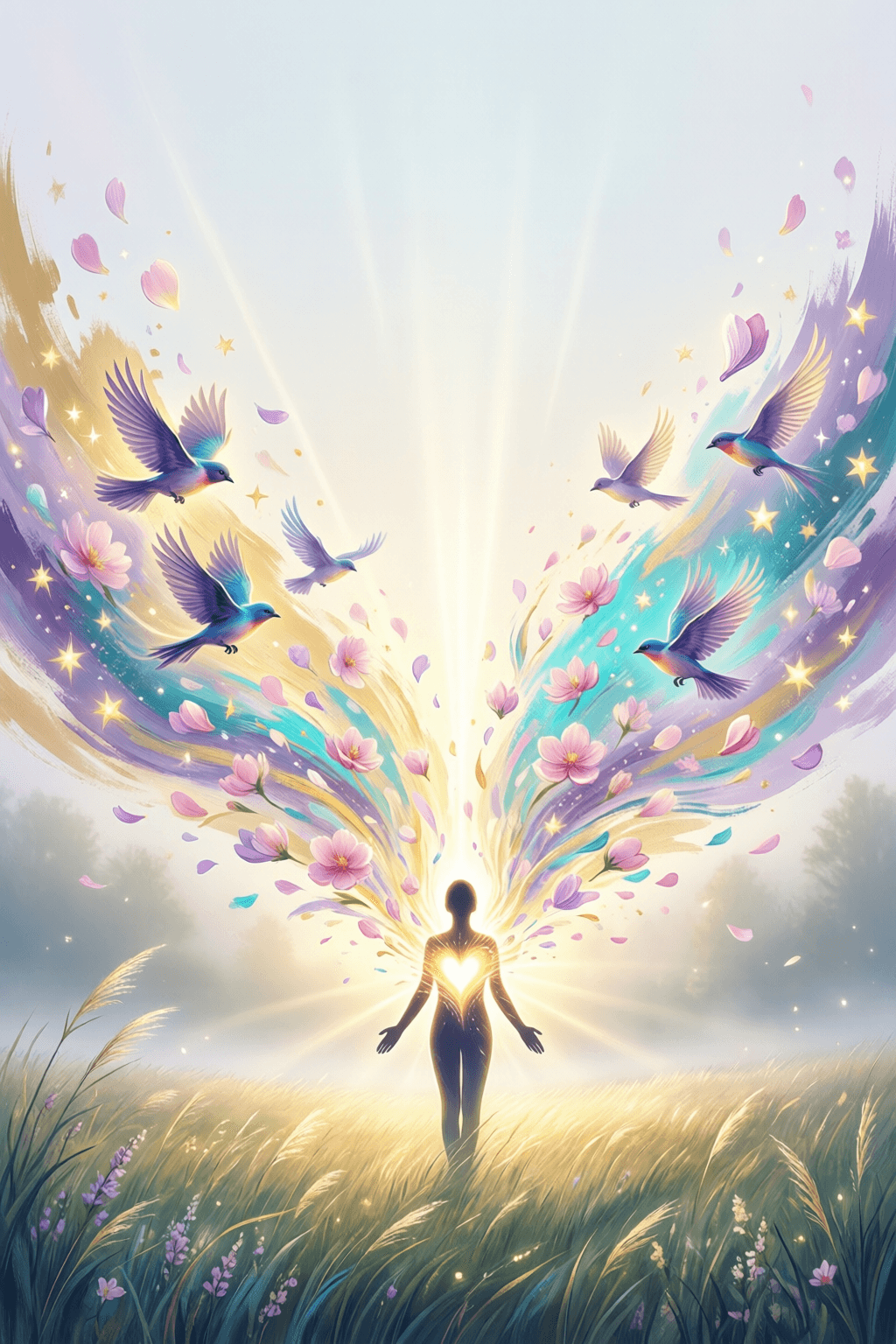
What keeps life fascinating is the constant creativity of the soul. — Deepak Chopra
—What lingers after this line?
A Living Source of Wonder
At its core, Deepak Chopra’s line suggests that life stays interesting not because the world is fixed and exciting on its own, but because the inner self continually reinterprets it. The phrase “creativity of the soul” points to a wellspring of meaning, imagination, and renewal that keeps ordinary existence from becoming spiritually stale. In this way, fascination is not merely discovered; it is generated. Even familiar routines can feel newly alive when approached with curiosity, reflection, or compassion. Chopra’s broader work, including The Spontaneous Fulfillment of Desire (2003), often returns to this idea that inner awareness shapes the richness of outer experience.
Creativity Beyond Artistic Talent
Importantly, Chopra’s statement broadens creativity far beyond painting, music, or writing. Here, creativity can mean inventing a new response to difficulty, finding beauty in a mundane moment, or reframing pain into insight. Thus, the soul’s creativity becomes a daily act of interpretation rather than a rare gift reserved for artists. This wider view echoes thinkers such as Carl Jung, who saw the psyche as symbolic and generative rather than mechanical. As a result, life remains fascinating because human beings are constantly producing inner images, hopes, and meanings that reshape how they inhabit the world.
The Soul as a Renewable Force
From there, the quote implies that the soul is not static but inexhaustibly active. What prevents boredom, then, is this ongoing capacity for inner renewal: a person can suffer loss, encounter uncertainty, and still imagine a different future. The fascination of life lies partly in that unpredictability of inner transformation. This insight recalls Ralph Waldo Emerson’s essays, especially “Self-Reliance” (1841), where the individual spirit is treated as a source of fresh perception. Similarly, Chopra suggests that when people stay connected to that deeper vitality, they do not merely endure life—they participate in its continual remaking.
Spirituality and Everyday Experience
At the same time, the quote does not require dramatic mystical experiences to be true. The soul’s creativity may appear in small moments: a changed conversation, a sudden forgiveness, a new question, or the decision to begin again. Consequently, fascination emerges in ordinary life, where inner depth quietly alters what seems externally repetitive. This perspective resembles spiritual traditions that treat awareness itself as transformative. For instance, in the Bhagavad Gita, action gains meaning when rooted in deeper consciousness rather than mere habit. Chopra’s wording similarly invites readers to see daily life as animated by an invisible, creative center.
An Antidote to Mechanical Living
Finally, Chopra’s thought can be read as a warning against living on autopilot. When people surrender entirely to routine, utility, and external validation, life can flatten into predictability. By contrast, the “constant creativity of the soul” resists that deadening pattern, restoring surprise, purpose, and inward freedom. Therefore, the quote is ultimately hopeful: fascination is always recoverable because it arises from within. So long as the inner life remains capable of wonder, reinterpretation, and growth, existence never becomes fully exhausted. The world may repeat itself, but the soul keeps making something new of it.
Recommended Reading
As an Amazon Associate, we earn from qualifying purchases.
One-minute reflection
What does this quote ask you to notice today?
Related Quotes
6 selectedTo be creative means to be in love with life. You can be creative only if you love life enough that you want to enhance its beauty. — Osho
Osho
At its core, Osho’s statement proposes that creativity does not begin with technique, talent, or originality, but with affection for existence itself. In this view, a person creates because life feels precious enough to...
Read full interpretation →We are born makers. We move what we're learning from our heads to our hearts through our hands. — Brené Brown
Brené Brown
Brené Brown’s line begins with a striking claim: making is not a hobby added onto life, but part of our basic human design. To say “we are born makers” suggests that creativity is native to us, whether we are cooking, bu...
Read full interpretation →Creativity is intelligence having fun. — George Scialabba
George Scialabba
At first glance, George Scialabba’s line turns creativity into something disarmingly simple: intelligence at play. Rather than presenting invention as grim labor or mystical inspiration, the quote suggests that original...
Read full interpretation →Creativity is not the finding of a thing, but the making something out of it after it is found. — James Russell Lowell
James Lowell
James Russell Lowell’s line shifts attention away from the romantic myth of the sudden genius who invents from nothing. Instead, he argues that creativity truly begins after the initial encounter—after an idea, object, p...
Read full interpretation →Sometimes you have to stop and be bored, because boredom is the dream-killer's worst enemy. — Elizabeth Gilbert
Elizabeth Gilbert
At first glance, Elizabeth Gilbert’s remark sounds counterintuitive, because boredom is usually treated as something to escape. Yet her point turns that assumption upside down: when we stop filling every empty moment, we...
Read full interpretation →Rest is not laziness; it is the essential fuel that allows your creativity to ignite once more. — Arianna Huffington
Arianna Huffington
At first glance, Arianna Huffington’s statement challenges a deep cultural bias: the tendency to equate nonstop activity with virtue and rest with weakness. By insisting that rest is not laziness, she reframes it as a ne...
Read full interpretation →More From Author
More from Deepak Chopra →Healing is the return of the memory of wholeness. — Deepak Chopra
At first glance, Deepak Chopra’s line reframes healing as something larger than the disappearance of pain or illness. To call healing “the return of the memory of wholeness” suggests that wellness is not newly manufactur...
Read full interpretation →Healing is not linear; energy comes and goes like waves, but it always moves forward. — Deepak Chopra
At its heart, Deepak Chopra’s line reframes healing as motion rather than perfection. Instead of imagining recovery as a straight climb upward, he presents it as a tide: energy rises, retreats, and returns.
Read full interpretation →Healthy boundaries allow us to be more fully present in our lives. — Deepak Chopra
At first glance, Deepak Chopra’s statement links two ideas that are often treated separately: limits and mindfulness. Yet the connection is intuitive.
Read full interpretation →Giving connects two people, the giver and the receiver. And this connection gives birth to a new sense of belonging. — Deepak Chopra
At its core, Deepak Chopra’s statement presents giving as more than a transaction; it is a relationship. The act immediately links one person’s intention with another person’s need, turning a simple exchange into a share...
Read full interpretation →