
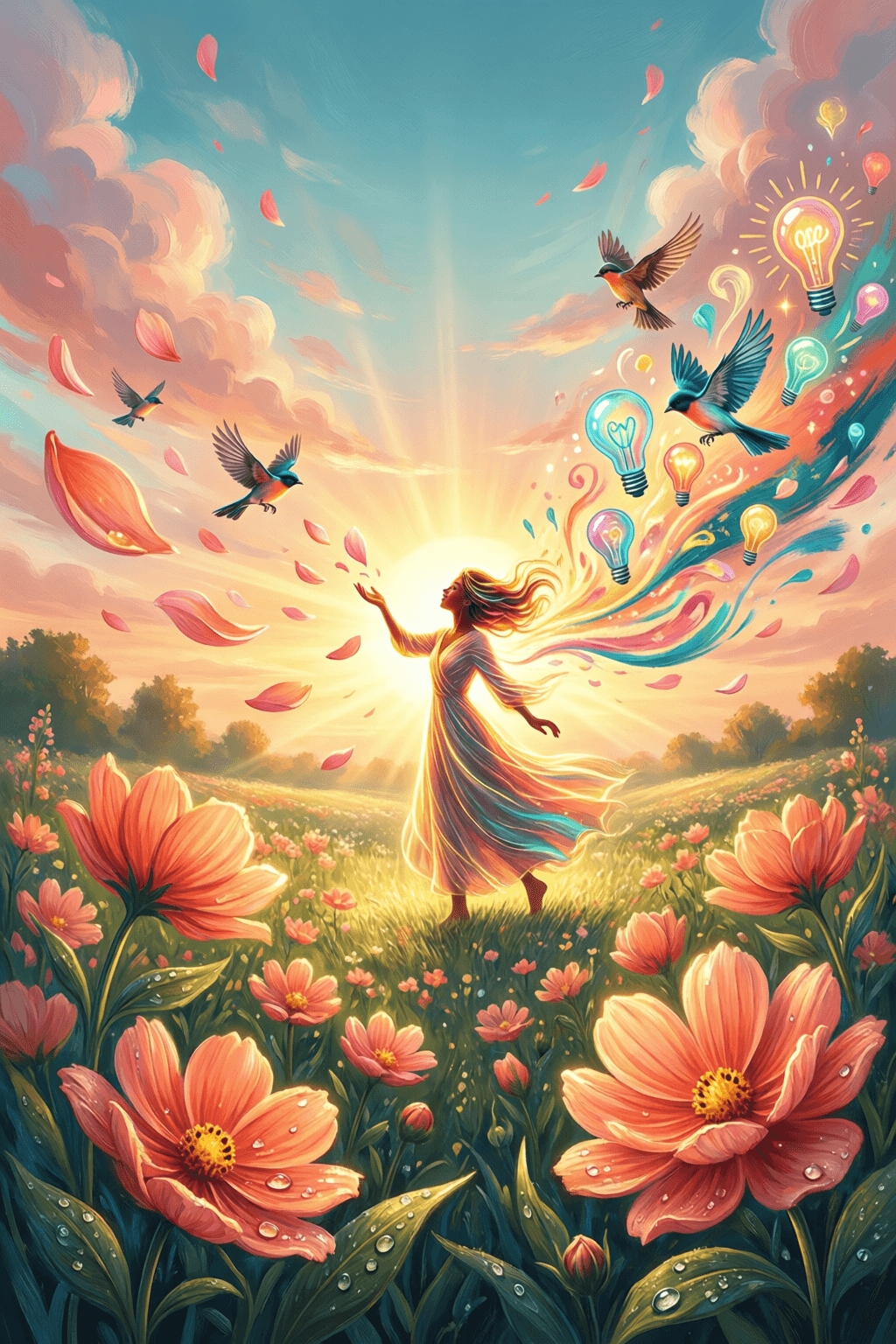
To be creative means to be in love with life. You can be creative only if you love life enough that you want to enhance its beauty. — Osho
—What lingers after this line?
Love as the Root of Creation
At its core, Osho’s statement proposes that creativity does not begin with technique, talent, or originality, but with affection for existence itself. In this view, a person creates because life feels precious enough to be answered, shaped, and celebrated. Creativity becomes less an act of production and more an act of devotion toward the world. From that starting point, the quote shifts our understanding of art and invention: one does not create merely to impress others, but to deepen beauty where one has already perceived it. The impulse to paint, write, garden, teach, or build arises from gratitude, as though loving life naturally overflows into making something worthy of it.
Beyond Art Into Everyday Living
Seen this way, creativity extends far beyond traditional artistic fields. Osho’s idea suggests that arranging a meal with care, speaking kindly in a tense moment, or turning routine work into something thoughtful can all be creative acts. Once love of life becomes the source, creativity appears wherever someone chooses to enrich ordinary experience. Consequently, the quote democratizes creation. It implies that creativity belongs not only to painters or poets, but to anyone who meets life with responsiveness and delight. Much as John Dewey’s Art as Experience (1934) argued that aesthetic meaning grows out of lived experience, Osho frames creativity as a quality of being fully alive.
Beauty as an Active Response
Importantly, Osho does not describe beauty as something fixed that we merely admire from afar. Instead, he presents it as something we are moved to enhance. That subtle shift matters: loving life means refusing passive appreciation and choosing participation. We do not simply notice beauty; we contribute to it. In that sense, creativity becomes a form of stewardship. Just as Japanese garden design developed through centuries of careful refinement transforms natural space without erasing its essence, the creative person adds harmony to the world while honoring what is already there. Love of life, then, becomes visible through the desire to leave things more luminous than one found them.
The Inner Condition of Openness
However, such creativity requires an inner posture as much as outward effort. To be in love with life is to remain open to wonder, surprise, and even vulnerability. A cynical or numb mind may still produce clever work, yet Osho implies that genuine creativity asks for a deeper yes to existence. It depends on receptivity before expression. This idea echoes Abraham Maslow’s later writings on self-actualization, where creativity often appears not as rare genius but as freshness of perception. People become creative, in part, because they allow themselves to encounter the world vividly. Thus, the enhancement of beauty begins in attention: one must first feel life intensely before one can answer it imaginatively.
A Quiet Challenge to Modern Life
At the same time, the quotation quietly critiques ways of living that reduce existence to utility, speed, or survival alone. When life is treated as a problem to manage rather than a mystery to cherish, creativity tends to shrink into efficiency. Osho resists that reduction by reconnecting creation with joy, reverence, and affection. Accordingly, his words can be read as an invitation to recover a lost intimacy with the world. The poet Rainer Maria Rilke’s Letters to a Young Poet (1903–1908) similarly urges the reader to live the questions deeply, suggesting that art grows from one’s mode of being. Osho’s point is comparable: a richer life does not merely inspire creativity; it is the soil from which creativity grows.
Creation as Celebration
Ultimately, the quote gathers its force from a simple but demanding claim: creativity is celebration made visible. If one truly loves life, one will not remain content to consume it passively; one will answer by adding song, form, care, color, or meaning. Creation becomes a thank-you spoken in material form. Therefore, Osho’s insight is both poetic and practical. It asks us to measure creativity not only by novelty, but by the depth of our relationship with living itself. The most creative life may be the one that continually enlarges beauty—in works, in relationships, and in daily gestures—because it has first fallen in love with being here.
One-minute reflection
What feeling does this quote bring up for you?
Related Quotes
6 selectedTo be creative is to participate in the great process of creation — and participating in creativity is participating in life. — Rajneesh
Rajneesh
Rajneesh frames creativity not as a rare talent but as an act of joining something larger than oneself. At once, the quote shifts attention away from finished masterpieces and toward participation in an ongoing process o...
Read full interpretation →A creative life is an amplifying life. It’s a magnifying life. — Elizabeth Gilbert
Elizabeth Gilbert
Elizabeth Gilbert’s line suggests that creativity does not merely produce art; rather, it changes the scale at which life is felt. To call creative living an “amplifying life” is to say that attention, emotion, and meani...
Read full interpretation →Creativity takes courage. — Henri Matisse
Henri Matisse
This quote highlights that being creative often involves exposing one's inner thoughts and feelings, which requires a significant amount of courage as it makes one vulnerable to criticism and judgment.
Read full interpretation →To create is to live twice. — Albert Camus
Albert Camus
This quote suggests that the act of creation gives life a deeper meaning. By creating, individuals experience a second life as they bring new ideas and forms to existence.
Read full interpretation →To love beauty is to see light. — Victor Hugo
Victor Hugo
Victor Hugo’s line suggests that beauty is not merely something pleasing to the eye; it is a way of perceiving the world more clearly. To love beauty is to become receptive to illumination, as if the soul gains a new sou...
Read full interpretation →The moment a man begins to talk about technique, that's proof that he is fresh out of ideas. — Dylan Thomas
Dylan Thomas
Dylan Thomas’s remark begins with a sharp suspicion: when an artist talks too much about technique, the living impulse behind the work may already be gone. Technique, in this sense, becomes a substitute language, a way o...
Read full interpretation →More From Author
More from Osho →The ultimate mysteries are opened only to those who have immense patience. — Osho
Osho’s statement begins with a simple but demanding premise: the deepest truths do not yield to force. In this view, mystery is not a puzzle to be solved quickly but a reality that unfolds on its own terms.
Read full interpretation →Sadness gives depth. Happiness gives height. Sadness gives roots. Happiness gives branches. Both are needed, and the higher a tree goes, the deeper it goes. — Osho
At the heart of Osho’s image is a simple but powerful metaphor: a person grows like a tree. Happiness lifts life upward, opening it into lightness, expansion, and possibility, while sadness pulls experience downward into...
Read full interpretation →The essence of your being is determined by what you choose to become. — Osho
This quote emphasizes that individuals are not defined solely by their past or innate traits but by the conscious choices they make to grow and evolve into the person they wish to become.
Read full interpretation →Courage is a love affair with the unknown. — Osho
At its core, Osho’s statement redefines courage not as simple fearlessness, but as a positive, passionate engagement with uncertainty. Rather than merely overcoming fear, courage becomes the act of welcoming the unknown...
Read full interpretation →