
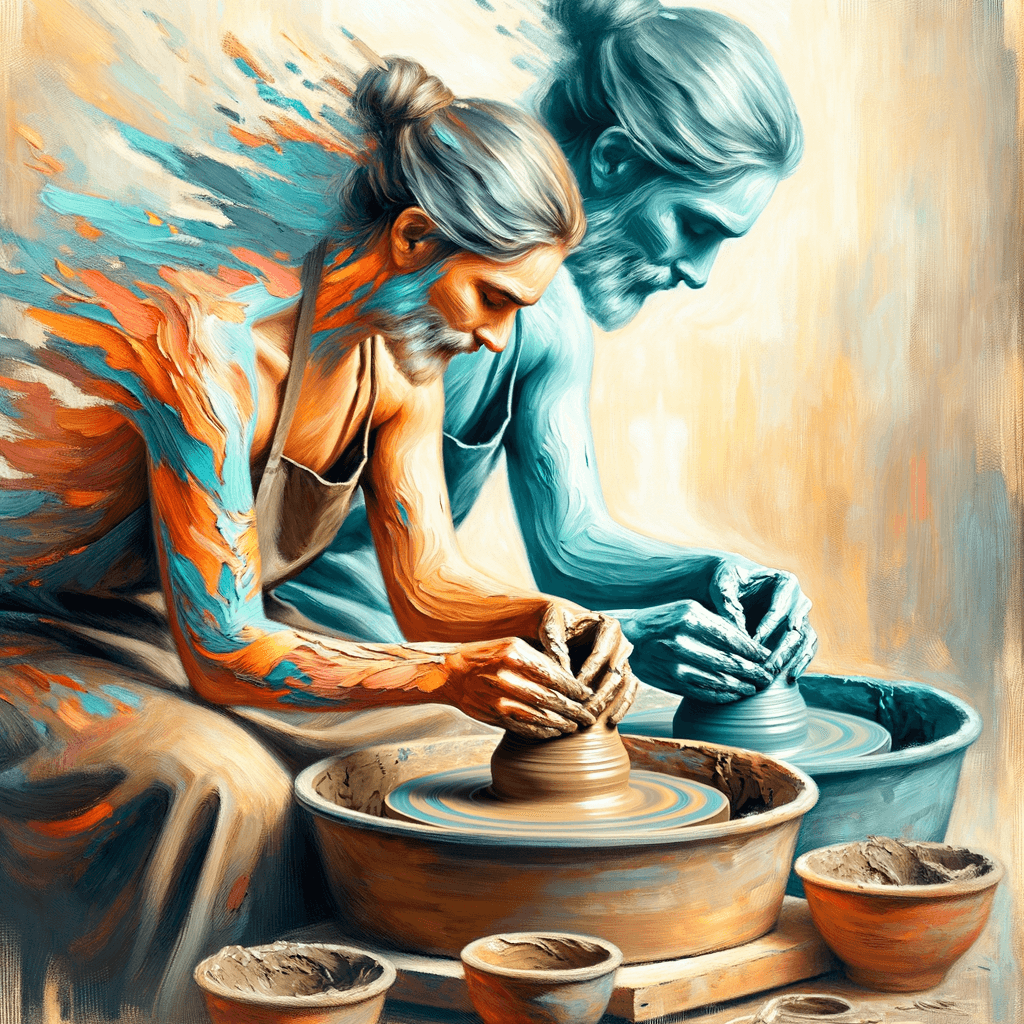
To create is to live twice. — Albert Camus
—What lingers after this line?
The Essence of Creation
This quote suggests that the act of creation gives life a deeper meaning. By creating, individuals experience a second life as they bring new ideas and forms to existence.
Existential Perspective
Camus, a philosopher known for his contributions to existentialism, implies that creation allows us to confront and embrace the absurdity of life, thus enriching our human experience.
Immortality Through Art
The idea of living twice can also refer to the legacy that creators leave behind. Art and creations can transcend time, allowing creators to live on through their work even after their physical existence ends.
Personal Fulfillment
Creating provides individuals with a sense of purpose and fulfillment. Engaging in creative endeavors can lead to self-discovery and a deeper understanding of one’s identity.
The Process of Creation
The quote highlights that the process of creation itself is transformative. It is through the act of creating that individuals experience joy, struggle, and ultimately the richness of life.
One-minute reflection
Where does this idea show up in your life right now?
Related Quotes
6 selectedTo be creative is to participate in the great process of creation — and participating in creativity is participating in life. — Rajneesh
Rajneesh
Rajneesh frames creativity not as a rare talent but as an act of joining something larger than oneself. At once, the quote shifts attention away from finished masterpieces and toward participation in an ongoing process o...
Read full interpretation →A creative life is an amplifying life. It’s a magnifying life. — Elizabeth Gilbert
Elizabeth Gilbert
Elizabeth Gilbert’s line suggests that creativity does not merely produce art; rather, it changes the scale at which life is felt. To call creative living an “amplifying life” is to say that attention, emotion, and meani...
Read full interpretation →To be creative means to be in love with life. You can be creative only if you love life enough that you want to enhance its beauty. — Osho
Osho
At its core, Osho’s statement proposes that creativity does not begin with technique, talent, or originality, but with affection for existence itself. In this view, a person creates because life feels precious enough to...
Read full interpretation →Creativity takes courage. — Henri Matisse
Henri Matisse
This quote highlights that being creative often involves exposing one's inner thoughts and feelings, which requires a significant amount of courage as it makes one vulnerable to criticism and judgment.
Read full interpretation →To live a creative life, we must lose our fear of being wrong. — Joseph Chilton Pearce
Joseph Chilton Pearce
This quote emphasizes the importance of embracing uncertainty and the unknown. Creativity often involves exploring uncharted territories, and fearing mistakes can stifle that exploration.
Read full interpretation →The moment a man begins to talk about technique, that's proof that he is fresh out of ideas. — Dylan Thomas
Dylan Thomas
Dylan Thomas’s remark begins with a sharp suspicion: when an artist talks too much about technique, the living impulse behind the work may already be gone. Technique, in this sense, becomes a substitute language, a way o...
Read full interpretation →More From Author
More from Albert Camus →You will never be able to experience everything. So, please, do poetical justice to your soul and simply experience yourself. — Albert Camus
Camus begins from a humbling truth: no person can live every possible life, see every landscape, or test every path. Because existence is finite, the dream of total experience becomes a source of restlessness rather than...
Read full interpretation →Peace is the only battle worth waging. — Albert Camus
At first glance, Camus frames peace through an apparent contradiction: a battle fought not for conquest, but to end the need for conquest itself. By calling peace the only struggle worth pursuing, he redirects human cour...
Read full interpretation →Sometimes carrying on, just carrying on, is the superhuman achievement. — Albert Camus
At first glance, Camus shifts the meaning of heroism away from grand victories and toward something far more ordinary: persistence. By saying that “just carrying on” can be a superhuman achievement, he honors the invisib...
Read full interpretation →In order to understand the world, one has to turn away from it on occasion. — Albert Camus
Camus’ line sounds contradictory at first: how can you understand the world by turning away from it? Yet the paradox points to a familiar truth—immersion can blur perception, while distance can sharpen it.
Read full interpretation →