
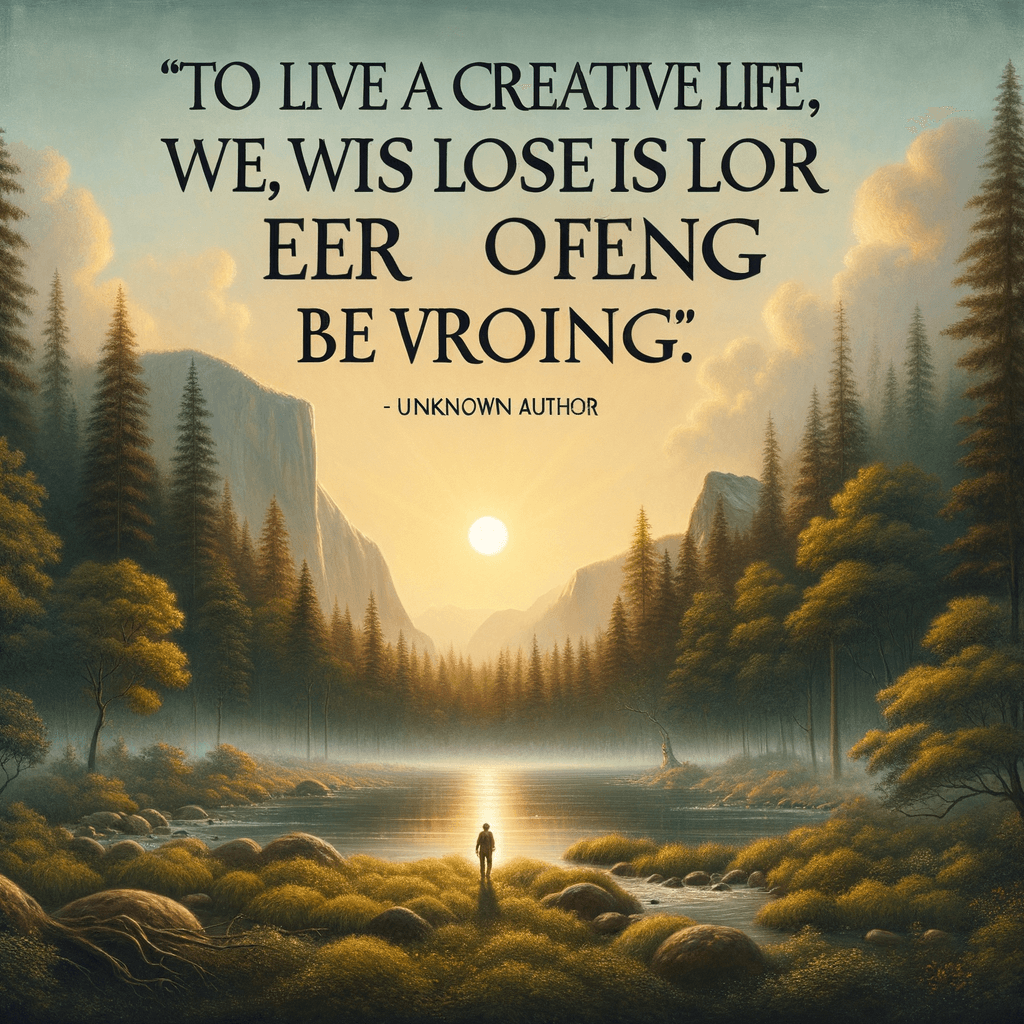
To live a creative life, we must lose our fear of being wrong. — Joseph Chilton Pearce
—What lingers after this line?
Embracing Uncertainty
This quote emphasizes the importance of embracing uncertainty and the unknown. Creativity often involves exploring uncharted territories, and fearing mistakes can stifle that exploration.
Overcoming Perfectionism
It highlights the need to overcome perfectionism. Fear of being wrong can paralyze us, preventing us from taking risks and trying new things, which are essential components of creativity.
Learning from Mistakes
The quote suggests that mistakes are integral to the creative process. By losing the fear of being wrong, we become more open to learning from our errors and evolving our ideas and skills.
Innovative Thinking
Creativity requires thinking outside the box and challenging conventional wisdom. This often means venturing into areas where there are no guaranteed right answers, and being comfortable with that uncertainty can lead to innovation.
Personal Growth
On a personal level, letting go of the fear of being wrong allows for greater self-expression and authenticity. It encourages individuals to pursue their passions and express themselves freely without the burden of judgment.
Joseph Chilton Pearce's Influence
Joseph Chilton Pearce was an American author known for his work on human development and the expansion of human potential. His ideas often revolved around the importance of nurturing creativity and breaking free from limiting beliefs.
One-minute reflection
What feeling does this quote bring up for you?
Related Quotes
6 selectedThe moment a man begins to talk about technique, that's proof that he is fresh out of ideas. — Dylan Thomas
Dylan Thomas
Dylan Thomas’s remark begins with a sharp suspicion: when an artist talks too much about technique, the living impulse behind the work may already be gone. Technique, in this sense, becomes a substitute language, a way o...
Read full interpretation →To be courageous is to act with the heart. — Molière
Molière
Molière’s line suggests that courage is not merely the absence of fear, but the decision to move despite it. By connecting courage with the heart, he frames bravery as an emotional and moral act rather than a simple disp...
Read full interpretation →Imperfection inspires invention, imagination, and creativity. — Mary Sharratt
Mary Sharratt
Mary Sharratt’s insight begins with a reversal of ordinary expectations: imperfection is not merely something to fix, but something that awakens possibility. When a plan fails, a surface cracks, or an idea refuses to fit...
Read full interpretation →The best people possess a feeling for beauty, the courage to take risks, the discipline to tell the truth, the capacity for sacrifice. — Ernest Hemingway
Ernest Hemingway
Hemingway’s line presents goodness not as politeness or success, but as a demanding inner code. The “best people” are those who combine sensitivity, bravery, honesty, and self-denial—qualities that do not always coexist...
Read full interpretation →Don't think. Thinking is the enemy of creativity. It's self-conscious, and anything self-conscious is lousy. — Ray Bradbury
Ray Bradbury
At first glance, Ray Bradbury’s line sounds almost rebellious: “Don’t think. Thinking is the enemy of creativity.” Yet his target is not intelligence itself, but the paralyzing kind of self-awareness that makes an artist...
Read full interpretation →You can be cautious or you can be creative, but there's no such thing as a cautious creative. — George Lois
George Lois
George Lois draws a sharp line between two mindsets: caution protects what already exists, while creativity risks making something new. At first glance, the statement sounds absolute, yet that severity is exactly its poi...
Read full interpretation →More From Author
More from Joseph Chilton Pearce →