
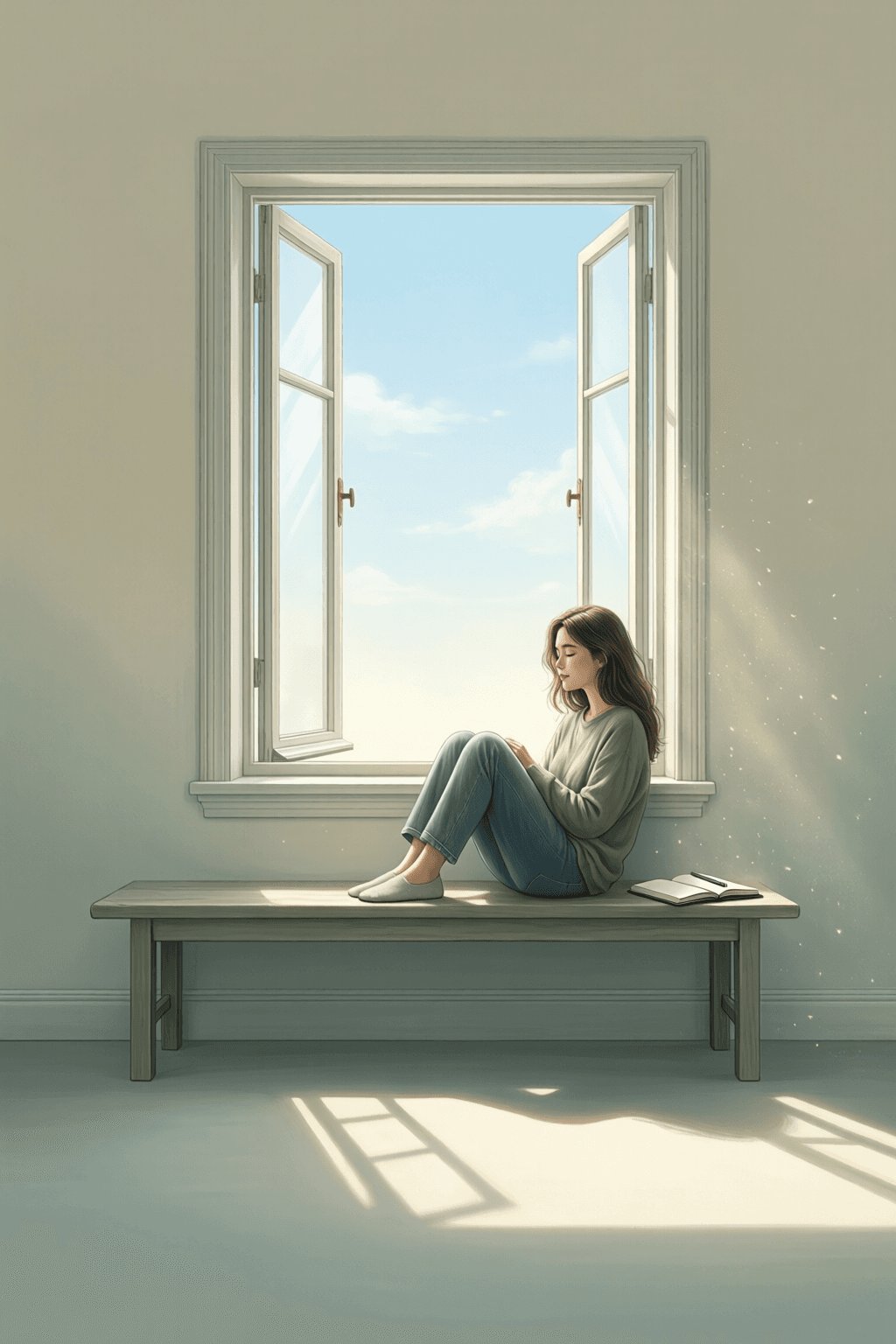
Sometimes you have to stop and be bored, because boredom is the dream-killer's worst enemy. — Elizabeth Gilbert
—What lingers after this line?
The Hidden Value of Stopping
At first glance, Elizabeth Gilbert’s remark sounds counterintuitive, because boredom is usually treated as something to escape. Yet her point turns that assumption upside down: when we stop filling every empty moment, we create space for the mind to recover its depth. In that stillness, distraction loses its grip, and the quieter impulses that feed creativity begin to reappear. In this sense, boredom is not failure or laziness but a threshold. Rather than killing ambition, it protects it from being smothered by constant stimulation. Gilbert suggests that dreams do not always need more activity; sometimes they need less noise.
Why Constant Entertainment Drains Imagination
From there, the quote becomes a critique of modern restlessness. A mind trained to expect endless novelty often loses patience with the slow, uncertain work that real dreams require. Scrolling, refreshing, and consuming can create the illusion of engagement, while quietly exhausting the attention needed to imagine something original. As a result, boredom becomes a kind of resistance. By enduring an unoccupied moment instead of anesthetizing it, we interrupt the cycle of instant gratification. What initially feels empty can then become fertile, because the imagination finally has room to wander instead of merely react.
Boredom as a Gateway to Creative Thought
This is why many artists and thinkers have treated idle time as essential rather than wasteful. Neuroscience offers a parallel insight: studies on the brain’s default mode network, such as work summarized by Marcus Raichle and colleagues (2001), suggest that when the mind is not fixed on an external task, it often shifts into inward processing linked to memory, reflection, and idea-making. Consequently, boredom can serve as the doorway to unexpected connections. A person staring out a window may appear unproductive, yet that pause can allow scattered experiences to reorganize themselves into a plan, an image, or a dream worth pursuing.
The Real Enemy of Dreams
Gilbert’s phrase “dream-killer” is especially striking because it identifies the true threat not as boredom but as avoidance. Dreams often die from fragmentation, from the habit of never staying still long enough to hear what we actually want. Instead of confronting uncertainty, many people bury it beneath busyness, and that busyness can become more destructive than any temporary lull. Seen this way, boredom is the enemy of the dream-killer because it exposes what distraction tries to conceal. Once the noise fades, unfinished desires, neglected talents, and deeper longings come back into view. That return can be uncomfortable, but it is also the beginning of honesty.
Learning to Endure Empty Moments
Therefore, Gilbert’s insight is also practical. To protect a dream, one may need to relearn how to wait in line without a phone, sit in silence, or take a walk without audio filling every second. These small acts of restraint train attention, and over time they restore a tolerance for the unstructured mental space where ideas mature. Henry David Thoreau’s Walden (1854) similarly praises deliberate simplicity, arguing that a quieter life sharpens perception. In a culture that equates stimulation with vitality, choosing occasional boredom becomes an act of discipline—one that keeps the inner life from being crowded out.
A More Generous Understanding of Restlessness
Ultimately, Gilbert is asking us to reinterpret boredom not as a dead zone but as a transitional state. It can feel uncomfortable precisely because it strips away the easy pleasures that keep us occupied. Yet if we remain there long enough, the discomfort often gives way to curiosity, and curiosity is one of the earliest signs that a dream is still alive. Thus the quote carries a hopeful message. Our best aspirations are not always revived by more effort, more input, or more urgency. Sometimes they survive because we were willing to stop, feel the emptiness, and let the mind begin dreaming again.
Recommended Reading
As an Amazon Associate, we earn from qualifying purchases.
One-minute reflection
Where does this idea show up in your life right now?
Related Quotes
6 selectedA creative life is an amplifying life. It’s a magnifying life. — Elizabeth Gilbert
Elizabeth Gilbert
Elizabeth Gilbert’s line suggests that creativity does not merely produce art; rather, it changes the scale at which life is felt. To call creative living an “amplifying life” is to say that attention, emotion, and meani...
Read full interpretation →Rest is not laziness; it is the essential fuel that allows your creativity to ignite once more. — Arianna Huffington
Arianna Huffington
At first glance, Arianna Huffington’s statement challenges a deep cultural bias: the tendency to equate nonstop activity with virtue and rest with weakness. By insisting that rest is not laziness, she reframes it as a ne...
Read full interpretation →Originality — A target best hit when not aimed at. — Charles Searle
Charles Searle
At first glance, Charles Searle’s remark seems contradictory: how can originality be achieved by not trying to achieve it? Yet that is precisely his point.
Read full interpretation →Getting sober is a radically creative act. — Meredith Bell
Meredith Bell
At first glance, Meredith Bell’s statement reframes sobriety in a striking way: it is not merely the removal of alcohol or drugs, but the invention of a new way to live. Calling it a “radically creative act” shifts the f...
Read full interpretation →The comfort zone is the great enemy to creativity; moving beyond it necessitates intuition, which in turn configures new perspectives and conquers fears. — Bruce Lee
Bruce Lee
Bruce Lee begins with a blunt diagnosis: comfort can quietly become the enemy of invention. Familiar routines feel safe because they reduce uncertainty, yet that same predictability often narrows perception and dulls exp...
Read full interpretation →The future is uncertain… but this uncertainty is at the very heart of human creativity. — Ilya Prigogine
Ilya Prigogine
At first glance, uncertainty seems like a condition to resist, since people often associate it with instability, fear, and loss of control. Yet Ilya Prigogine turns that assumption inside out, arguing that uncertainty is...
Read full interpretation →More From Author
More from Elizabeth Gilbert →Solace is found not by rearranging the circumstances of your life but by realizing who you are at the deepest level. — Elizabeth Gilbert
Elizabeth Gilbert’s sentence begins by gently rejecting a common assumption: that peace arrives once life is reorganized into a more favorable shape. We often imagine solace waiting on the other side of a new job, a diff...
Read full interpretation →True luxury in our modern age is not extravagance, but the ability to protect your peace and reclaim your own time. — Elizabeth Gilbert
At first glance, Elizabeth Gilbert overturns the usual image of luxury as wealth on display—designer goods, grand houses, or lavish travel. Instead, she argues that in modern life, real privilege lies in something less v...
Read full interpretation →You are not responsible for fixing everything that is broken. You are only responsible for showing up to your own life. — Elizabeth Gilbert
Elizabeth Gilbert’s quote begins by dismantling a common illusion: that a good, caring person must somehow repair every failure, soothe every conflict, and hold together every fraying edge of life. Instead, she draws a b...
Read full interpretation →The most radical act in a digital age is to choose to create something that has no purpose other than your own joy. — Elizabeth Gilbert
At first glance, Elizabeth Gilbert’s quote sounds simple, yet it carries a defiant charge. In a digital culture that constantly asks what a creation can earn, prove, or optimize, making something purely for delight becom...
Read full interpretation →