
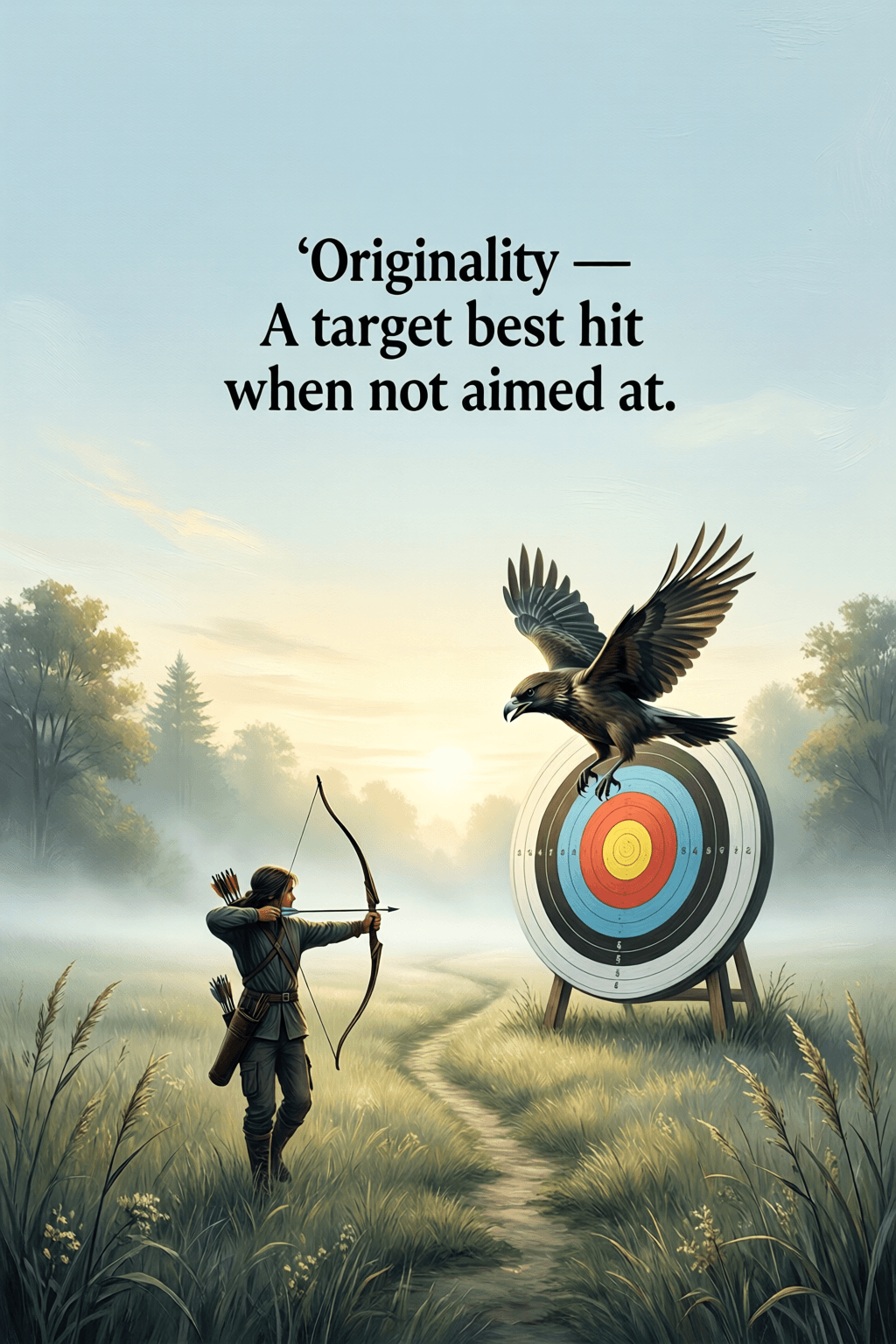
Originality — A target best hit when not aimed at. — Charles Searle
—What lingers after this line?
The Paradox at the Heart of Creativity
At first glance, Charles Searle’s remark seems contradictory: how can originality be achieved by not trying to achieve it? Yet that is precisely his point. The moment a person strains to appear original, the effort often becomes self-conscious, theatrical, or derivative, because it is shaped by what others might think is new rather than by an authentic inner impulse. In that sense, originality behaves like a side effect rather than a direct product. It emerges when attention is fixed on the work itself—solving a problem, expressing a truth, or following curiosity. Thus, Searle suggests that the most distinctive creations arise not from chasing novelty for its own sake, but from deep engagement with something real.
Why Direct Pursuit Can Produce Imitation
Seen from another angle, the hunger to be original can trap artists and thinkers in comparison. If someone keeps asking, “Has this been done before?” or “How can I look different?”, the mind remains tethered to existing models. Ironically, the attempt to escape influence can make one even more dependent on it. Consequently, deliberate originality often hardens into mannerism. Oscar Wilde’s essays, especially “The Critic as Artist” (1891), hint at this tension by showing that style grows out of cultivated perception rather than forced eccentricity. What appears new is often the natural outcome of a mind so absorbed in its subject that it stops performing difference and begins discovering it.
Historical Examples of Indirect Originality
History repeatedly supports Searle’s insight. Shakespeare did not invent most of his plots; rather, he transformed borrowed stories into works of singular power. Likewise, Cervantes’ Don Quixote (1605) began partly as a satire of chivalric romance, yet through that focused aim it became something startlingly original: a modern psychological novel before the term existed. Similarly, scientific creativity often works this way. Isaac Newton, in a 1675 letter, famously wrote, “If I have seen further it is by standing on the shoulders of giants.” The line suggests that originality does not require isolation from the past. Instead, it often appears when inherited materials are pursued so deeply and honestly that they become new in the handling.
The Psychology of Unforced Invention
Moreover, modern psychology helps explain why indirect pursuit works. In studies of creativity, researchers such as Mihaly Csikszentmihalyi in Flow: The Psychology of Optimal Experience (1990) describe how people do their most inventive work when fully immersed in a task rather than anxiously monitoring results. In a state of flow, self-consciousness recedes, and unexpected connections become easier to make. As a result, originality often surfaces when the mind is relaxed enough to recombine ideas freely. By contrast, pressure to be unique can narrow attention and inhibit experimentation. Searle’s aphorism therefore captures a practical truth: innovation is more likely when the creator forgets the performance of originality and enters the process of making.
A Lesson for Artists, Thinkers, and Everyday Life
Finally, Searle’s observation reaches beyond art into ordinary life. People also become most distinctive when they are not trying too hard to seem distinctive. A speaker who aims to communicate clearly, a teacher who aims to awaken understanding, or a designer who aims to solve a real problem may all produce something memorable precisely because usefulness and sincerity lead them away from cliché. Therefore, the quote offers both caution and encouragement. It warns against chasing novelty as a badge, yet it reassures us that originality is not a trick reserved for a gifted few. More often, it is the byproduct of attention, honesty, and commitment—an elusive target that is struck most cleanly when one aims at the work, not at the reputation of being new.
One-minute reflection
Where does this idea show up in your life right now?
Related Quotes
6 selectedGetting sober is a radically creative act. — Meredith Bell
Meredith Bell
At first glance, Meredith Bell’s statement reframes sobriety in a striking way: it is not merely the removal of alcohol or drugs, but the invention of a new way to live. Calling it a “radically creative act” shifts the f...
Read full interpretation →The comfort zone is the great enemy to creativity; moving beyond it necessitates intuition, which in turn configures new perspectives and conquers fears. — Bruce Lee
Bruce Lee
Bruce Lee begins with a blunt diagnosis: comfort can quietly become the enemy of invention. Familiar routines feel safe because they reduce uncertainty, yet that same predictability often narrows perception and dulls exp...
Read full interpretation →The future is uncertain… but this uncertainty is at the very heart of human creativity. — Ilya Prigogine
Ilya Prigogine
At first glance, uncertainty seems like a condition to resist, since people often associate it with instability, fear, and loss of control. Yet Ilya Prigogine turns that assumption inside out, arguing that uncertainty is...
Read full interpretation →Even in literature and art, no man who bothers about originality will ever be original: whereas if you simply try to tell the truth, you will, nine times out of ten, become original without ever having noticed it. — C.S. Lewis
C.S. Lewis
At first glance, C.S. Lewis presents a paradox: the harder an artist chases originality, the less likely it is to appear.
Read full interpretation →Originality is clarity. — Zadie Smith
Zadie Smith
At first glance, Zadie Smith’s line overturns a common assumption. People often treat originality as novelty for its own sake, as if being new automatically means being meaningful.
Read full interpretation →To be creative is to participate in the great process of creation — and participating in creativity is participating in life. — Rajneesh
Rajneesh
Rajneesh frames creativity not as a rare talent but as an act of joining something larger than oneself. At once, the quote shifts attention away from finished masterpieces and toward participation in an ongoing process o...
Read full interpretation →More From Author
More from Charles Searle →