
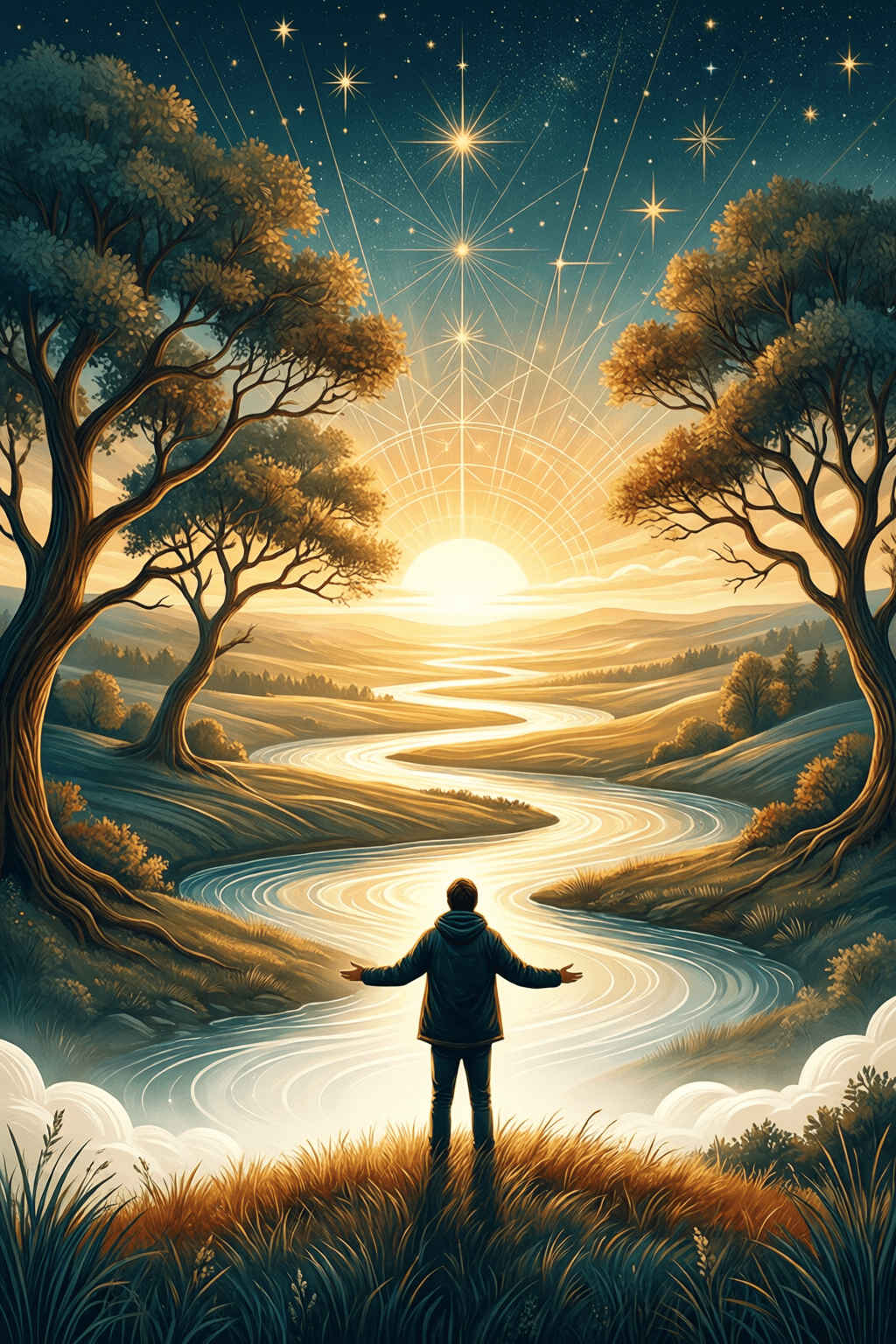
To be creative is to participate in the great process of creation — and participating in creativity is participating in life. — Rajneesh
—What lingers after this line?
Creation as Participation
Rajneesh frames creativity not as a rare talent but as an act of joining something larger than oneself. At once, the quote shifts attention away from finished masterpieces and toward participation in an ongoing process of making, shaping, and becoming. In that sense, to create is to step into the stream of existence rather than stand apart from it. This idea has deep philosophical roots. Henri Bergson’s Creative Evolution (1907) portrays life itself as a dynamic, unfolding movement, not a fixed machine. Seen this way, creativity becomes less about producing art objects and more about answering life with fresh attention, original action, and a willingness to contribute to what is still emerging.
Beyond Art and Into Daily Life
From there, the quote naturally widens the meaning of creativity. It is not confined to painting, music, or literature; it also appears in how one solves problems, raises children, cooks a meal, or starts a conversation with unusual warmth. By linking creativity directly to life, Rajneesh suggests that every day offers chances to create form, meaning, and connection. In fact, John Dewey’s Art as Experience (1934) argues that the aesthetic impulse lives within ordinary experience, not only inside galleries or concert halls. A teacher inventing a better way to explain a lesson or a neighbor turning a vacant lot into a garden participates in this same life-giving force. Thus creativity becomes democratic: a mode of living available to anyone awake to possibility.
Vitality, Presence, and Aliveness
Because the quote ties creativity to life itself, it also implies that creative action restores a sense of aliveness. When people make something new, they often feel more present, more absorbed, and more internally awake. Psychologist Mihaly Csikszentmihalyi’s Flow (1990) describes this state as intense engagement, where self-consciousness fades and experience feels vivid, purposeful, and whole. Consequently, creativity can be understood as a remedy for numb routine. A person who writes a poem after years of silence, replants a neglected balcony, or learns to improvise on the piano is not merely acquiring a skill; they are recovering contact with their own vitality. In this transition from passivity to participation, life feels less observed and more directly lived.
A Spiritual View of Making
At the same time, Rajneesh’s wording gives creativity a spiritual dimension. The “great process of creation” suggests a cosmos that is still unfolding, and human creativity becomes a small but meaningful echo of that larger movement. This perspective recalls traditions in which making is sacred: in Genesis, creation begins with divine utterance, while Rabindranath Tagore’s The Religion of Man (1931) links human expression to a profound communion with existence. Therefore, creativity is not merely self-expression but also relationship. One listens, responds, and collaborates with the materials of the world—language, sound, color, memory, circumstance. The creative act becomes an encounter between the self and something wider, giving ordinary making a sense of wonder and reverence.
The Courage to Risk Newness
Yet participation in creation is not comfortable by default, because genuine creativity requires risk. To make something new is to leave repetition behind and face uncertainty, criticism, and failure. Rajneesh’s claim implies that living fully includes this vulnerability: life is not mechanical preservation but ongoing invention. This is why so many creative breakthroughs begin in imperfect attempts. Vincent van Gogh’s letters (1880s) repeatedly show a man wrestling with doubt while insisting on the necessity of expression. Similarly, in everyday life, the courage to propose an untested idea at work or begin a project without guarantees is already a creative affirmation. Newness, however fragile, is one of the clearest signs that one is actively participating in life.
Living as a Co-Creator
Finally, the quote leads to an ethical and existential conclusion: if creativity is participation in life, then to live well is to live as a co-creator rather than a passive consumer. One need not control the whole world to shape a corner of it. Small acts of imagination—repairing, composing, encouraging, designing, rethinking—become ways of honoring existence itself. In this light, Rajneesh offers more than praise for artistic originality; he offers a philosophy of engagement. Life deepens when people stop merely inheriting forms and begin contributing to them. By creating, they do not escape reality; rather, they enter it more fully, leaving behind traces of attention, courage, and meaning.
Recommended Reading
As an Amazon Associate, we earn from qualifying purchases.
One-minute reflection
What's one small action this suggests?
Related Quotes
6 selectedWhat keeps life fascinating is the constant creativity of the soul. — Deepak Chopra
Deepak Chopra
At its core, Deepak Chopra’s line suggests that life stays interesting not because the world is fixed and exciting on its own, but because the inner self continually reinterprets it. The phrase “creativity of the soul” p...
Read full interpretation →A creative life is an amplifying life. It’s a magnifying life. — Elizabeth Gilbert
Elizabeth Gilbert
Elizabeth Gilbert’s line suggests that creativity does not merely produce art; rather, it changes the scale at which life is felt. To call creative living an “amplifying life” is to say that attention, emotion, and meani...
Read full interpretation →To be creative means to be in love with life. You can be creative only if you love life enough that you want to enhance its beauty. — Osho
Osho
At its core, Osho’s statement proposes that creativity does not begin with technique, talent, or originality, but with affection for existence itself. In this view, a person creates because life feels precious enough to...
Read full interpretation →Creativity takes courage. — Henri Matisse
Henri Matisse
This quote highlights that being creative often involves exposing one's inner thoughts and feelings, which requires a significant amount of courage as it makes one vulnerable to criticism and judgment.
Read full interpretation →To create is to live twice. — Albert Camus
Albert Camus
This quote suggests that the act of creation gives life a deeper meaning. By creating, individuals experience a second life as they bring new ideas and forms to existence.
Read full interpretation →We are born makers. We move what we're learning from our heads to our hearts through our hands. — Brené Brown
Brené Brown
Brené Brown’s line begins with a striking claim: making is not a hobby added onto life, but part of our basic human design. To say “we are born makers” suggests that creativity is native to us, whether we are cooking, bu...
Read full interpretation →More From Author
More from Rajneesh →