
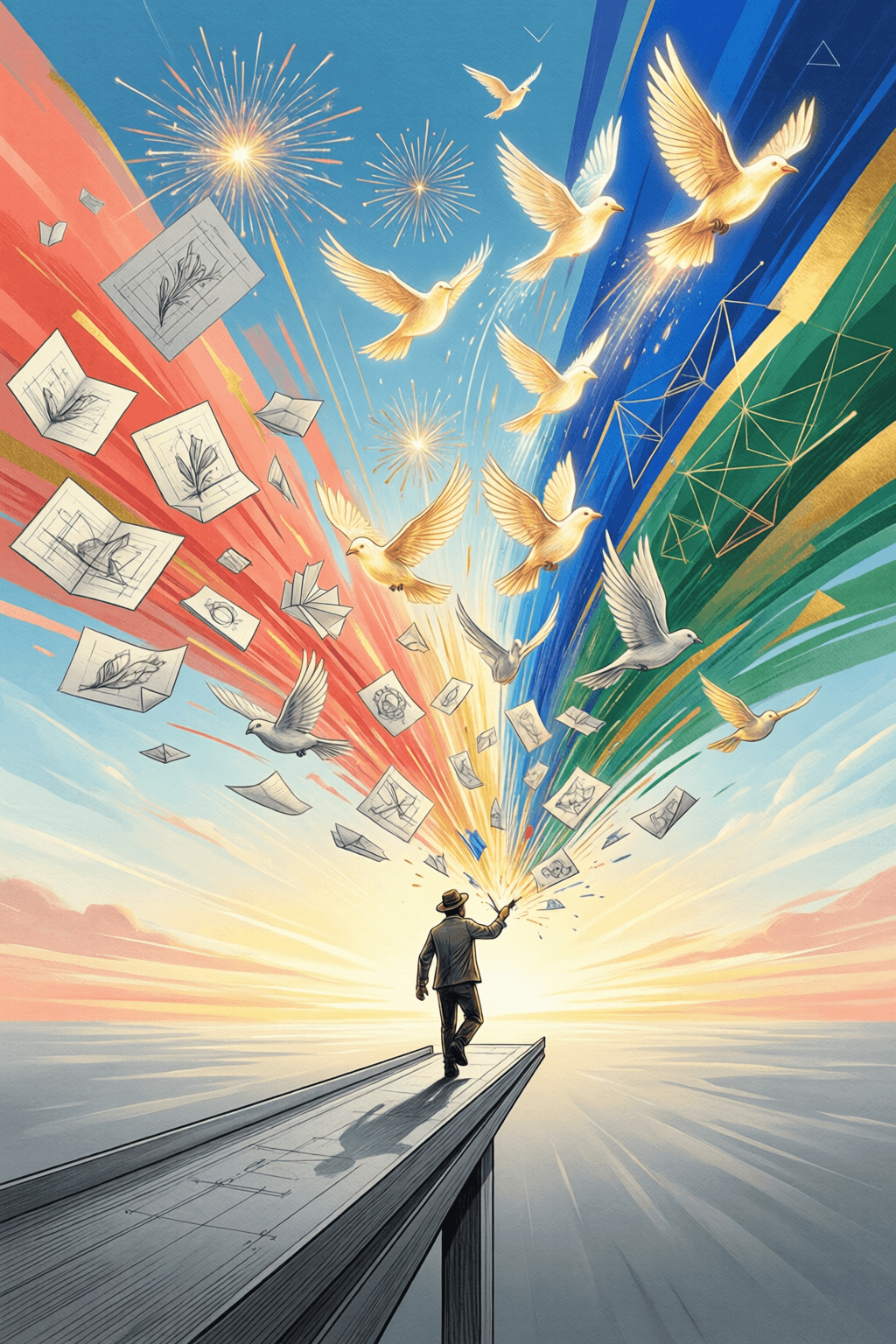
You can be cautious or you can be creative, but there's no such thing as a cautious creative. — George Lois
—What lingers after this line?
The Core Tension in Lois’s Claim
George Lois draws a sharp line between two mindsets: caution protects what already exists, while creativity risks making something new. At first glance, the statement sounds absolute, yet that severity is exactly its point. He is not denying that artists or thinkers can be thoughtful; rather, he argues that genuine invention requires a willingness to offend expectations, court failure, and move before certainty arrives. In that sense, caution becomes more than prudence—it becomes a brake on originality. If every idea must be approved by fear, novelty is filtered out before it can take shape. Lois’s quote therefore reframes creativity as an act of nerve, suggesting that the boldest work begins where excessive self-protection ends.
Advertising as Proof of Bold Thinking
This idea becomes especially vivid in Lois’s own field. As a legendary advertising creative, he helped produce campaigns that stood out precisely because they refused bland safety. His famous Esquire covers in the 1960s, for example, used striking visual concepts and cultural provocation to force public attention, showing how memorable work often emerges from a willingness to challenge decorum. From there, Lois’s quote reads less like a slogan and more like a professional law. In industries shaped by public reaction, cautious work may avoid criticism, but it rarely changes anything. By contrast, daring concepts can fail spectacularly—yet they are also the ones with the power to redefine taste, conversation, and culture.
Why Fear Narrows the Imagination
Seen psychologically, caution tends to narrow perception. When people become preoccupied with avoiding mistakes, they favor familiar patterns, predictable outcomes, and socially approved choices. Research by Teresa Amabile in The Social Psychology of Creativity (1983) suggests that creativity flourishes under conditions of intrinsic motivation and freedom, not under the heavy pressure of evaluation and restraint. As a result, excessive caution does not merely slow the creative process; it reshapes it into imitation. The mind begins asking, “What is safest?” rather than “What is possible?” Lois’s remark captures this shift with brutal efficiency: once fear becomes the governing principle, the imagination starts editing itself before it has had a chance to discover anything surprising.
Historical Patterns of Creative Risk
History repeatedly supports Lois’s point. The Impressionists were mocked for departing from academic painting, Stravinsky’s The Rite of Spring (1913) sparked uproar, and James Joyce’s Ulysses (1922) was censored for obscenity. In each case, innovation appeared reckless to contemporaries because it violated accepted standards of form, taste, or morality. Yet this is precisely the pattern worth noticing. What later generations celebrate as visionary often began as something judged imprudent. Therefore, caution may preserve reputation in the short term, but it seldom opens new artistic territory. Creative breakthroughs usually arrive wearing the disguise of bad judgment, at least to those invested in the old rules.
The Difference Between Reckless and Creative
Still, Lois’s quote should not be mistaken for an endorsement of chaos. Creativity is not the absence of discipline; it is the refusal to let fear dictate the boundaries of thought. Pablo Picasso’s long development before Cubism and Martha Graham’s rigorous reinvention of dance show that boldness often rests on deep craft rather than impulsive rebellion alone. This distinction matters because the opposite of caution is not stupidity but courage. A creative person may revise, test, and refine relentlessly, yet the original leap still demands vulnerability. Lois’s insight, then, is best understood as a challenge: be responsible to the work, not submissive to the fear of how the work will be received.
A Challenge to Modern Professional Culture
Finally, the quote speaks powerfully to workplaces that praise innovation while punishing risk. Many organizations ask for disruptive ideas, yet reward only those that fit existing expectations, budgets, and hierarchies. In such settings, people learn to perform creativity cautiously—offering variations instead of breakthroughs. Lois rejects that compromise outright. His words insist that if an idea feels entirely safe, it is probably not creative enough to matter. The deeper implication is uncomfortable but liberating: originality requires the possibility of embarrassment, rejection, and failure. Without that exposure, what remains may be competent, polished, and useful—but not truly creative.
One-minute reflection
Where does this idea show up in your life right now?
Related Quotes
6 selectedCreativity is intelligence having fun. — George Scialabba
George Scialabba
At first glance, George Scialabba’s line turns creativity into something disarmingly simple: intelligence at play. Rather than presenting invention as grim labor or mystical inspiration, the quote suggests that original...
Read full interpretation →To live a creative life, we must lose our fear of being wrong. — Joseph Chilton Pearce
Joseph Chilton Pearce
This quote emphasizes the importance of embracing uncertainty and the unknown. Creativity often involves exploring uncharted territories, and fearing mistakes can stifle that exploration.
Read full interpretation →Creativity takes courage. — Henri Matisse
Henri Matisse
This quote highlights that being creative often involves exposing one's inner thoughts and feelings, which requires a significant amount of courage as it makes one vulnerable to criticism and judgment.
Read full interpretation →Almost always, the creative dedicated minority has made the world better. — Martin Luther King, Jr.
Martin Luther King Jr.
Martin Luther King, Jr. distills a sweeping historical truth into a single sentence: progress is often driven not by the passive majority but by a small, committed group willing to imagine a better order.
Read full interpretation →If you are not willing to look stupid, nothing great is ever going to happen to you. — Julia Cameron
Julia Cameron
Julia Cameron’s remark begins with a hard truth: many people do not fail because they lack talent, but because they fear embarrassment. In that sense, ‘looking stupid’ becomes shorthand for being seen trying, stumbling,...
Read full interpretation →What keeps life fascinating is the constant creativity of the soul. — Deepak Chopra
Deepak Chopra
At its core, Deepak Chopra’s line suggests that life stays interesting not because the world is fixed and exciting on its own, but because the inner self continually reinterprets it. The phrase “creativity of the soul” p...
Read full interpretation →More From Author
More from George Lois →