
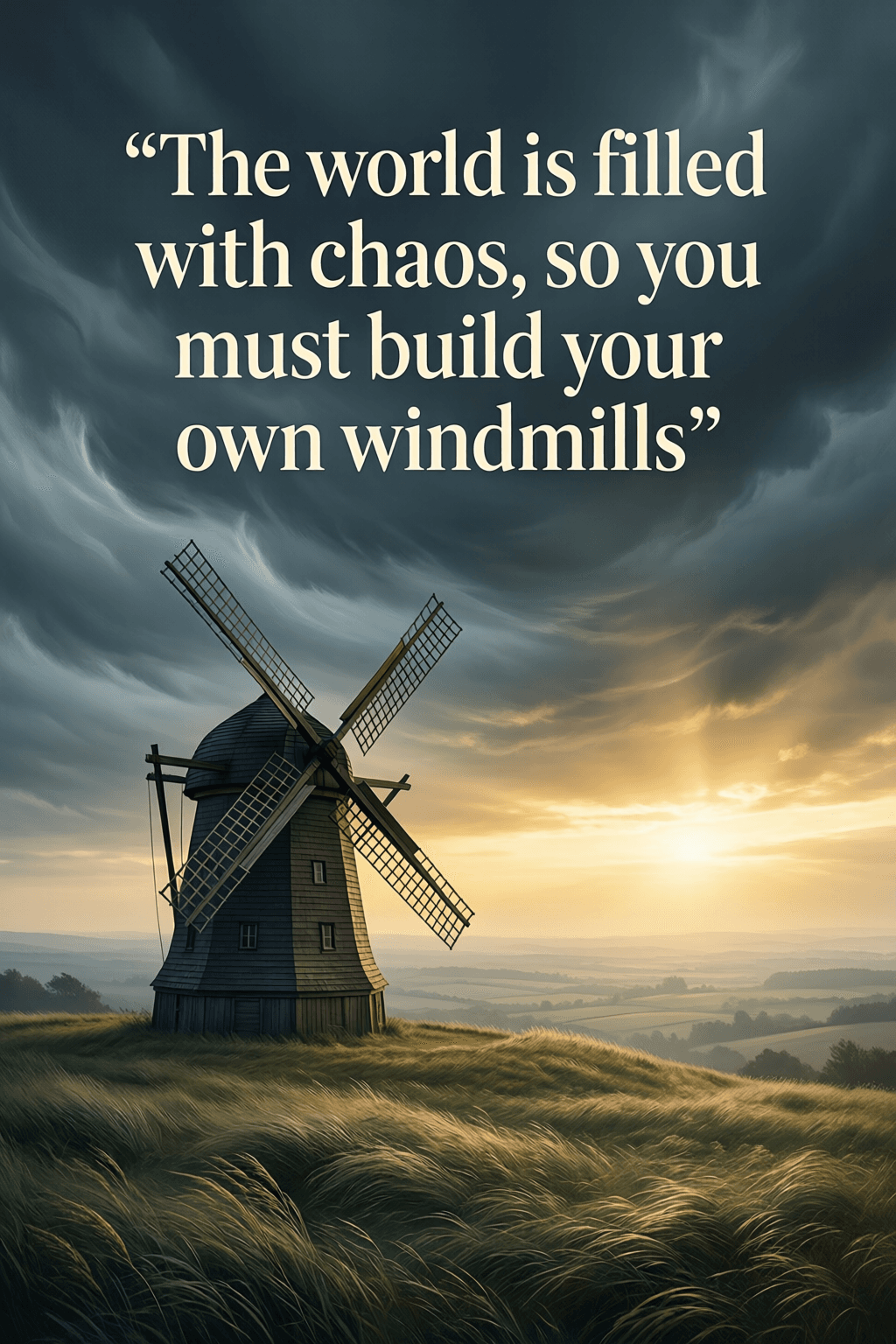
The world is filled with chaos, so you must build your own windmills. — John F. Kennedy
—What lingers after this line?
Chaos as the Starting Point
At first glance, Kennedy’s remark accepts a hard truth: the world rarely offers perfect order, fairness, or clarity. Instead of promising stability, it acknowledges confusion as a permanent feature of human life. In that sense, chaos is not an exception to endure briefly, but the very condition in which individuals must learn to act. From there, the quote shifts the burden of meaning onto the person. If the world is unruly, waiting for ideal circumstances becomes a form of surrender. Kennedy’s phrasing urges initiative, suggesting that people must respond to disorder not with despair, but with construction—creating structures, habits, and ideals that allow them to move with intention.
The Symbolism of Windmills
The image of “windmills” is especially revealing because a windmill does not eliminate the wind; it harnesses it. Thus, Kennedy’s metaphor implies that adversity can become usable energy when shaped by imagination and discipline. Rather than resisting every disruptive force, one can build something that turns turbulence into motion, power, or direction. This idea recalls Miguel de Cervantes’s Don Quixote, Part I (1605), where windmills symbolize misperception and futile struggle. Kennedy subtly reverses that legacy. Instead of attacking windmills as imagined enemies, he advises building them as instruments of purpose. In that reversal, chaos ceases to be merely a threat and becomes raw material for meaningful action.
Self-Creation Through Action
Once the metaphor is clear, the quote begins to sound less like social commentary and more like a philosophy of self-creation. To build one’s own windmills is to refuse passivity and become an author of one’s environment. Even when institutions fail or circumstances fracture, a person can still shape routines, commitments, and communities that generate stability. In this way, the line echoes existentialist themes found in Jean-Paul Sartre’s Existentialism Is a Humanism (1946), which argues that meaning is made through choice rather than inherited fully formed. Kennedy’s wording is more practical and less abstract, yet the moral center is similar: identity is forged not by waiting for order, but by building it.
Resilience Rather Than Control
Importantly, the quote does not suggest mastering the entire world. That would be impossible, and the acknowledgment of chaos already rules out total control. Instead, it promotes resilience—the capacity to create small zones of coherence within a turbulent reality. A windmill stands because it is designed for rough conditions, not because rough conditions disappear. Here the wisdom feels modern. Psychologists studying resilience, such as Viktor Frankl in Man’s Search for Meaning (1946), emphasize that people endure hardship by discovering purpose within it rather than escaping it entirely. Kennedy’s image works in the same spirit: the answer to disorder is not domination, but adaptive construction.
A Civic and Personal Challenge
Finally, the quote carries both personal and civic force. On an individual level, it asks each person to build an inner framework of values, discipline, and hope. Yet it also hints at public responsibility, because windmills can serve more than one person; they are structures that transform a shared environment. In that sense, private resolve can become communal benefit. Therefore, Kennedy’s statement is neither naïve optimism nor bleak realism. It is a call to practical idealism: accept the world’s disorder, then answer it with invention. By building our own windmills—our institutions, principles, and acts of service—we do more than survive chaos. We give it direction.
One-minute reflection
Where does this idea show up in your life right now?
Related Quotes
6 selectedWhen I hear somebody sigh, 'Life is hard,' I am always tempted to ask, 'Compared to what?' — Sydney J. Harris
Sydney J. Harris
Sydney J. Harris’s remark begins with an ordinary expression of fatigue: “Life is hard.” Yet his response, “Compared to what?” quietly turns complaint into inquiry.
Read full interpretation →Don't fight the challenges. Just find a new way to stand. — Germany Kent
Germany Kent
Germany Kent’s words begin with a quiet reversal of instinct: instead of treating every challenge as an enemy to defeat, she invites us to reconsider our posture toward difficulty. The emphasis is not on surrender, but o...
Read full interpretation →Optimist: someone who figures that taking a step backward after taking a step forward is not a disaster, it's more like a cha-cha. — Robert Brault
Robert Brault
Robert Brault’s line begins with a witty redefinition: an optimist is not someone who denies backward motion, but someone who interprets it differently. Instead of treating a setback as proof of failure, the optimist see...
Read full interpretation →How to guarantee failure: let other people's opinions determine your priorities. — Alex Hormozi
Alex Hormozi
Alex Hormozi’s warning begins with a simple but uncomfortable truth: failure often starts when a person hands over the authority to decide what matters. Other people’s opinions may sound like advice, concern, criticism,...
Read full interpretation →A mind grows by staying with difficulty long enough for the experience to change it. — Mary Catherine Bateson
Mary Catherine Bateson
Mary Catherine Bateson’s observation begins with a quiet but demanding truth: the mind does not grow merely by encountering difficulty, but by remaining with it. Challenge becomes transformative only when we resist the u...
Read full interpretation →When you are friends with your storm, you dance, instead of getting blown away. — Michael Bassey Johnson
Michael Bassey Johnson
Michael Bassey Johnson’s line begins with a striking reversal: the storm is not merely an enemy to survive, but a force one can learn to understand. In this sense, the storm may represent grief, fear, conflict, uncertain...
Read full interpretation →More From Author
More from John F. Kennedy →Let us not seek the Republican answer or the Democratic answer, but the right answer. Let us not seek to fix blame for the past. Let us accept our own responsibility for the future. — John F. Kennedy
At its core, John F. Kennedy’s statement urges citizens to rise above partisan identity and focus on what is genuinely right.
Read full interpretation →We are tied to the ocean. And when we go back to the sea... we are going back from whence we came. — John F. Kennedy
Kennedy’s words begin with a biological and poetic truth at once: humanity is not separate from the ocean, but born from a world shaped by it. Modern evolutionary science traces life’s earliest beginnings to the sea, so...
Read full interpretation →We must find time to stop and thank the people who make a difference in our lives. — John F. Kennedy
John F. Kennedy’s remark begins with a simple but demanding idea: gratitude requires intention.
Read full interpretation →We choose to go to the Moon in this decade and do the other things, not because they are easy, but because they are hard. — John F. Kennedy
Kennedy’s line reframes hardship as a chosen catalyst rather than a deterrent. By declaring that the nation would pursue tasks precisely because they are hard, he cast difficulty as the forge of capability and character.
Read full interpretation →