
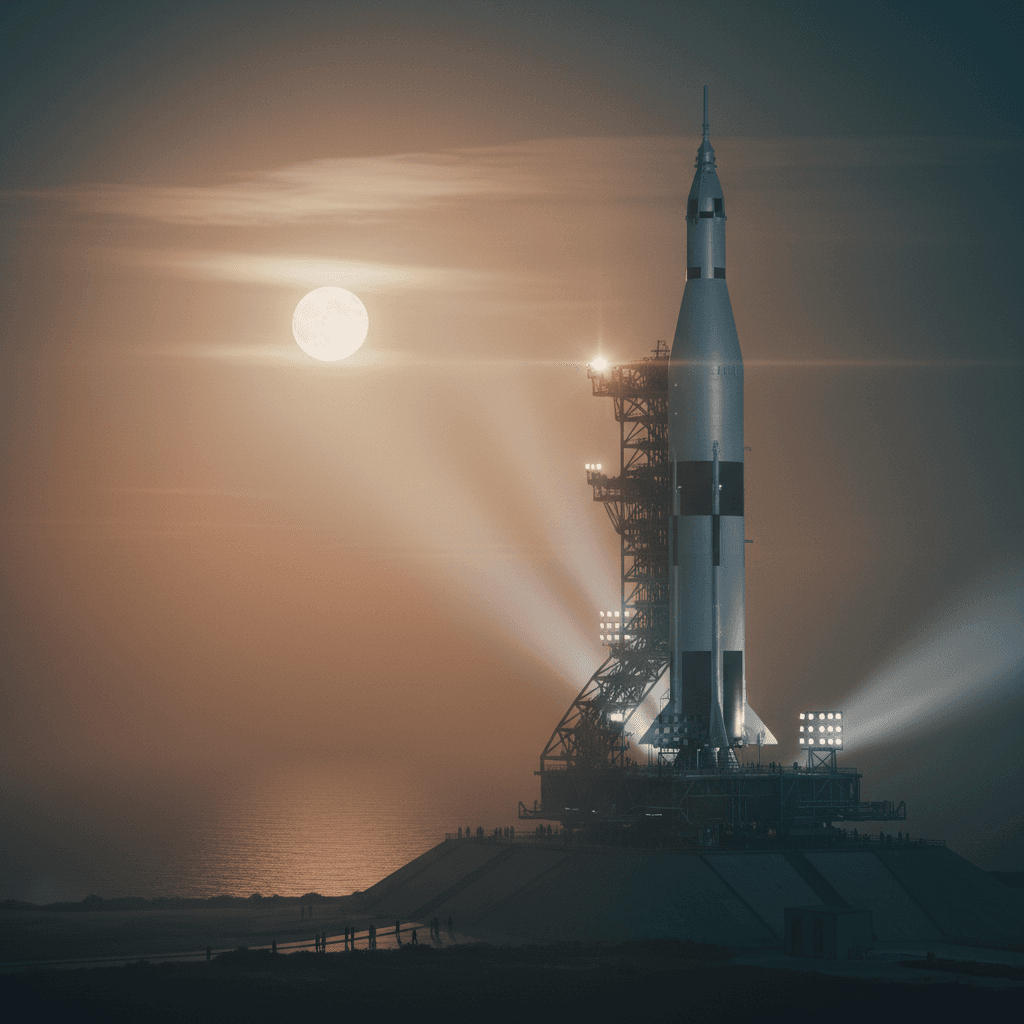
We choose to go to the Moon in this decade and do the other things, not because they are easy, but because they are hard. — John F. Kennedy
—What lingers after this line?
A Creed of Constructive Difficulty
Kennedy’s line reframes hardship as a chosen catalyst rather than a deterrent. By declaring that the nation would pursue tasks precisely because they are hard, he cast difficulty as the forge of capability and character. This mirrors William James’s notion of the “strenuous mood” (1907), where voluntary exertion awakens latent energies. In this light, the quote is less bravado than a civic ethic: difficulty as a deliberate instrument for growth.
Cold War Context and Public Purpose
Placed within its moment, the vow answered a geopolitical challenge. After Yuri Gagarin’s 1961 orbital flight, Kennedy moved from urgency to vision—first with his pledge to Congress to land a man on the Moon “before this decade is out” (May 25, 1961), then with the Rice University speech (Sept 12, 1962) that etched the moral rationale. Thus, competition with the USSR became a public narrative of purpose, converting anxiety into coordinated national ambition.
Engineering the Near-Impossible
From there, rhetoric had to harden into hardware. The program adopted lunar-orbit rendezvous, championed by John C. Houbolt (1962), and built the Saturn V, a launch vehicle tall as a skyscraper. Equally audacious, the Apollo Guidance Computer ran on kilobytes of memory, yet—with Margaret Hamilton’s pioneering “software engineering”—executed real-time control (NASA History Series). In other words, the promise translated into systems thinking, iterative testing, and a culture that learned as fast as it built.
Risk, Accountability, and Public Consent
Yet hardship was not abstract; it was mortal. The Apollo 1 fire killed Gus Grissom, Ed White, and Roger Chaffee (Jan 27, 1967), forcing redesigns and a reckoning with safety. Public support wavered, budgets tightened, and scrutiny intensified. Nevertheless, the program endured by institutionalizing lessons learned—transparent failure analysis, checklists, and redundancy—demonstrating that choosing the hard thing also means accepting accountability in full view of the citizenry.
The Moonshot as an Innovation Pattern
Consequently, “moonshot” became a template for tackling problems whose solutions demand coordination, deadlines, and measurable milestones. The Apollo model fused clear goals, empowered teams, rapid prototyping, and tolerance for bounded risk—principles echoed in DARPA programs (founded 1958) and later industrial R&D. This approach proved that ambition, when paired with disciplined execution, can compress timelines and convert improbable goals into cumulative, testable progress.
Legacy Beyond the Lunar Footprints
In the decades since Apollo 11 (July 20, 1969), the legacy has extended well past Tranquility Base. Systems engineering matured; integrated-circuit demand accelerated; remote sensing reshaped Earth science; and a generation of students chose STEM, inspired by televised launches and meticulous checklists. Thus, the payoff of choosing the hard path was not only a flag on the Moon but a durable capability to organize knowledge, industry, and imagination at scale.
Renewing the Ethic for Today’s Challenges
Ultimately, Kennedy’s cadence still offers a governing principle: aim where difficulty is highest and impact widest. Climate resilience, pandemic preparedness, fusion energy, and equitable AI each qualify as hard things worth choosing. By translating moral purpose into specific, time-bound goals—just as Rice Stadium’s speech did—societies can rekindle shared resolve and make tomorrow’s audacity feel, in retrospect, like today’s common sense.
One-minute reflection
Where does this idea show up in your life right now?
Related Quotes
6 selectedForge ahead where maps end; the brave craft new paths as they go. — J.R.R. Tolkien
J.R.R. Tolkien
Tolkien’s line evokes the moment when the comfort of the known world runs out—when the map quite literally ends. At such boundaries, most people turn back, trusting only what has been charted before.
Read full interpretation →Wanderer, there is no path, the path is made by walking.
walking.
This quote implies that one's personal journey is unique and not pre-determined. It highlights the idea that individuals create their own path through life experiences and decisions.
Read full interpretation →Do not go where the path may lead, go instead where there is no path and leave a trail. — Ralph Waldo Emerson
Ralph Waldo Emerson
Emerson encourages individuals to forge their own paths rather than following the conventional routes. This promotes the idea of individualism and nonconformity, suggesting that personal success and fulfillment come from...
Read full interpretation →Do not follow where the path may lead. Go instead where there is no path and leave a trail. - Ralph Waldo Emerson
Ralph Waldo Emerson
This quote encourages embracing your unique individuality rather than conforming to pre-defined paths. It’s a call to define your own journey and make a mark distinct from others.
Read full interpretation →Do not follow where the path may lead. Go instead where there is no path and leave a trail. — Muriel Strode
Muriel Strode
This quote encourages individuals to seek their own unique paths in life rather than following pre-established routes. It highlights the importance of personal growth and self-discovery.
Read full interpretation →Only those who will risk going too far can possibly find out how far one can go. — T.S. Eliot, United Kingdom.
T.S. Eliot, United Kingdom.
This quote highlights the importance of taking risks in order to discover one's true potential. It suggests that staying within comfort zones does not lead to growth or understanding of one's capabilities.
Read full interpretation →More From Author
More from John F. Kennedy →Let us not seek the Republican answer or the Democratic answer, but the right answer. Let us not seek to fix blame for the past. Let us accept our own responsibility for the future. — John F. Kennedy
At its core, John F. Kennedy’s statement urges citizens to rise above partisan identity and focus on what is genuinely right.
Read full interpretation →We are tied to the ocean. And when we go back to the sea... we are going back from whence we came. — John F. Kennedy
Kennedy’s words begin with a biological and poetic truth at once: humanity is not separate from the ocean, but born from a world shaped by it. Modern evolutionary science traces life’s earliest beginnings to the sea, so...
Read full interpretation →We must find time to stop and thank the people who make a difference in our lives. — John F. Kennedy
John F. Kennedy’s remark begins with a simple but demanding idea: gratitude requires intention.
Read full interpretation →The world is filled with chaos, so you must build your own windmills. — John F. Kennedy
At first glance, Kennedy’s remark accepts a hard truth: the world rarely offers perfect order, fairness, or clarity. Instead of promising stability, it acknowledges confusion as a permanent feature of human life.
Read full interpretation →