
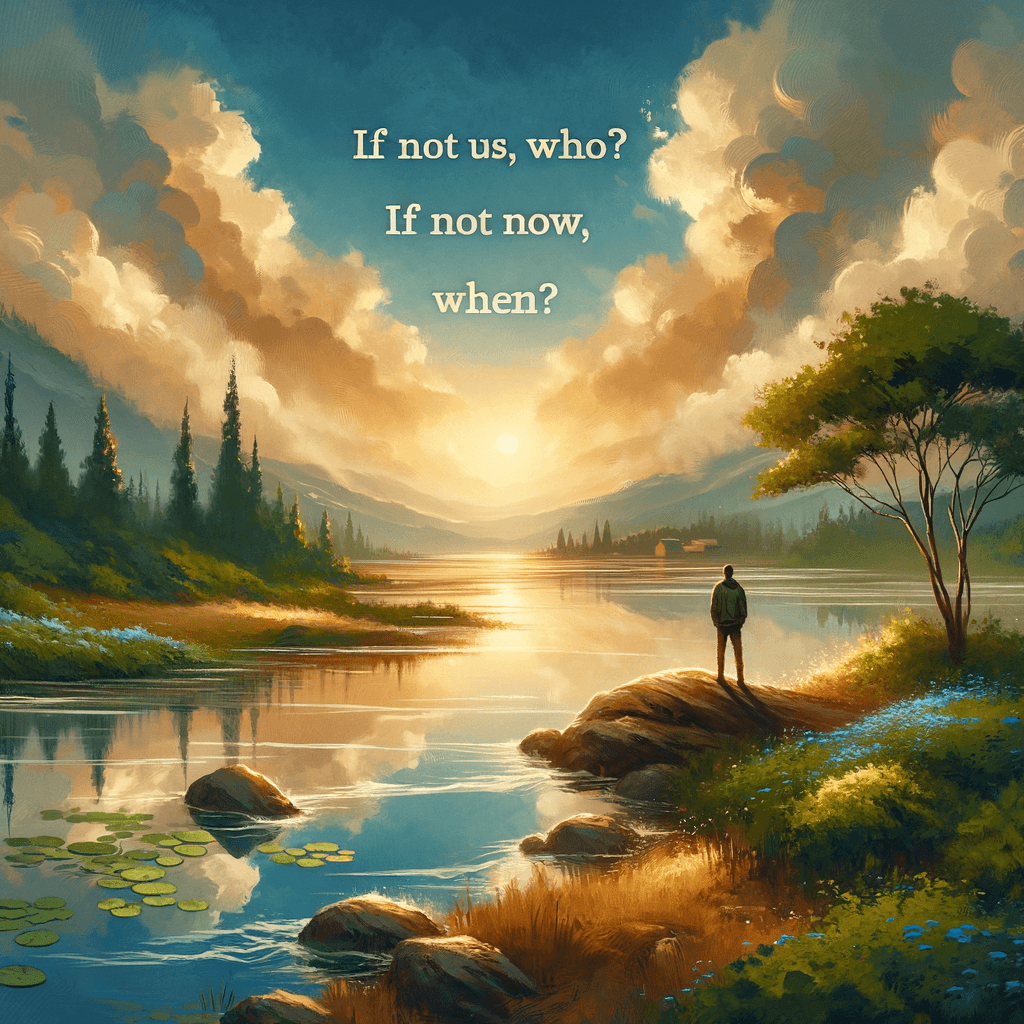
If not us, who? If not now, when? — John F. Kennedy
—What lingers after this line?
Call to Action
This quote serves as a powerful call to action, urging individuals to take responsibility for creating change rather than waiting for others to do it.
Empowerment
Kennedy emphasizes the importance of individual agency and empowerment, suggesting that the power to enact change lies within each of us.
Urgency of Change
The phrase 'If not now, when?' highlights the urgency that often accompanies important actions, encouraging people not to delay their efforts in making a difference.
Collective Responsibility
The quote underscores the idea of collective responsibility, implying that societal change relies on the active participation of every individual.
Historical Context
John F. Kennedy, the 35th President of the United States, was known for his inspirational speeches during a time of social and political upheaval in the 1960s, further reinforcing the relevance of this quote in that context.
One-minute reflection
What does this quote ask you to notice today?
Related Quotes
6 selectedAsk not what your country can do for you – ask what you can do for your country. — John F. Kennedy, United States.
John F. Kennedy, United States.
This quote emphasizes the idea of civic duty and the responsibility of individuals towards their community and nation. It encourages citizens to take an active role in contributing to the welfare of their country.
Read full interpretation →The highest office is the office of citizen. — Felix Frankfurter
Felix Frankfurter
At its heart, Felix Frankfurter’s line elevates citizenship above titles, rank, or formal authority. To call citizen the “highest office” is to argue that democracy does not ultimately rest on presidents, judges, or legi...
Read full interpretation →Life is too short to be subtle — Mary Quant
Mary Quant
Mary Quant’s line begins with a blunt accounting: life is finite, and that fact should change how we show up in the world. If time is scarce, then excessive restraint can become a kind of self-sabotage—postponing honest...
Read full interpretation →Stop acting as if life is a rehearsal. — Marcus Aurelius
Marcus Aurelius
Marcus Aurelius’ line cuts through a common habit: treating the present like a draft version of life. If we assume the “real” moment is still ahead—after we’re more prepared, more confident, more secure—we postpone the v...
Read full interpretation →Work with urgency and tenderness; creation needs both flame and care. — Vincent van Gogh
Vincent van Gogh
Van Gogh’s line reads like a practical creed: work fast enough that the moment doesn’t cool, yet gently enough that the work isn’t bruised by haste. Urgency and tenderness are not competing moods here but paired tools, e...
Read full interpretation →Break the routine of waiting; invent urgency and call it progress. — James Baldwin
James Baldwin
At the outset, Baldwin’s line sketches a ritual familiar to modern life: abandon the quiet discomfort of waiting, manufacture bustle, then baptize it as progress. The allure is clear—speed reads as virtue, motion masquer...
Read full interpretation →More From Author
More from John F. Kennedy →Let us not seek the Republican answer or the Democratic answer, but the right answer. Let us not seek to fix blame for the past. Let us accept our own responsibility for the future. — John F. Kennedy
At its core, John F. Kennedy’s statement urges citizens to rise above partisan identity and focus on what is genuinely right.
Read full interpretation →We are tied to the ocean. And when we go back to the sea... we are going back from whence we came. — John F. Kennedy
Kennedy’s words begin with a biological and poetic truth at once: humanity is not separate from the ocean, but born from a world shaped by it. Modern evolutionary science traces life’s earliest beginnings to the sea, so...
Read full interpretation →We must find time to stop and thank the people who make a difference in our lives. — John F. Kennedy
John F. Kennedy’s remark begins with a simple but demanding idea: gratitude requires intention.
Read full interpretation →The world is filled with chaos, so you must build your own windmills. — John F. Kennedy
At first glance, Kennedy’s remark accepts a hard truth: the world rarely offers perfect order, fairness, or clarity. Instead of promising stability, it acknowledges confusion as a permanent feature of human life.
Read full interpretation →