
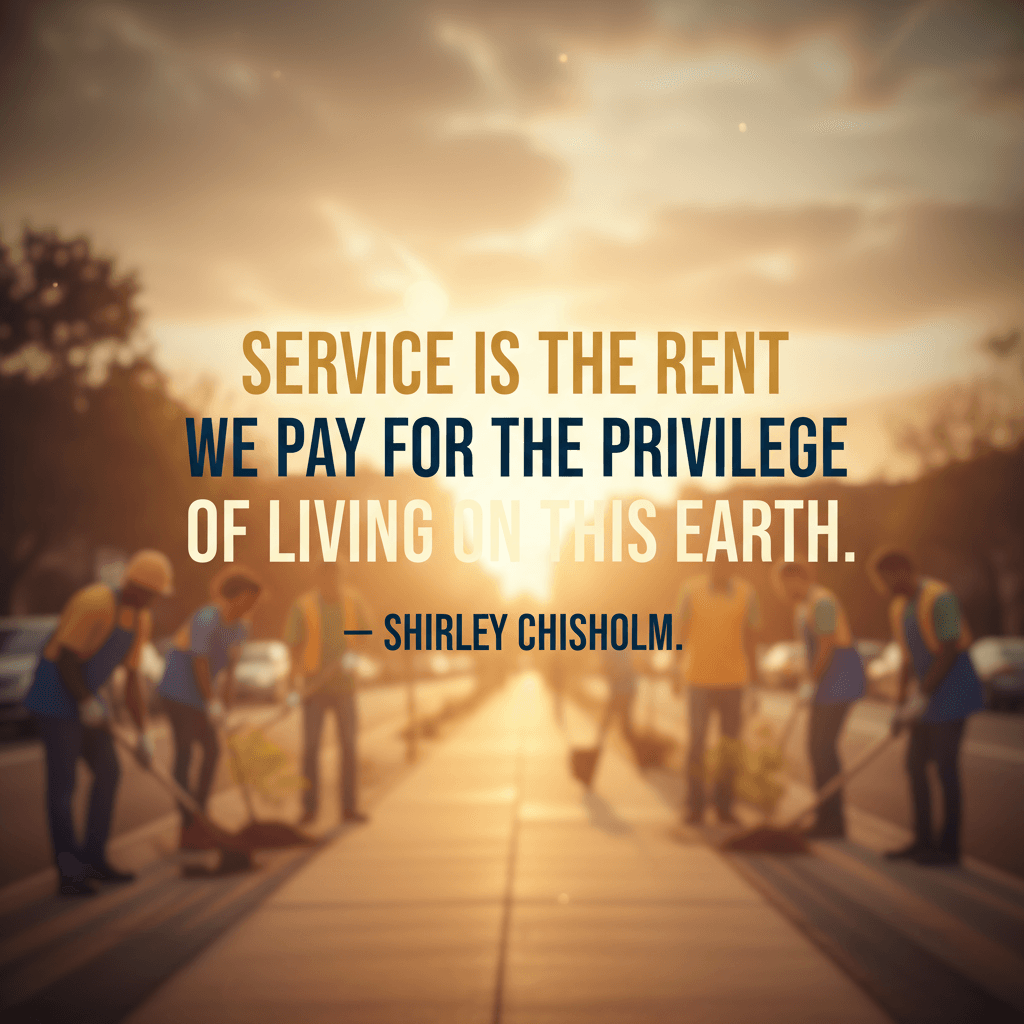
Service is the rent we pay for the privilege of living on this earth. — Shirley Chisholm
—What lingers after this line?
The Moral Economy of Rent
At the outset, Shirley Chisholm’s metaphor reframes life as a lease, not an entitlement: service is the recurring payment that keeps our collective dwelling livable. By invoking “rent,” she links personal privilege to public obligation, suggesting that benefits—safety, education, infrastructure, even clean air—are sustained only when we contribute back. This logic echoes the civic strand of the social contract from Rousseau’s The Social Contract (1762), where rights are balanced by duties. Yet Chisholm sharpens the point: service is not charity’s afterthought but society’s operating cost. In this view, the question shifts from “Should I help?” to “How am I meeting the terms of my stay?”
Chisholm’s Life as Proof
To ground the metaphor, Chisholm’s career modeled a life of steady payments. Elected in 1968 as the first Black woman to the U.S. Congress, she championed childcare, nutrition, and labor protections while helping found the Congressional Black Caucus (1971). Her autobiography Unbought and Unbossed (1970) chronicles a politics of service over status, and her 1972 presidential run broadened who could be seen at the center of power. In classrooms, committee rooms, and campaign stops, she treated service less as sentiment than as structure—programs funded, barriers lowered, doors opened. Thus her line reads not as rhetoric but as a ledger entry: time, courage, and policy were her recurring rent.
From Rights to Responsibilities
Building on this example, the rent metaphor nudges democracies beyond a rights-only grammar. Alexis de Tocqueville observed in Democracy in America (1835) that voluntary associations sustain U.S. civic life; Chisholm’s phrasing updates that insight, emphasizing everyday contribution as the price of civilizational membership. The turn is subtle yet decisive: rights name what we are owed; responsibilities name what we owe. Martin Luther King Jr.’s reminder that “Everybody can be great because anybody can serve” (1968) complements Chisholm’s claim by democratizing the means of payment. Together they imply that greatness is not scarce—it accrues wherever people convert concern into maintenance of the common good.
Stewardship of the Commons
Extending the metaphor, the planet itself is the building we cohabit. Garrett Hardin’s “The Tragedy of the Commons” (1968) warned that shared resources degrade without restraint, yet Elinor Ostrom’s Governing the Commons (1990) showed communities can sustain commons through norms of monitoring, reciprocity, and care. Chisholm’s “rent” evokes those very norms: routine, accountable acts—tree planting, watershed protection, emissions cuts—are not extras but payments keeping the roof from leaking. Moreover, intergenerational equity enters the ledger. When we overdraw ecological credit, our children inherit arrears. Stewardship then becomes both pragmatic and moral, a way to ensure the dwelling remains habitable for tenants yet to arrive.
Service’s Transformative Psychology
At a human level, paying this rent reshapes the payer. Studies on prosocial behavior suggest a “helper’s high,” linking volunteering to reduced stress and improved well-being; Stephen G. Post’s review in Altruism and Health (2005) synthesizes evidence of benefits ranging from cardiovascular markers to life satisfaction. Likewise, the Harvard Study of Adult Development, summarized by Robert Waldinger (2015), correlates sustained relationships—and by extension, sustained contribution—with healthier, longer lives. Thus service is not self-erasure but self-making. As we move attention outward, identity thickens: competence grows, networks deepen, and meaning coheres. The paradox resolves—what we give away returns as purpose.
Equity, Limits, and Fair Rent
Yet to be just, the metaphor must account for unequal leases. Expecting the most burdened to subsidize a building they scarcely control risks moralizing inequity. Chisholm herself pressed for structural remedies—food programs, fair hiring, and political access—so that service complements, not replaces, justice (Unbought and Unbossed, 1970). Think of “rent” as progressive: those with more space and security can shoulder a larger share. Moreover, sustainable service requires boundaries; as Audre Lorde argued, self-care can be political (1988), preserving the capacity to serve without burnout. In this light, mutual aid traditions—Kropotkin’s Mutual Aid (1902) describes them—distribute both giving and receiving, keeping the community solvent.
Practicing the Rent We Owe
Consequently, payment becomes practical: match skills to needs, then ritualize the habit. A data analyst can help a food bank forecast demand; a retiree can mentor at a local school; neighbors can maintain a community fridge. Civic channels matter too—serve on a board, show up at hearings, or support national service pathways like the Edward M. Kennedy Serve America Act (2009). Finally, audit your ledger: set recurring “rent” appointments, track hours and outcomes, and invite others into the practice. As participation compounds, the building holds—safer streets, stronger schools, a cleaner block—proving Chisholm’s contention that service is not only noble; it is the price of staying.
One-minute reflection
Why might this line matter today, not tomorrow?
Related Quotes
6 selectedThe highest office is the office of citizen. — Felix Frankfurter
Felix Frankfurter
At its heart, Felix Frankfurter’s line elevates citizenship above titles, rank, or formal authority. To call citizen the “highest office” is to argue that democracy does not ultimately rest on presidents, judges, or legi...
Read full interpretation →A farmer is helpless to grow grain; all he can do is provide the right conditions for the growing of grain. — Richard J. Foster
Richard J. Foster
At first glance, Foster’s farming metaphor shifts attention away from control and toward humility. A farmer cannot command a seed to sprout, just as a person cannot force true growth—whether spiritual, personal, or relat...
Read full interpretation →Stop begging God to increase your territory when you can't even maintain the territory you already have. — Iyanla Vanzant
Iyanla Vanzant
At its core, Iyanla Vanzant’s statement confronts a common contradiction: people often ask for more influence, wealth, opportunity, or responsibility before proving they can care for what is already in their hands. In th...
Read full interpretation →It is not our part here to take thought only for a season, or for a few lives of men, or for a passing age of the world. — J.R.R. Tolkien
J.R.R. Tolkien
At its core, Tolkien’s line rejects narrow, short-term thinking. He urges us to look beyond a single season, a generation, or even an era, and to measure our actions against a far larger horizon.
Read full interpretation →Ours is not the task of fixing the entire world all at once, but of stretching out to mend the part of the world within our reach. — Clarissa Pinkola Estés
Clarissa Pinkola Estés
Clarissa Pinkola Estés begins by stripping away the fantasy of total repair. The quote quietly challenges the heroic impulse to “fix everything,” suggesting that such ambition can become a form of avoidance—grand, exhaus...
Read full interpretation →Keep a quiet steadiness; storms pass and the ground still needs tending. — Thich Nhat Hanh
Thich Nhat Hanh
Thich Nhat Hanh’s line frames life as a field and our responsibilities as ongoing tending of the ground. The storms represent crises, conflicts, or emotional upheavals that feel all-consuming in the moment.
Read full interpretation →More From Author
More from Shirley Chisholm →You don’t make progress by standing on the sidelines, whimpering and complaining. — Shirley Chisholm
This quote encourages individuals to get involved and take initiative instead of remaining passive.
Read full interpretation →If they don't give you a seat at the table, bring a folding chair. — Shirley Chisholm
Shirley Chisholm’s line converts a scene of exclusion into a blueprint for action. The “table” represents where decisions are made; the “seat,” the power to shape them.
Read full interpretation →