
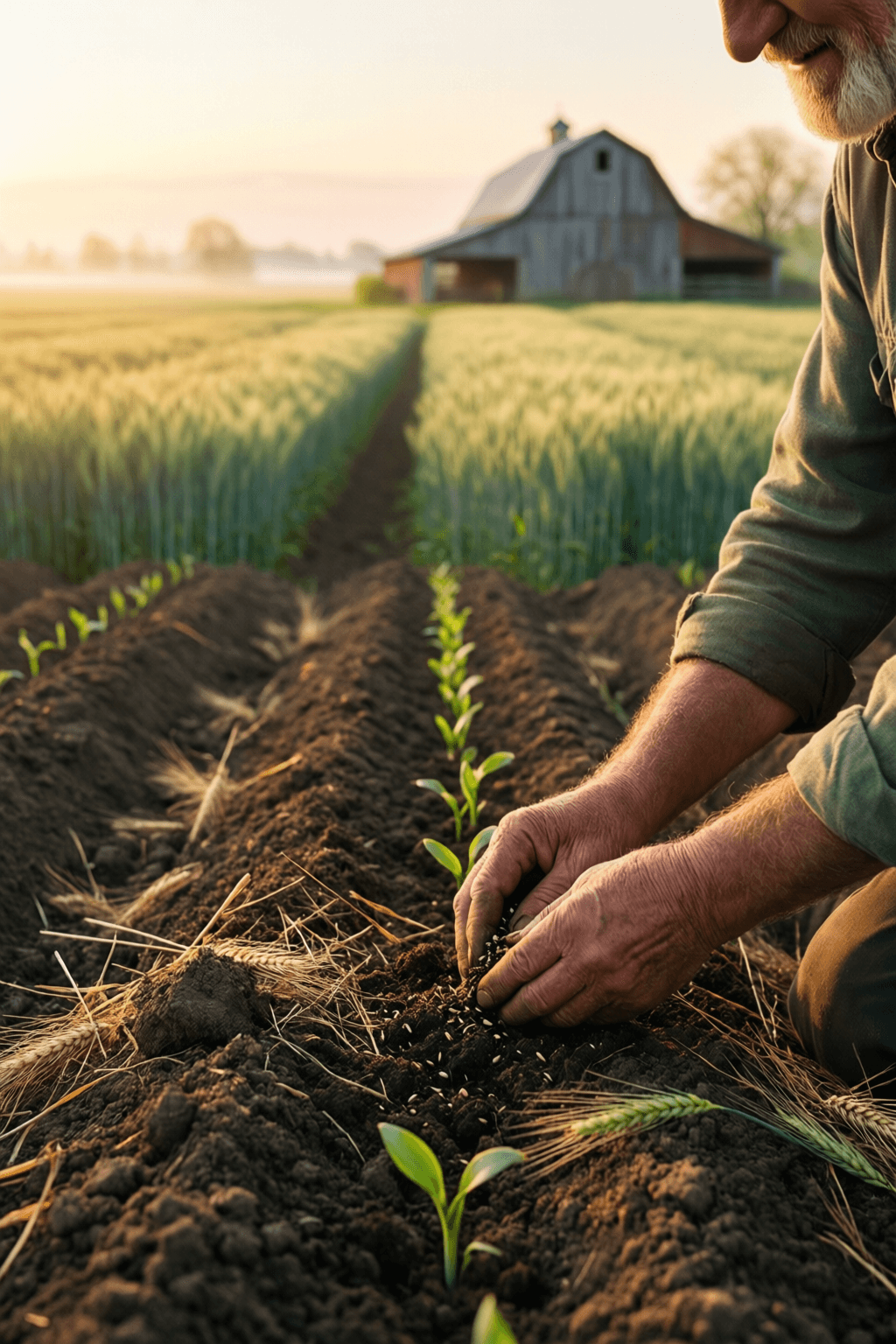
A farmer is helpless to grow grain; all he can do is provide the right conditions for the growing of grain. — Richard J. Foster
—What lingers after this line?
The Humility Behind the Image
At first glance, Foster’s farming metaphor shifts attention away from control and toward humility. A farmer cannot command a seed to sprout, just as a person cannot force true growth—whether spiritual, personal, or relational—into existence by sheer effort. Instead, the quote emphasizes a quieter responsibility: preparing the soil, protecting the field, and waiting with patience for what cannot be manufactured. In this way, the image gently challenges modern habits of impatience. We often assume that enough pressure, discipline, or technique can produce instant transformation. Foster counters that real growth is not engineered like a machine; rather, it emerges when life-giving conditions are faithfully maintained.
The Difference Between Effort and Control
From that humility follows an important distinction: effort still matters, but control does not belong to us. A farmer works hard—plowing, watering, weeding—yet even the most diligent laborer cannot create life from scratch. Likewise, in Richard J. Foster’s broader spiritual vision, seen in Celebration of Discipline (1978), practices such as prayer, solitude, and study do not manufacture maturity; they simply open space for it. Consequently, the quote rescues effort from becoming obsession. It suggests that disciplined action has value not because it guarantees outcomes, but because it prepares us to receive them. This turns labor into cooperation with a process larger than ourselves.
Patience as a Form of Wisdom
Once we accept that growth cannot be forced, patience becomes more than passive waiting; it becomes a form of wisdom. Farmers understand seasons, delays, and hidden activity beneath the soil. In the same manner, much of human development happens invisibly before any outward result appears. What looks like stagnation may actually be a period of rooting. This perspective echoes ancient sources such as the Bible’s Parable of the Sower in Mark 4, where the condition of the ground shapes what the seed becomes. Foster’s point similarly reminds us that timing matters. We may not see immediate results, yet careful tending is never wasted when the process itself is alive.
An Ethics of Environment
Moreover, the quote expands beyond the individual and points toward the environments we create for others. Teachers, parents, mentors, and leaders often fall into the trap of trying to force outcomes in those they care for. Foster’s image offers a gentler ethic: provide nourishment, consistency, and safety, then allow growth to unfold in its own time. A good classroom, for example, does not inject knowledge directly into a child; it cultivates curiosity, trust, and repetition. Similarly, healthy communities do not compel wisdom by pressure alone. They create conditions in which people can take root, fail safely, and mature with authenticity.
Trusting What We Cannot Manufacture
Ultimately, Foster’s sentence is about trust. After all the preparing, watering, and watching, the farmer must depend on forces beyond personal mastery—sunlight, rain, life within the seed itself. So too with any meaningful transformation: we participate, but we do not possess final control over the mystery of becoming. Therefore, the quote offers both comfort and challenge. It comforts us by releasing the burden of total responsibility, yet it challenges us to remain faithful in the small, ordinary acts that make growth possible. In the end, our task is not to force the harvest, but to tend the field well.
Recommended Reading
As an Amazon Associate, we earn from qualifying purchases.
One-minute reflection
Why might this line matter today, not tomorrow?
Related Quotes
6 selectedTo cultivate anything—a garden, a skill, a soul—requires the courage to wait for what you have planted. — Wendell Berry
Wendell Berry
At first glance, Wendell Berry’s quote seems to praise patience, yet it goes further by naming patience as courage. To plant anything—a seed, a habit, a belief in oneself—is to act without immediate proof of success.
Read full interpretation →It is easy finding reasons why other folks should be patient. — George Eliot
George Eliot
George Eliot’s remark turns on a quiet but piercing irony: patience is a virtue we readily prescribe when someone else must practice it. In other words, distance makes endurance look simple.
Read full interpretation →Learning is a lifelong process of unlearning the need for immediate results. Patience is the discipline of trusting the slow, quiet compounding of your efforts. — Confucius
Confucius
At its core, this saying presents learning not as a race toward instant achievement, but as a gradual reshaping of expectation. The phrase “unlearning the need for immediate results” suggests that education is not only a...
Read full interpretation →If you want to move forward, you must first give yourself permission to stand still. Perspective is often the result of stopping long enough to actually see. — Alain de Botton
Alain de Botton
At first glance, Alain de Botton’s line seems contradictory: how can standing still help us move forward? Yet that tension is precisely his point.
Read full interpretation →Everything that is made is made by slow, steady effort. — Mary Oliver
Mary Oliver
Mary Oliver’s line distills a quiet truth: meaningful things rarely appear all at once. Instead, they emerge through repetition, patience, and attention, whether one is writing a poem, raising a family, or restoring a ga...
Read full interpretation →To do anything to a high standard, you must be prepared to be bored for long periods of time. — James Clear
James Clear
James Clear’s observation cuts against the modern preference for constant stimulation. At first glance, high achievement looks exciting from the outside, yet the path toward it is usually repetitive, slow, and uneventful...
Read full interpretation →More From Author
More from Richard J. Foster →