
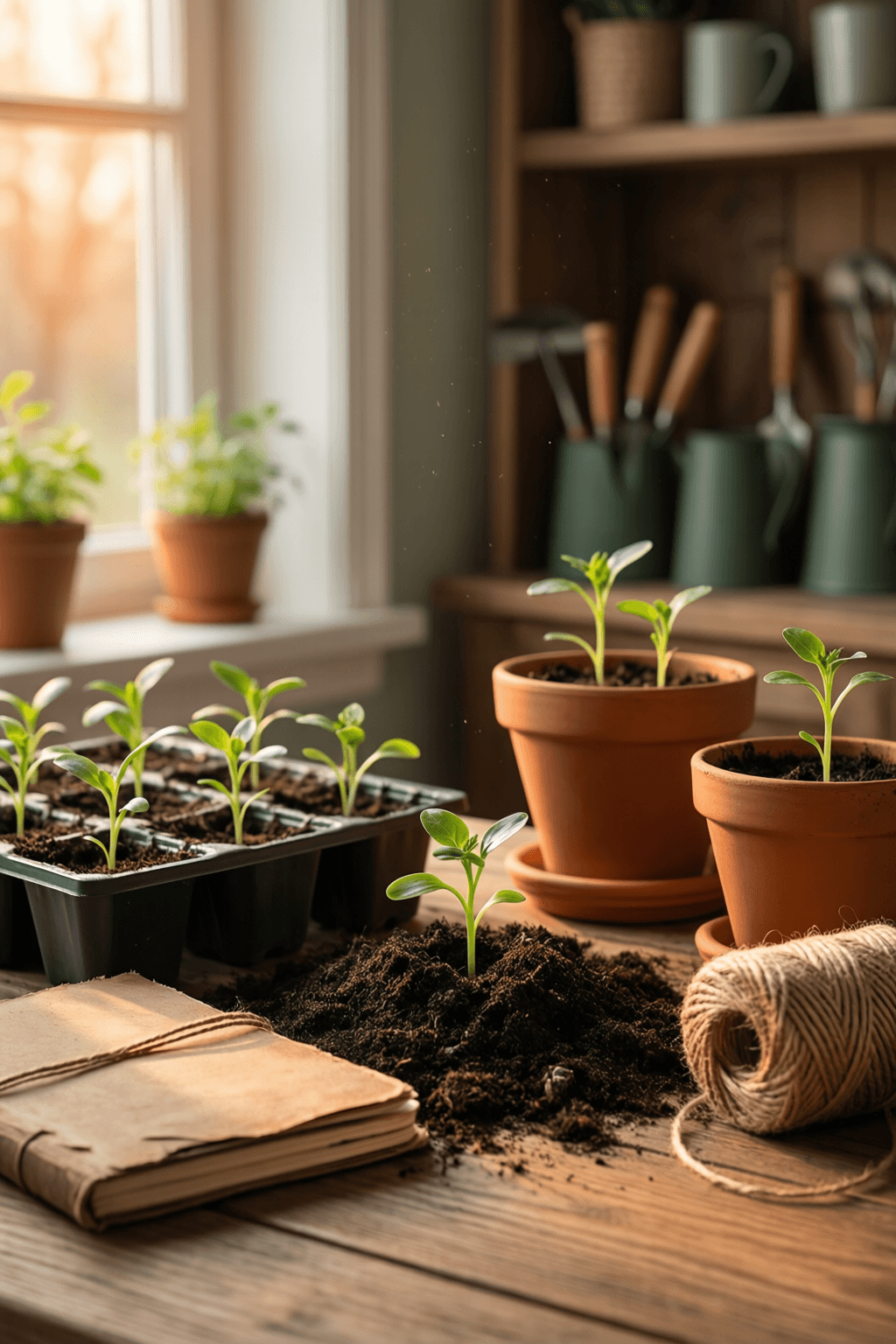
To cultivate anything—a garden, a skill, a soul—requires the courage to wait for what you have planted. — Wendell Berry
—What lingers after this line?
Waiting as an Act of Courage
At first glance, Wendell Berry’s quote seems to praise patience, yet it goes further by naming patience as courage. To plant anything—a seed, a habit, a belief in oneself—is to act without immediate proof of success. In this sense, waiting is not passive delay but a brave acceptance of uncertainty. Berry’s phrasing also suggests that growth cannot be forced. A gardener cannot tug a sprout upward, just as a person cannot rush wisdom or mastery. What matters, then, is the willingness to remain faithful to a process whose results are still invisible.
The Garden as a Human Mirror
From there, the image of a garden becomes more than a rural metaphor; it reflects the structure of human life itself. Seeds require soil, weather, and time, and people likewise need conditions that support steady development. Berry, whose essays such as The Unsettling of America (1977) often defend agrarian rhythms, repeatedly returns to the idea that real flourishing follows seasons rather than schedules. Consequently, the garden teaches humility. One may prepare the ground with care, but rain, sunlight, and unseen biological processes still play their part. The lesson is clear: cultivation involves effort, yet it also demands reverence for forces beyond our control.
Skill Grows Through Unseen Repetition
The quote then broadens naturally from gardening to the making of a skill. Learning music, writing, carpentry, or any craft often feels unrewarding in the early stages because improvement arrives gradually. A pianist’s scales or a writer’s abandoned drafts may seem fruitless at first, but they are the buried seeds from which fluency eventually emerges. In that way, Berry challenges a culture obsessed with quick results. Psychologist Anders Ericsson’s research on expertise, popularized in Peak (2016), similarly shows that mastery is built through long, deliberate practice rather than sudden talent. What appears effortless in the end is usually the harvest of long endurance.
The Soul’s Slow Formation
More deeply still, Berry includes the soul, shifting the idea of cultivation inward. Character, faith, moral clarity, and inner peace rarely appear in dramatic flashes; more often, they are formed through repeated choices, quiet disciplines, and long stretches of reflection. Much like a field left fallow before bearing fruit, the inner life often matures in silence. This insight echoes older traditions. For example, Marcus Aurelius’ Meditations (c. 180 AD) presents self-formation as a daily practice of attention and restraint, not a sudden conversion into wisdom. Berry’s line belongs to that same lineage, reminding us that the soul becomes what it is through sustained care.
Resisting the Demand for Immediate Results
Accordingly, the quote also reads as a quiet protest against modern impatience. Contemporary life encourages constant measurement—faster progress, visible outcomes, instant feedback—yet many meaningful things develop below the surface. Relationships deepen slowly, trust accumulates gradually, and even recovery from grief or failure unfolds in uneven stages. Berry’s wisdom invites a different posture: one that values fidelity over speed. An anecdote as ordinary as tending a backyard tomato plant makes the point well; watering it daily does not produce overnight fruit, but neglecting it in frustration guarantees nothing will come. The courage lies in continuing the care before the evidence appears.
Hope Rooted in Faithful Labor
Ultimately, Berry unites labor and hope. Planting is an act of belief that the future can answer present effort, even when no outcome is guaranteed. This is why cultivation—whether of land, talent, or spirit—demands not only discipline but trust: trust in time, in process, and sometimes in life itself. Thus the quote offers a gentle ethic for living. We are asked to work carefully, to wait bravely, and to understand that growth often happens invisibly before it becomes visible. In that union of action and patience, Berry finds something essential: the courage to keep tending what matters until it is ready to bloom.
Recommended Reading
As an Amazon Associate, we earn from qualifying purchases.
One-minute reflection
What feeling does this quote bring up for you?
Related Quotes
6 selectedWe must learn to treat our own hearts with the same patience and steady hand we would offer to a piece of fine, delicate wood. — Wendell Berry
Wendell Berry
Wendell Berry’s line begins with a striking comparison: the human heart is like fine, delicate wood, something beautiful yet easily damaged by haste or rough treatment. In that image, he shifts self-regard away from judg...
Read full interpretation →Patience is not passive waiting; it is the courage to stand in the middle of a process and trust that the bloom is coming. — Mary Oliver
Mary Oliver
At first glance, patience is often mistaken for mere delay or resignation, yet Mary Oliver overturns that assumption immediately. In her view, patience is not passive waiting but an active inner stance: a decision to rem...
Read full interpretation →It is easy finding reasons why other folks should be patient. — George Eliot
George Eliot
George Eliot’s remark turns on a quiet but piercing irony: patience is a virtue we readily prescribe when someone else must practice it. In other words, distance makes endurance look simple.
Read full interpretation →Learning is a lifelong process of unlearning the need for immediate results. Patience is the discipline of trusting the slow, quiet compounding of your efforts. — Confucius
Confucius
At its core, this saying presents learning not as a race toward instant achievement, but as a gradual reshaping of expectation. The phrase “unlearning the need for immediate results” suggests that education is not only a...
Read full interpretation →If you want to move forward, you must first give yourself permission to stand still. Perspective is often the result of stopping long enough to actually see. — Alain de Botton
Alain de Botton
At first glance, Alain de Botton’s line seems contradictory: how can standing still help us move forward? Yet that tension is precisely his point.
Read full interpretation →Everything that is made is made by slow, steady effort. — Mary Oliver
Mary Oliver
Mary Oliver’s line distills a quiet truth: meaningful things rarely appear all at once. Instead, they emerge through repetition, patience, and attention, whether one is writing a poem, raising a family, or restoring a ga...
Read full interpretation →More From Author
More from Wendell Berry →Nobody can discover the world for somebody else. Only when we discover it for ourselves does it become common ground and a common bond. — Wendell Berry
Wendell Berry begins with a simple but demanding truth: no one can hand another person a fully lived understanding of the world. Facts can be taught, maps can be drawn, and advice can be offered, yet genuine knowledge re...
Read full interpretation →We must learn to treat our own hearts with the same patience and steady hand we would offer to a piece of fine, delicate wood. — Wendell Berry
Wendell Berry’s line begins with a striking comparison: the human heart is like fine, delicate wood, something beautiful yet easily damaged by haste or rough treatment. In that image, he shifts self-regard away from judg...
Read full interpretation →You are not a machine designed to be productive 24/7. Even the most fertile land must lie fallow to produce a harvest again. — Wendell Berry
Wendell Berry’s line begins by challenging a modern assumption: that our worth is measured by constant productivity. By stating plainly that you are “not a machine,” he re-centers the conversation on human limits—physica...
Read full interpretation →The Earth is what we all have in common. — Wendell Berry
Wendell Berry’s line sounds almost obvious at first, yet its force comes from how quickly it dissolves our usual divisions. Before nationality, ideology, or profession, we inhabit the same planet with the same basic depe...
Read full interpretation →