
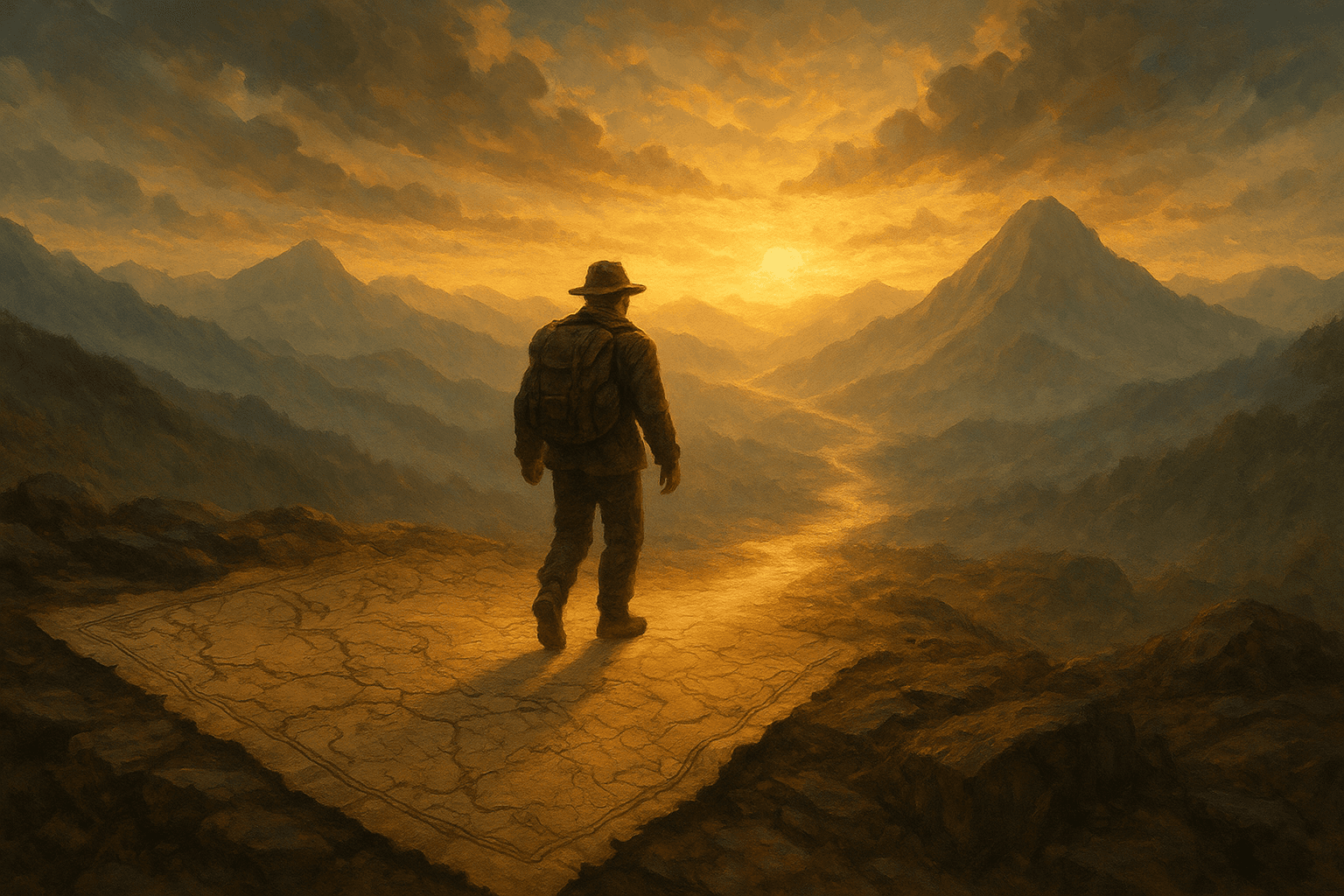
Forge ahead where maps end; the brave craft new paths as they go. — J.R.R. Tolkien
—What lingers after this line?
Leaving the Edge of the Known
Tolkien’s line evokes the moment when the comfort of the known world runs out—when the map quite literally ends. At such boundaries, most people turn back, trusting only what has been charted before. Yet, the quote insists that true progress begins exactly there, where certainty fades and imagination must replace ink on parchment. This shift from relying on established routes to embracing the blank space is the first step toward genuine discovery. By framing the unknown as a forge rather than a void, Tolkien suggests that endings of maps are beginnings of possibilities.
Courage as a Creative Force
From this threshold, bravery becomes something more than raw daring; it turns into a creative force. To “craft new paths” implies design, improvisation, and responsiveness to the terrain rather than reckless wandering. In *The Lord of the Rings* (1954–55), characters like Frodo and Sam move into lands no hobbit has seen, not to chase glory, but because conscience and necessity demand it. Their courage is not loud heroism but quiet perseverance, transforming fear into motion. Thus, Tolkien binds bravery with craftsmanship: the brave do not merely survive the unknown; they shape it into a route others can follow.
From Wanderers to Waymakers
As the journey continues, those who once seemed like aimless wanderers gradually become waymakers. Initially, stepping off the map looks like drifting without direction. However, with each decision and adjustment, they turn random motion into an emergent trail. History mirrors this pattern: early seafarers crossing uncharted oceans and explorers charting mountain passes shifted from being perceived as fools to being recognized as pioneers. In the same way, Tolkien’s phrase suggests that the difference between getting lost and breaking new ground lies not in the absence of roads but in the presence of purpose.
Innovation at the Frontier of Uncertainty
Following this logic, the quote applies as much to ideas as to geography. Scientific and artistic breakthroughs often occur where established frameworks no longer explain what we see, and old ‘maps’ of knowledge fail. Einstein’s reimagining of space and time or Marie Curie’s work on radioactivity pushed beyond the prevailing intellectual charts of their eras. In these arenas, bravery means risking one’s reputation and security to test unproven paths. Thus the frontier becomes less a place and more a condition—a state in which prior guidance runs out and experimentation lights the way forward.
Personal Growth in Uncharted Territory
Brought down to everyday life, Tolkien’s insight illuminates personal growth. Moments such as changing careers, moving to a new country, or ending a long-standing relationship often feel like staring at the edge of one’s own map. There are no guarantees, only hunches and values to steer by. Yet, by choosing to move anyway, individuals gradually discover new capabilities, relationships, and identities that could never have emerged on familiar ground. Over time, their once-terrifying unknown becomes the new normal, and the paths they have crafted may guide others through similar transitions.
Responsibility of the Path-Creator
Finally, Tolkien’s wording hints at an ethical dimension: those who forge ahead shape not just their own fate but the options available to others. A newly made path can invite, liberate, or mislead, depending on the intentions and care of its maker. In Tolkien’s legendarium, leaders such as Aragorn reopen ancient roads not to dominate but to restore balance and hope. Likewise, modern trailblazers—in technology, social movements, or local communities—carry a responsibility to consider who will walk the routes they leave behind. Thus, forging ahead is both an act of courage and an enduring commitment to those who follow.
One-minute reflection
What feeling does this quote bring up for you?
Related Quotes
6 selectedCourage is found in unlikely places. — J. R. R. Tolkien
J.R.R. Tolkien
Tolkien’s line gently overturns the usual image of courage as something reserved for warriors, rulers, or legendary heroes. Instead, it suggests that bravery often appears in ordinary people and modest settings, where no...
Read full interpretation →Travel inward with courage and return with new maps for living. — Paulo Coelho
Paulo Coelho
Coelho’s line reframes travel as an inward expedition rather than a change of scenery. To “travel inward” is to observe your fears, desires, habits, and hidden assumptions with the same attentiveness you’d bring to a for...
Read full interpretation →To be courageous is to act with the heart. — Molière
Molière
Molière’s line suggests that courage is not merely the absence of fear, but the decision to move despite it. By connecting courage with the heart, he frames bravery as an emotional and moral act rather than a simple disp...
Read full interpretation →The best people possess a feeling for beauty, the courage to take risks, the discipline to tell the truth, the capacity for sacrifice. — Ernest Hemingway
Ernest Hemingway
Hemingway’s line presents goodness not as politeness or success, but as a demanding inner code. The “best people” are those who combine sensitivity, bravery, honesty, and self-denial—qualities that do not always coexist...
Read full interpretation →If you are not willing to look stupid, nothing great is ever going to happen to you. — Julia Cameron
Julia Cameron
Julia Cameron’s remark begins with a hard truth: many people do not fail because they lack talent, but because they fear embarrassment. In that sense, ‘looking stupid’ becomes shorthand for being seen trying, stumbling,...
Read full interpretation →You don't have to bully yourself out of feeling fear. You just have to move while it's still there. — Annie Wright
Annie Wright
At its core, Annie Wright’s quote challenges the common belief that courage begins only after fear has disappeared. Instead, it reframes fear as something that can accompany action rather than prevent it.
Read full interpretation →More From Author
More from J.R.R. Tolkien →Courage is found in unlikely places. — J. R. R. Tolkien
Tolkien’s line gently overturns the usual image of courage as something reserved for warriors, rulers, or legendary heroes. Instead, it suggests that bravery often appears in ordinary people and modest settings, where no...
Read full interpretation →It is not our part here to take thought only for a season, or for a few lives of men, or for a passing age of the world. — J.R.R. Tolkien
At its core, Tolkien’s line rejects narrow, short-term thinking. He urges us to look beyond a single season, a generation, or even an era, and to measure our actions against a far larger horizon.
Read full interpretation →Faithless is he that says farewell when the road darkens. — J.R.R. Tolkien
Tolkien’s line draws a sharp boundary between affection that is convenient and fidelity that is real. Saying farewell “when the road darkens” suggests abandoning a person, cause, or duty precisely at the moment it demand...
Read full interpretation →Shape wonder into shelter; imagination becomes home when it is shared. — J.R.R. Tolkien
Tolkien’s image of shaping wonder into shelter echoes his idea of “sub-creation,” the human craft of making secondary worlds within the primary one. In On Fairy-Stories (1939), he argues that stories offer recovery, esca...
Read full interpretation →