
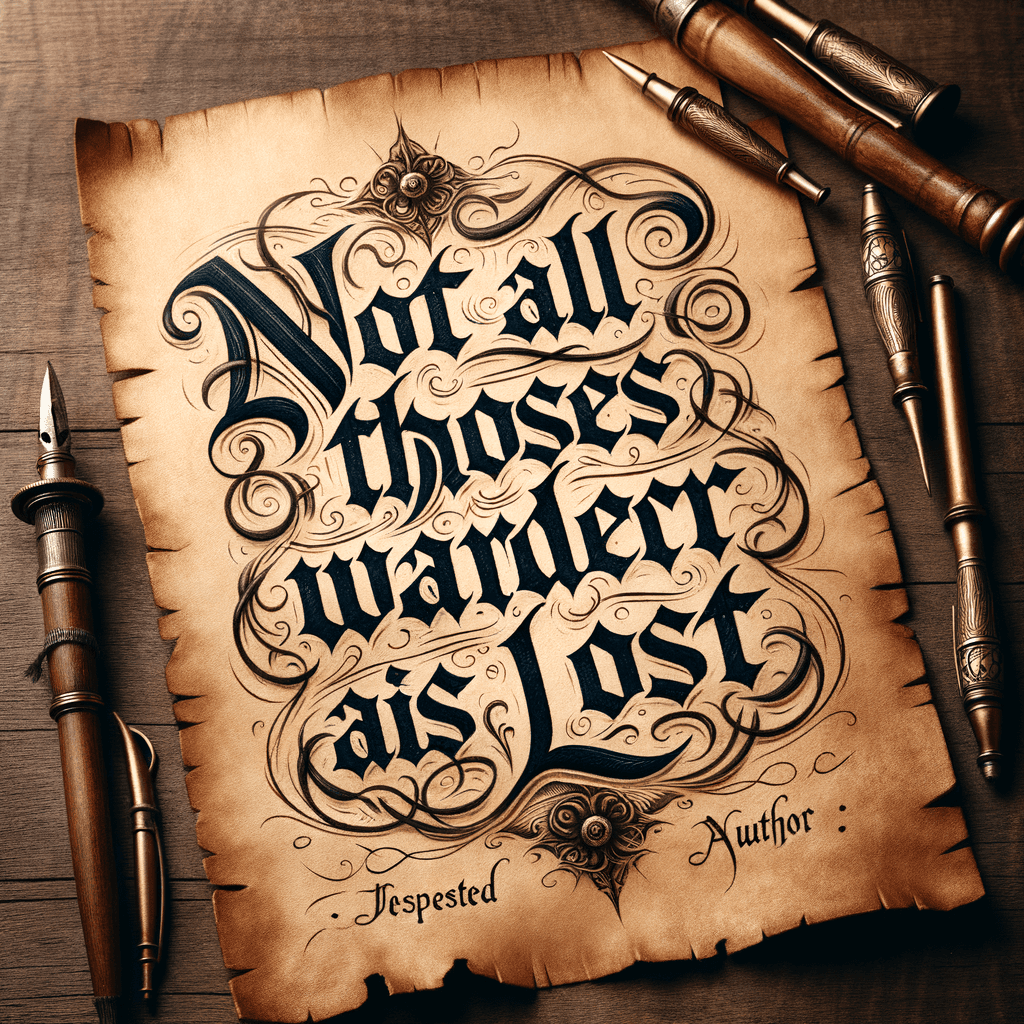
Not all those who wander are lost. - J.R.R. Tolkien
—What lingers after this line?
Exploration and Discovery
This quote highlights the value of exploration and discovery. It suggests that wandering, or exploring new paths, can lead to personal growth and understanding, even if it appears aimless to others.
Individual Journey
It emphasizes the uniqueness of individual journeys. Each person has their own path and way of finding meaning and purpose in life. Just because someone's path differs from the norm does not mean they are lost.
Rejection of Conformity
The quote also challenges societal expectations and norms. It celebrates those who take unconventional routes and resist conformity, suggesting that true fulfillment can come from venturing off the beaten path.
Depth and Perception
It underscores the idea that surface appearances can be misleading. Just because someone seems to be wandering or appears directionless does not mean they lack purpose or insight.
Literary Context
J.R.R. Tolkien, author of 'The Lord of the Rings,' often wrote about journeys and quests. This quote reflects themes in his work, where characters embark on adventures that lead to self-discovery and broader understanding.
One-minute reflection
Why might this line matter today, not tomorrow?
Related Quotes
6 selectedNot all those who wander are lost. - J.R.R. Tolkien
J.R.R. Tolkien
This quote points out that wandering or taking an unconventional path doesn’t necessarily mean a person is directionless or lacks purpose. It celebrates the idea of seeking one's unique path in life.
Read full interpretation →Not all those who wander are lost. - J.R.R. Tolkien
J.R.R. Tolkien
This quote suggests that wandering, whether physically or in a metaphorical sense, can be part of a purposeful journey of self-discovery. Not everyone who seems to lack direction is without purpose.
Read full interpretation →You will succeed if you persevere; and you will find joy in the journey. — J.R.R. Tolkien
J.R.R. Tolkien
The quote highlights the importance of persistence in achieving success. It suggests that steadfast effort and commitment, even in the face of challenges, will ultimately lead to accomplishment.
Read full interpretation →Traveler, there is no path, the path is made by walking.
walking.
This quote emphasizes that each individual must create their own path in life. Rather than following a predefined route, one must carve out their own unique journey through experiences and actions.
Read full interpretation →Traveler, there is no path; the path is made by walking. - Antonio Machado
Antonio Machado
This quote emphasizes the power of individual action and decision-making. It suggests that one's journey is created through their own efforts and choices, rather than following a preordained route.
Read full interpretation →Originality is the best form of rebellion. — Mike Sasso
Mike Sasso
Mike Sasso’s line reframes rebellion in a striking way: instead of imagining protest only as noise, confrontation, or spectacle, it presents originality as a subtler but often more enduring act of defiance. To create som...
Read full interpretation →More From Author
More from J.R.R. Tolkien →Courage is found in unlikely places. — J. R. R. Tolkien
Tolkien’s line gently overturns the usual image of courage as something reserved for warriors, rulers, or legendary heroes. Instead, it suggests that bravery often appears in ordinary people and modest settings, where no...
Read full interpretation →It is not our part here to take thought only for a season, or for a few lives of men, or for a passing age of the world. — J.R.R. Tolkien
At its core, Tolkien’s line rejects narrow, short-term thinking. He urges us to look beyond a single season, a generation, or even an era, and to measure our actions against a far larger horizon.
Read full interpretation →Faithless is he that says farewell when the road darkens. — J.R.R. Tolkien
Tolkien’s line draws a sharp boundary between affection that is convenient and fidelity that is real. Saying farewell “when the road darkens” suggests abandoning a person, cause, or duty precisely at the moment it demand...
Read full interpretation →Forge ahead where maps end; the brave craft new paths as they go. — J.R.R. Tolkien
Tolkien’s line evokes the moment when the comfort of the known world runs out—when the map quite literally ends. At such boundaries, most people turn back, trusting only what has been charted before.
Read full interpretation →