
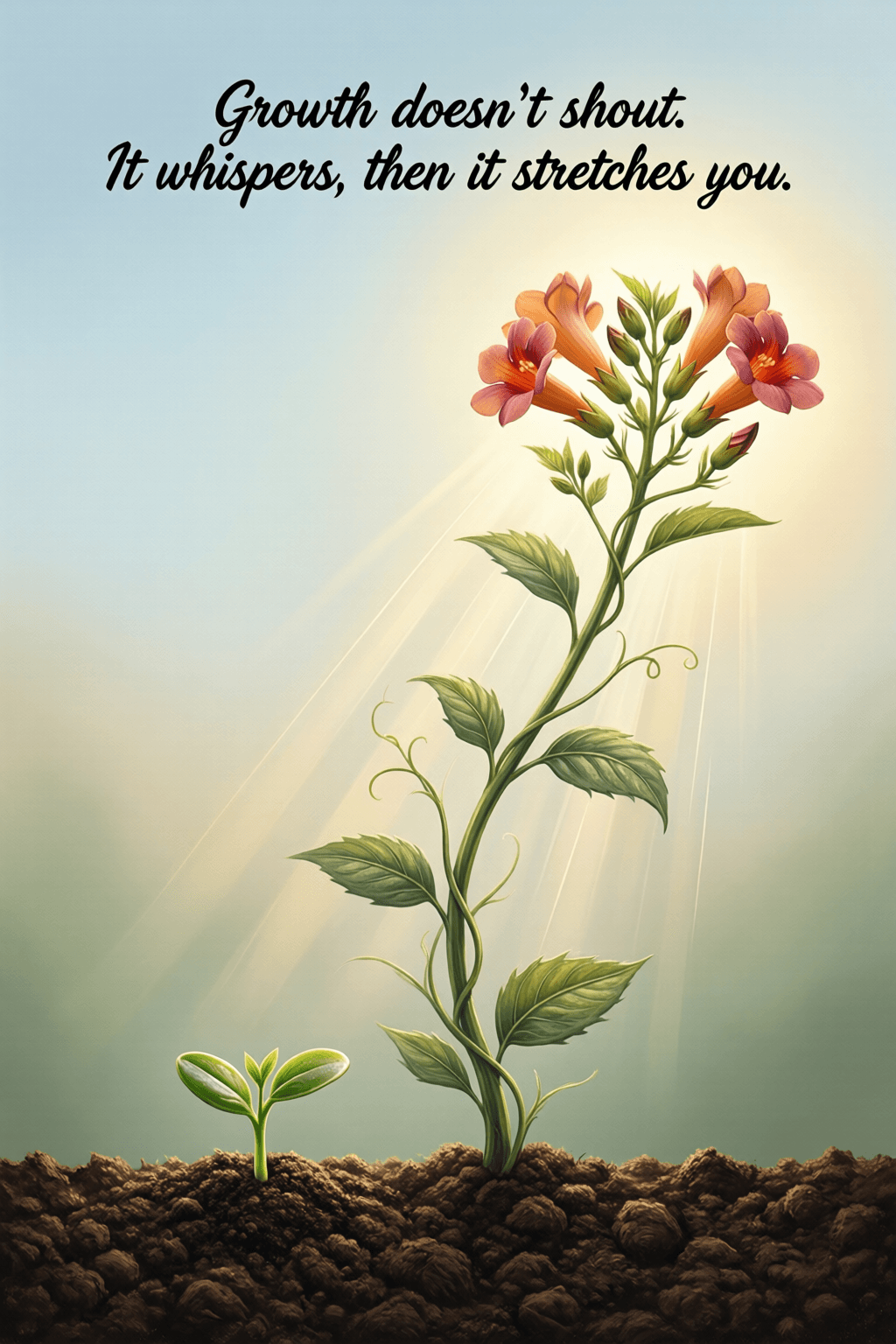
Growth doesn't shout. It whispers, then it stretches you. — Elizabeth Gilbert
—What lingers after this line?
The Quiet Arrival of Change
Elizabeth Gilbert’s line begins by rejecting the dramatic image many people associate with transformation. Rather than arriving with fanfare, growth often enters softly, as a faint intuition, a private discomfort, or a subtle sense that life can no longer remain the same. In this way, the whisper becomes important precisely because it is easy to ignore. That quiet beginning reflects how real change usually works. Before a visible breakthrough, there is often an inward shift: a question that lingers, a restlessness that will not leave, or a new desire that feels both fragile and insistent. Gilbert captures this early stage beautifully, showing that growth first asks for attention before it asks for action.
Why Growth Rarely Looks Dramatic
From there, the quote suggests that meaningful development is not always recognizable in the moment. We tend to celebrate milestones—graduations, promotions, bold reinventions—yet the inner work that makes them possible is quieter and less theatrical. As James Clear’s Atomic Habits (2018) argues, lasting change is often the result of small, repeated shifts rather than one grand decision. Consequently, growth can feel underwhelming while it is happening. A person may simply be learning to speak more honestly, endure uncertainty, or revise an old belief. These changes do not shout, but over time they alter the structure of a life. Gilbert’s phrasing reminds us that what is subtle is not therefore small.
The Stretch of Becoming
Yet the second half of the quote introduces tension: growth does not remain a whisper forever. Eventually, it stretches you, meaning it pulls you beyond familiar habits, identities, and limits. That stretching can feel uncomfortable because it asks for expansion before confidence fully arrives. This idea appears across literature and philosophy. In Viktor Frankl’s Man’s Search for Meaning (1946), human development emerges through response to difficulty, not escape from it. Similarly, the stretching Gilbert describes is not punishment but enlargement. It is the sensation of becoming more capable than the self that first heard the whisper, even if that process feels awkward or demanding.
Discomfort as a Sign of Expansion
Because of this, discomfort should not always be mistaken for failure. Often, the unease that accompanies growth is evidence that an old frame is no longer sufficient. Learning a skill, leaving a limiting relationship, beginning therapy, or taking creative risks can all produce the feeling of being stretched thin before one feels strengthened. In that sense, Gilbert offers a corrective to the fantasy of effortless self-improvement. The metaphor of stretching suggests strain, vulnerability, and temporary instability, much like a muscle growing through resistance. What begins as a whisper becomes a demand for greater capacity, and the discomfort of that demand may be the very proof that change is real.
Listening Before Life Forces Movement
Accordingly, the quote also carries practical wisdom: listen when growth whispers, so life does not need to shout later. Many people recognize in hindsight that transformation began with a quiet signal—a persistent dissatisfaction, a creative urge, or a dawning awareness that something essential was being neglected. Cheryl Strayed’s Tiny Beautiful Things (2012) similarly urges readers to honor these inner truths before they harden into regret. By paying attention early, we cooperate with growth instead of resisting it until circumstances become painful. The whisper is gentler than the stretch, but both belong to the same process. Gilbert’s insight therefore encourages a more attentive life, one in which subtle inner knowledge is taken seriously.
A Gentler Definition of Personal Evolution
Ultimately, Gilbert reframes growth as both tender and demanding. It does not begin with spectacle but with sensitivity; it does not end with comfort but with expansion. This balanced vision is powerful because it honors the emotional truth of change: we are first invited, then challenged. As a result, the quote offers reassurance to anyone who feels uncertain in transition. If growth seems quiet at first and painful later, that does not mean it is absent or misguided. On the contrary, its whisper may be the earliest form of wisdom, and its stretch may be the shape of a larger life trying to emerge.
Recommended Reading
As an Amazon Associate, we earn from qualifying purchases.
One-minute reflection
Why might this line matter today, not tomorrow?
Related Quotes
6 selectedGrowth feels scary because comfort feels warm, but you can take one small step. Change doesn't crush you; staying still slowly does. — Justin Welsh
Justin Welsh
At first glance, Justin Welsh captures a tension nearly everyone recognizes: comfort feels safe precisely because it is familiar. Routine wraps itself around us like warmth, making even imperfect situations feel preferab...
Read full interpretation →Your choices must begin to reflect not just the person you are, but also the one you are becoming. — Brianna Wiest
Brianna Wiest
At its core, Brianna Wiest’s statement reframes identity as something unfinished. Rather than treating the self as a fixed fact, she suggests that who we are is continually revised through action.
Read full interpretation →To learn is to admit that you are unfinished, and there is a quiet, profound power in acknowledging that you are still becoming. — Pico Iyer
Pico Iyer
At its core, Pico Iyer’s reflection turns learning into an act of humility. To learn is not merely to gather information; rather, it is to recognize that one’s present self is partial, evolving, and open to revision.
Read full interpretation →Associate with those who will make a better person of you. — Seneca
Seneca
At its core, Seneca’s advice is remarkably practical: the people around us quietly shape who we become. In his moral letters, especially the spirit of the *Letters to Lucilius* (c.
Read full interpretation →Just as one person delights in improving his farm, and another his horse, so I delight in attending to my own improvement day by day. — Epictetus
Epictetus
Epictetus frames self-improvement as a form of steady, almost ordinary care. Just as a farmer inspects his fields or a horse owner trains and grooms with patience, he finds joy in tending to his own character.
Read full interpretation →You are not a machine built for constant output; you are a human being meant for meaningful growth. — Maya Angelou
Maya Angelou
At its core, Maya Angelou’s statement challenges a culture that often measures worth by visible productivity alone. By contrasting a machine with a human being, she exposes the danger of treating life as an endless cycle...
Read full interpretation →More From Author
More from Elizabeth Gilbert →The most radical act in a digital age is to choose to create something that has no purpose other than your own joy. — Elizabeth Gilbert
At first glance, Elizabeth Gilbert’s quote sounds simple, yet it carries a defiant charge. In a digital culture that constantly asks what a creation can earn, prove, or optimize, making something purely for delight becom...
Read full interpretation →We don't realize that, somewhere within us all, there does exist a supreme self who is eternally at peace. — Elizabeth Gilbert
Elizabeth Gilbert’s reflection begins with a striking contrast: while most people experience life as restless, reactive, and noisy, she suggests that another layer of identity quietly endures beneath that turbulence. In...
Read full interpretation →A creative life is an amplifying life. It’s a magnifying life. — Elizabeth Gilbert
Elizabeth Gilbert’s line suggests that creativity does not merely produce art; rather, it changes the scale at which life is felt. To call creative living an “amplifying life” is to say that attention, emotion, and meani...
Read full interpretation →To find your purpose, look not for a singular lightning strike of inspiration, but for the quiet tasks you are willing to repeat every day. — Elizabeth Gilbert
Elizabeth Gilbert reframes purpose as something discovered through steady practice rather than sudden revelation. At first glance, many people imagine purpose arriving as a dramatic epiphany, a single brilliant moment th...
Read full interpretation →