
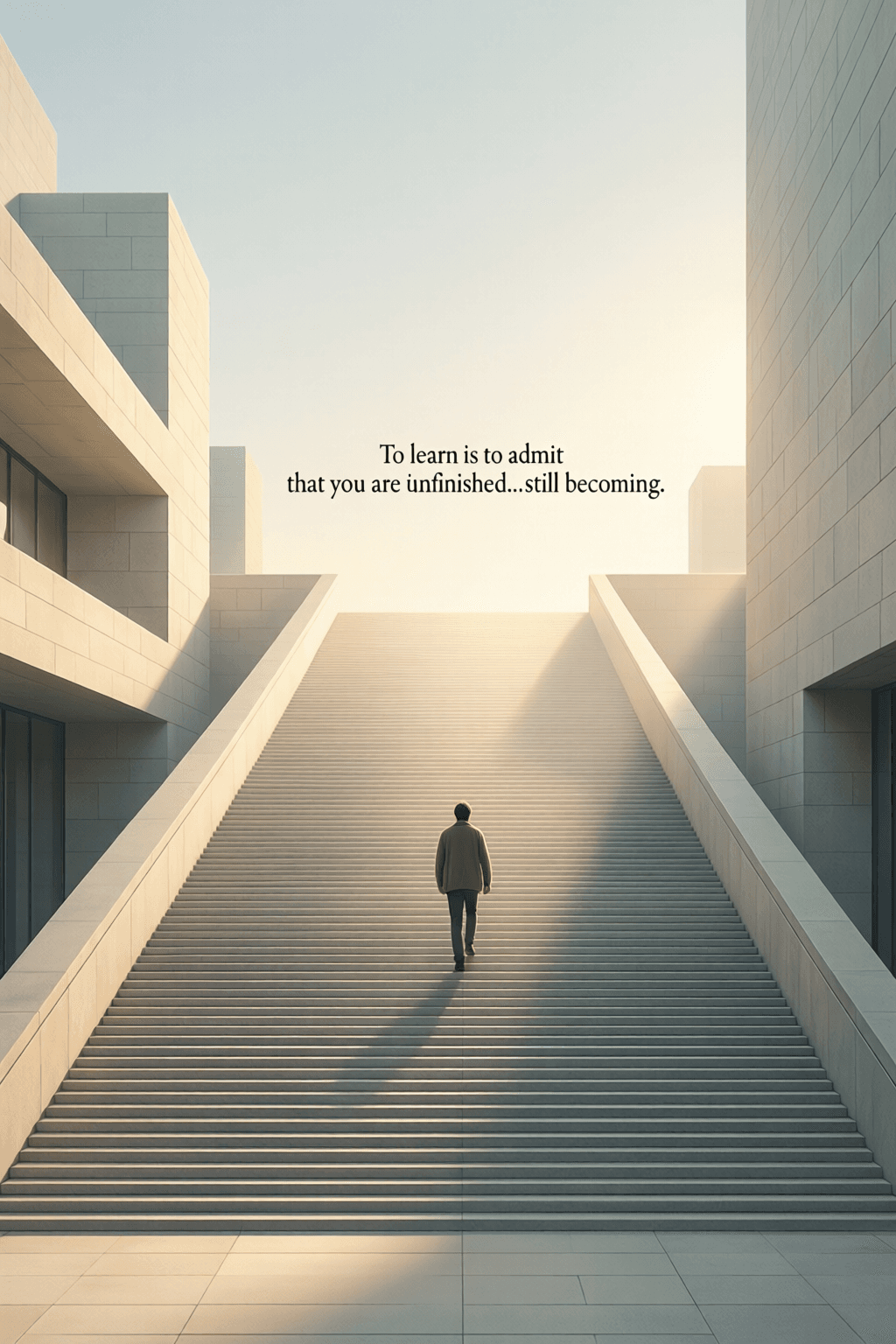
To learn is to admit that you are unfinished, and there is a quiet, profound power in acknowledging that you are still becoming. — Pico Iyer
—What lingers after this line?
The Wisdom of Incompleteness
At its core, Pico Iyer’s reflection turns learning into an act of humility. To learn is not merely to gather information; rather, it is to recognize that one’s present self is partial, evolving, and open to revision. In that sense, knowledge begins not with certainty but with the honest admission that we are unfinished. This idea carries a quiet dignity. Instead of treating incompleteness as failure, Iyer reframes it as possibility. What feels lacking today becomes the very space where growth can occur, and so the unfinished self is not deficient but alive with potential.
Humility as a Form of Strength
From that starting point, the quote suggests that vulnerability can be a source of power. Admitting that we do not know everything often appears weak in cultures that reward confidence and expertise. Yet Socrates in Plato’s Apology (c. 399 BC) built his philosophical method on precisely this awareness, claiming wisdom only in knowing that he did not know. In this light, humility is not self-erasure but disciplined openness. By setting aside the need to appear complete, a learner becomes more attentive, more curious, and ultimately more resilient. What first sounds like surrender gradually reveals itself as strength.
Becoming Rather Than Arriving
Iyer’s use of the phrase “still becoming” also shifts the focus from achievement to process. Rather than imagining life as a finished monument, the quote presents identity as something continually shaped by experience, reflection, and encounter. This perspective echoes John Dewey’s Democracy and Education (1916), where education is described not as preparation for life but as life itself. Consequently, learning becomes less about reaching a final state of mastery and more about remaining responsive to change. Each new lesson alters the learner, and each transformation opens the door to further revision. The self, then, is not a fixed product but an ongoing conversation.
The Quiet Power of Openness
Just as important, Iyer emphasizes that this power is “quiet.” He is not celebrating dramatic reinvention or public displays of growth, but the inward courage to remain teachable. In many lives, the deepest changes happen almost invisibly: a person listens more carefully after loss, revises an old belief after travel, or softens a certainty after meeting someone different. For example, travel writing throughout Iyer’s own career often returns to the idea that movement across cultures unsettles the illusion of completeness. The transformation is rarely loud; instead, it unfolds through patience, attention, and the willingness to be altered by what one encounters.
Learning as an Ethical Practice
This insight leads naturally to an ethical dimension. If I accept that I am unfinished, I may also become more generous toward the unfinishedness of others. Their mistakes, hesitations, and changes no longer appear as flaws alone, but as signs of their own becoming. In this way, learning fosters compassion as much as intellect. Martha Nussbaum’s Cultivating Humanity (1997) similarly argues that education can deepen our capacity to imagine lives beyond our own. Thus, the admission of incompletion does more than improve the mind; it enlarges the heart and makes coexistence more humane.
A Lifelong Invitation to Grow
Ultimately, the quote reads less like a definition of learning than an invitation to inhabit life differently. To remain a learner is to resist the temptation of finality—to refuse the comforting fiction that one is already complete. That refusal, though quiet, keeps the spirit awake. Therefore, Iyer’s words offer a hopeful vision of human development. We are not diminished by being unfinished; we are dignified by it. As long as we are still becoming, there remains room for wonder, revision, and renewal.
One-minute reflection
What feeling does this quote bring up for you?
Related Quotes
6 selectedLearning to love yourself is like learning to walk – essential, life-changing, and the only way to stand tall. — Vironika Tugaleva
Vironika Tugaleva
Vironika Tugaleva’s comparison begins with a simple but powerful truth: self-love is not a luxury, but a basic human necessity. Just as walking allows a child to move through the world with growing independence, learning...
Read full interpretation →The most gifted members of the human species are at their creative best when they cannot have their way, and must compensate for what they miss by realizing and cultivating their capacities. — Bryant H. McGill
Bryant H. McGill
Bryant H. McGill’s observation begins with a striking reversal: gifted people may not reach their highest potential when everything comes easily, but when something blocks their path.
Read full interpretation →A mind grows by staying with difficulty long enough for the experience to change it. — Mary Catherine Bateson
Mary Catherine Bateson
Mary Catherine Bateson’s observation begins with a quiet but demanding truth: the mind does not grow merely by encountering difficulty, but by remaining with it. Challenge becomes transformative only when we resist the u...
Read full interpretation →Consistency is a superpower. — Ryan Holiday
Ryan Holiday
Ryan Holiday’s line begins with a deceptively simple idea: greatness is rarely built through dramatic gestures. More often, it emerges from repeated actions that seem ordinary in isolation but become extraordinary over t...
Read full interpretation →Confidence is silent. Insecurities are loud. — Unknown (Wait—skip/replace with: True nobility is being superior to your former self. — Ernest Hemingway)
Ernest Hemingway
At its core, Hemingway’s line redefines nobility as an inward achievement rather than a social rank. Instead of measuring worth by wealth, pedigree, or dominance over others, it points to a quieter standard: becoming bet...
Read full interpretation →You are under no obligation to be consistent with the person you were yesterday. — James McCrae
James McCrae
At its core, James McCrae’s line challenges the quiet pressure to remain legible to others. Many people feel bound to opinions, habits, or identities simply because they once claimed them, as though consistency were a mo...
Read full interpretation →More From Author
More from Pico Iyer →Connection is not found in the scrolling, but in the pausing. Look up, breathe, and find the person standing right in front of you. — Pico Iyer
Pico Iyer’s reflection begins with a quiet reversal of modern habit: instead of searching for connection through constant motion, he locates it in stillness. The phrase “not found in the scrolling, but in the pausing” su...
Read full interpretation →The mind needs solitude in the same way a forest needs quiet after a storm. It is not because nothing is happening; it is because that is when everything begins to grow. — Pico Iyer
Pico Iyer compares the mind to a forest recovering after a storm, and the image immediately shifts our understanding of solitude. Rather than treating aloneness as emptiness, he presents it as a necessary period of renew...
Read full interpretation →To do one thing well is the only way to endure a world that demands we do everything at once. — Pico Iyer
At its core, Pico Iyer’s line argues that endurance now depends less on speed than on concentration. In a culture that praises multitasking, constant updates, and endless availability, he reframes survival as an act of d...
Read full interpretation →Inner calm is not a state you wait for, but a space you build within the daily noise. — Pico Iyer
At its core, Pico Iyer’s line shifts calm from something passive to something made. Rather than imagining peace as a rare mood that descends when life finally becomes quiet, he presents it as an inner architecture built...
Read full interpretation →