
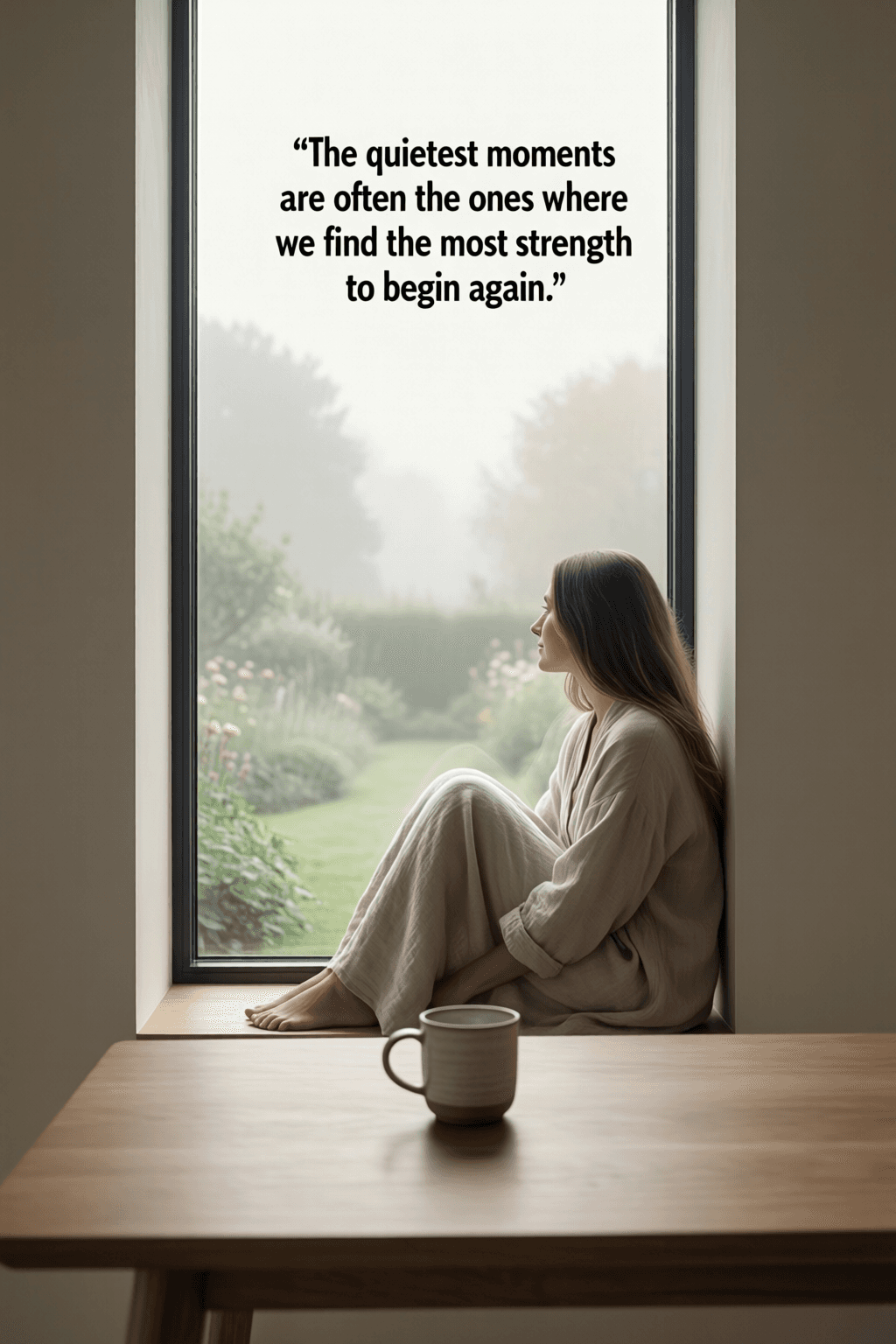
The quietest moments are often the ones where we find the most strength to begin again. — Anne Lamott
—What lingers after this line?
Strength Hidden in Stillness
At first glance, Anne Lamott’s line seems to praise silence, yet it goes further by suggesting that quiet is not emptiness but a source of recovery. In the absence of noise, distraction, and performance, people often hear their own inner life more clearly. What appears gentle on the surface can therefore become the place where courage gathers. This idea matters because new beginnings rarely arrive with fanfare. More often, they emerge in small, unremarkable pauses—an early morning alone, a walk after disappointment, a breath taken before trying again. Lamott’s insight reframes these modest intervals as the very ground from which resilience grows.
Why Beginnings Need Reflection
From that perspective, the quote also implies that renewal requires a moment of inward turning. Before people can begin again, they often need to step back from chaos long enough to understand what has been lost, what remains, and what still matters. Quiet makes this reckoning possible, not by erasing pain but by making it bearable to face. In this way, silence becomes practical rather than merely poetic. Marcus Aurelius’s Meditations (2nd century AD) repeatedly returns to the value of retreating into the self, arguing that composure allows one to meet difficulty with steadiness. Lamott’s words echo that tradition, presenting reflection as the doorway to action.
The Healing Power of Small Pauses
Moreover, Lamott points toward a truth many people recognize only in hindsight: healing often advances through brief, ordinary pauses rather than dramatic transformations. A quiet cup of coffee after grief, a few still minutes before a difficult conversation, or the hush of evening after failure can restore enough balance to continue. Strength, in this sense, is accumulated gently. Contemporary psychology supports this view. Research on mindfulness, popularized by Jon Kabat-Zinn’s Full Catastrophe Living (1990), shows that intentional moments of attention and stillness can reduce stress and improve emotional regulation. Thus, the quietest moments are not escapes from life but subtle practices that help people re-enter it with renewed steadiness.
Renewal After Loss or Failure
As the quote unfolds, it also speaks directly to those living through disappointment. To begin again after loss, shame, or exhaustion usually requires more than motivation; it requires a quieter kind of bravery. Loud confidence may falter, but private endurance—the willingness to sit with oneself and rise once more—often proves more durable. Literature offers many versions of this pattern. In Ernest Hemingway’s The Old Man and the Sea (1952), Santiago’s endurance is marked not by grand speeches but by solitary persistence. Similarly, Lamott suggests that the resolve to continue is often born in silent, unseen moments, where a person gathers enough faith to take the next step.
A Gentler Definition of Courage
Finally, Lamott’s words invite a broader understanding of courage itself. Modern culture often celebrates bold, visible strength, yet this quote honors a quieter form: the capacity to pause, listen, and begin again without spectacle. Such courage may look small from the outside, but inwardly it can be transformative. For that reason, the line carries both comfort and challenge. It comforts by reminding us that we do not need dramatic certainty to start over; sometimes a little stillness is enough. At the same time, it challenges us to respect silence not as passivity, but as the place where renewal takes its first true breath.
One-minute reflection
Where does this idea show up in your life right now?
Related Quotes
6 selectedWhen something in your life dies—whether it be a job, a hobby, or a dream—I encourage you not to focus on what could have been but instead to look for the new life and the new opportunities that result. — Ryan Hall
Ryan Hall
Ryan Hall frames loss as a kind of death, and that metaphor immediately broadens the quote beyond grief in the literal sense. A job can end, a cherished hobby can fade, and a long-held dream can collapse; yet in each cas...
Read full interpretation →The real flex is no longer looking busy. It is looking peaceful. It is having ambition without self-destruction. — Anonymous (skipped) -> The quietest moments are often where the greatest strength is found. — Mary Oliver
Mary Oliver
At first glance, these paired lines challenge a modern performance ritual: the need to appear constantly overwhelmed in order to seem important. Instead of praising busyness, they propose a subtler ideal—peacefulness as...
Read full interpretation →Real self-respect is quieter; it doesn't announce itself, it just holds. — Phil Van Treuren
Phil Van Treuren
At its core, Phil Van Treuren’s line distinguishes genuine self-respect from the kind of confidence that needs an audience. Real self-respect does not advertise itself through boasts, dramatic gestures, or constant self-...
Read full interpretation →It is a new dawn, it is a new day, it is a new life for me, and I am feeling good. — Nina Simone
Nina Simone
At its core, Nina Simone’s line turns ordinary time—dawn, day, life—into a sequence of renewal. Each phrase builds on the last, moving from the external world to the speaker’s inner state, until the declaration “I am fee...
Read full interpretation →You can start anew at any given moment. Life is just the passage of time and it is up to you to pass it as you please. — Charlotte Eriksson
Charlotte Eriksson
Charlotte Eriksson’s quote begins with a radical reassurance: renewal does not require permission from the past. By saying that you can start anew at any given moment, she shifts attention away from old mistakes and towa...
Read full interpretation →If you want to go somewhere, you have to know where you are. And here is as good a place as any to start. — Katniss Everdeen
Katniss Everdeen
Katniss Everdeen’s line turns a simple truth into practical wisdom: progress begins with honest self-location. Before anyone can chart a path toward change, they must first understand their present condition—emotionally,...
Read full interpretation →More From Author
More from Anne Lamott →Recovery is not a race. You don't have to feel guilty if it takes you longer than you thought it would. — Anne Lamott
Anne Lamott’s reminder begins by challenging one of the quiet cruelties of recovery: the belief that healing should follow a predictable schedule. Whether the wound is physical, emotional, or spiritual, people often comp...
Read full interpretation →Do not mistake your digital silence for peace. Real strength is found in the courage to speak the truth to the people who hold your heart. — Anne Lamott
At first glance, Anne Lamott’s quote challenges a familiar illusion: silence can resemble peace without actually creating it. Choosing not to speak may keep conflict out of sight, yet beneath that quiet surface, hurt, co...
Read full interpretation →Your worth is not a spreadsheet. You are not a project to be completed, but a life to be experienced. Stop measuring and start breathing. — Anne Lamott
Anne Lamott’s quote begins by confronting a habit many people barely notice: treating human value as if it could be tabulated. A spreadsheet symbolizes order, productivity, and comparison, yet it also reduces complexity...
Read full interpretation →The art of living is not about being a finished masterpiece; it is about being a work in progress that still knows how to laugh at its own paint spills. — Anne Lamott
At its heart, Anne Lamott’s remark reframes life from a quest for perfection into an ongoing act of creation. Instead of imagining ourselves as polished masterpieces, she invites us to see our days as brushstrokes still...
Read full interpretation →