
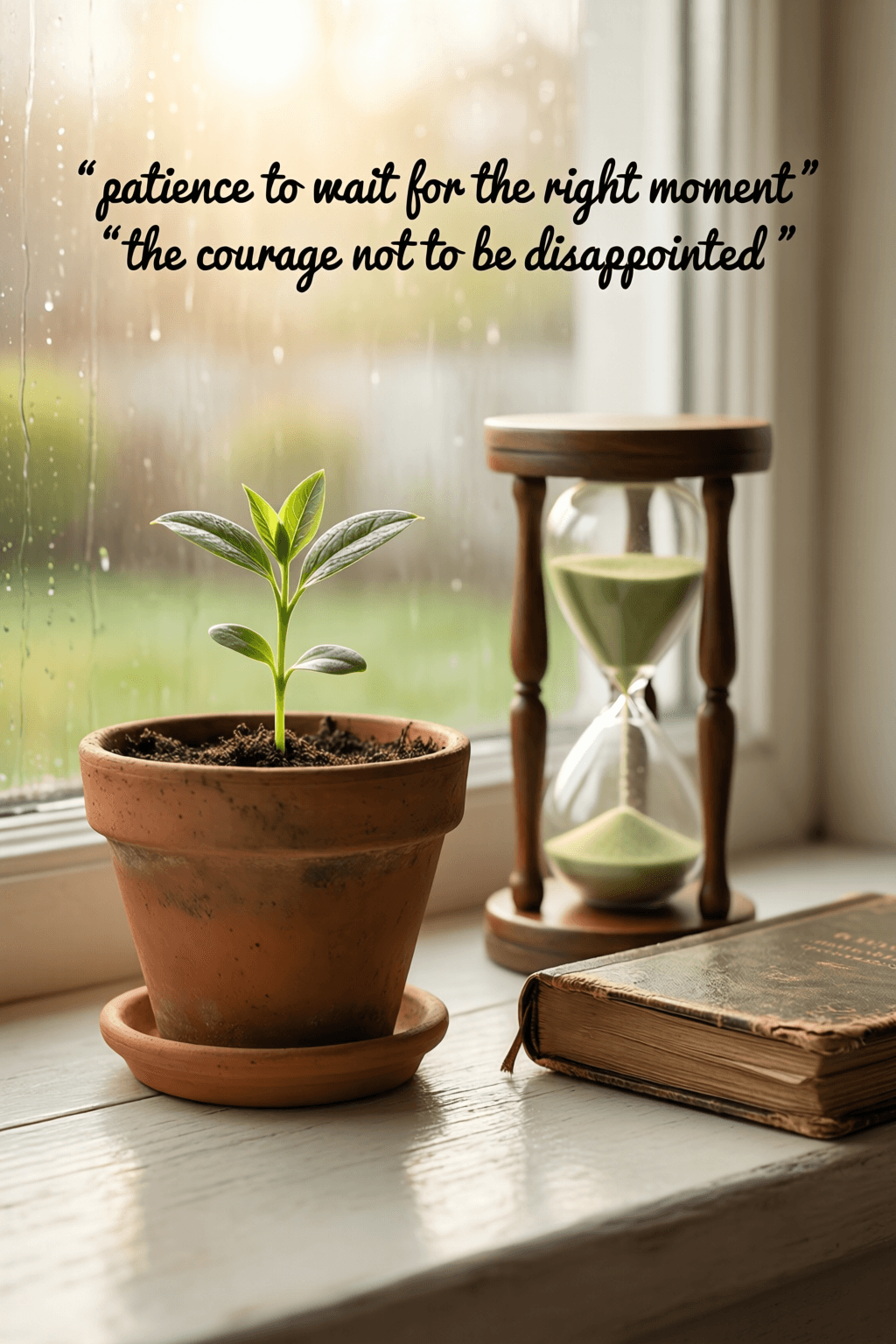
The two hardest tests on the spiritual road are the patience to wait for the right moment and the courage not to be disappointed with what we encounter. — Paul Coelho
—What lingers after this line?
A Double Trial of the Soul
At its core, Paulo Coelho’s reflection presents spiritual growth as a journey marked by two intertwined tests. The first is patience: the ability to endure uncertainty without forcing outcomes before their time. The second is courage: the strength to meet reality as it arrives, rather than collapsing into bitterness when it differs from our hopes. Together, these virtues suggest that the spiritual road is not only about seeking meaning, but also about learning how to receive life honestly.
Why Waiting Becomes a Discipline
From there, the idea of waiting takes on deeper significance. Patience is not mere passivity; it is an active discipline of trust, restraint, and attentiveness. In many traditions, this kind of waiting is sacred: the Psalms repeatedly urge believers to “wait on the Lord,” while Rumi’s poetry often frames longing itself as a form of transformation. Thus, the delay we resent may actually be the space in which character ripens.
The Shock of Reality
Yet waiting alone is not enough, which leads to Coelho’s second test. Even when the long-anticipated moment finally comes, reality may appear ordinary, incomplete, or painfully different from what we imagined. Buddhist teachings on non-attachment, especially in texts like the Dhammapada, emphasize that suffering often arises from clinging to expectations. In this light, disappointment is not simply bad luck; it reveals the distance between our fantasies and the world before us.
Courage as Spiritual Maturity
Because of this, courage becomes more than bold action; it becomes emotional and spiritual steadiness. To remain open-hearted after unmet expectations is a demanding form of strength. Consider the biblical story of Elijah in 1 Kings 19: after dramatic hopes of renewal, he encounters exhaustion and silence, yet the divine appears not in spectacle but in a “still small voice.” The anecdote suggests that spiritual maturity often means accepting quieter truths than the ones we expected.
Letting Go of Idealized Outcomes
In turn, Coelho’s quote invites us to loosen our grip on idealized endings. Many people imagine that spiritual breakthroughs will feel unmistakably radiant, yet real insight often arrives in humble forms: a difficult conversation, an unwanted delay, or a moment of clarity born from failure. As the Stoic Epictetus argued in the Enchiridion, peace depends less on controlling events than on shaping our response to them. What disappoints us may still teach us.
A Faithful Way of Moving Forward
Ultimately, the two tests belong together. Patience prepares us to receive the future without panic, while courage helps us face that future without resentment. This creates a spirituality grounded not in fantasy, but in resilient hope. Coelho’s insight, then, is quietly demanding: the real challenge is not simply to reach the right moment, but to greet it with enough humility and strength to accept what it truly is.
Recommended Reading
As an Amazon Associate, we earn from qualifying purchases.
One-minute reflection
What's one small action this suggests?
Related Quotes
6 selectedOne doesn't get to be a master of one's own life by rushing. You have to learn the patience of a gardener who knows the harvest cannot be hurried. — Paulo Coelho
Paulo Coelho
At its core, Paulo Coelho’s reflection challenges a modern obsession with speed. He argues that mastery over one’s life does not come from frantic action or constant acceleration, but from learning when to wait, observe,...
Read full interpretation →An exhausted nervous system requires wise rest, not relentless productivity. — Unknown (Attributed to general wellness wisdom in 2026/Discarded; replacing with: The true measure of a person is not where they stand in times of comfort, but rather where they stand during challenges and controversies. — Martin Luther King Jr.)
Martin Luther King Jr.
At its heart, this statement argues that comfort is a poor test of character. When circumstances are easy, many people can appear principled, generous, or brave.
Read full interpretation →A garden is a grand teacher. It teaches patience and careful watchfulness; it teaches industry and thrift; above all it teaches entire trust. — Gertrude Jekyll
Gertrude Jekyll
Gertrude Jekyll presents the garden not merely as a decorative space but as a living instructor. From the opening phrase, she elevates cultivation into education, suggesting that soil, weather, and seasons quietly shape...
Read full interpretation →Do not mistake exhaustion for a lack of talent; even the deepest wells need time to refill their waters. — Maya Angelou
Maya Angelou
At its core, Maya Angelou’s line asks us to make a crucial distinction: being drained is not the same as being deficient. People often interpret a season of low output as proof that they have lost their gifts, yet Angelo...
Read full interpretation →True strength is not about never falling—it is about staying composed, learning from challenges, and continuing forward with a calm and focused mind. — Ben Okri
Ben Okri
At first glance, strength is often imagined as invulnerability, the ability to resist every blow without wavering. Ben Okri’s insight gently overturns that assumption by suggesting that real strength appears not in perfe...
Read full interpretation →The craft of living is a slow art, requiring the courage to be ordinary and the patience to be consistent. — Parker Palmer
Parker Palmer
Parker Palmer’s line frames living not as a sudden achievement but as a craft, something formed through repetition, attention, and humility. By calling it a “slow art,” he shifts the focus away from dramatic breakthrough...
Read full interpretation →More From Author
More from Paul Coelho →