
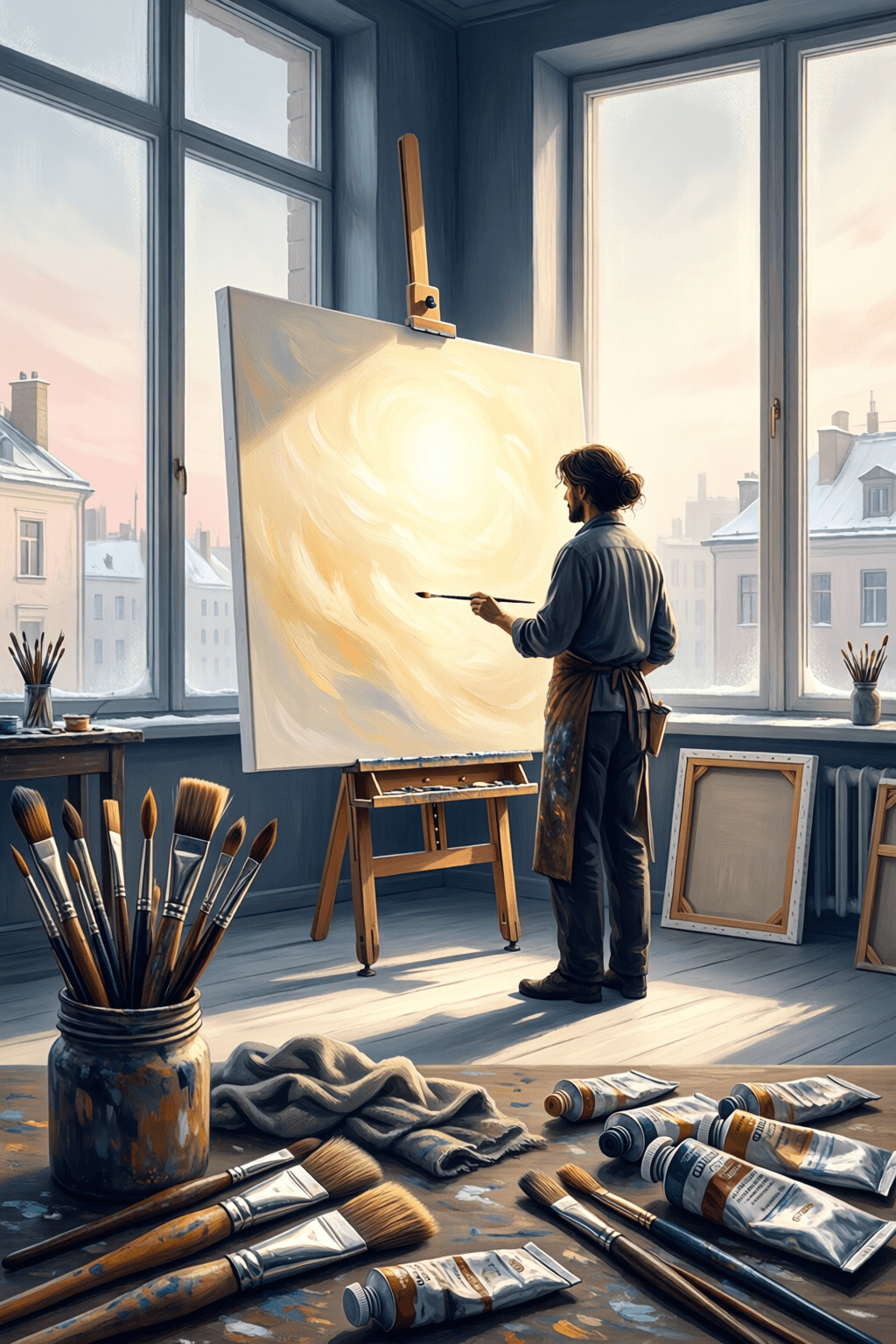
If I could say it in words there would be no reason to paint. — Edward Hopper
—What lingers after this line?
The Limits of Language
At its core, Edward Hopper’s remark suggests that some experiences resist verbal capture. If words were sufficient, painting would be unnecessary; art emerges precisely because feeling, atmosphere, and perception often exceed the reach of speech. In this sense, Hopper is not dismissing language but identifying its boundary. From there, painting becomes a response to what remains unsaid. A shadow across a room, the loneliness of a city window, or the tension in a figure’s posture may be understood instantly by the eye yet remain awkward in description. Hopper’s own canvases, such as Nighthawks (1942), demonstrate how silence itself can become a form of meaning.
Painting as Emotional Evidence
Moreover, Hopper’s statement implies that visual art does not merely illustrate ideas; it carries emotion in its own right. A painting can present mood directly, without passing through the filter of explanation. Color, composition, and light communicate states of mind that prose may only circle around. This helps explain why viewers often feel something before they know what they think. Mark Rothko likewise argued in interviews during the 1950s that his paintings were about basic human emotions rather than abstract theory. In that tradition, Hopper’s insight affirms painting as a language of felt experience rather than a decorative substitute for text.
Silence, Mystery, and Suggestion
Following this idea, Hopper’s quote also defends mystery. Words tend to define, classify, and conclude, whereas painting can leave meaning open, suspended, and alive. That openness allows the viewer to enter the work personally, bringing memory and emotion into the act of looking. For example, Johannes Vermeer’s interiors, such as Woman in Blue Reading a Letter (c. 1663–64), never fully explain their narratives, yet their emotional world feels palpable. Similarly, Hopper’s scenes often suggest stories without telling them outright. What cannot be pinned down in language becomes, through paint, more haunting and more memorable.
The Artist’s Need for Another Medium
At the same time, Hopper’s words reveal something about artistic necessity. Artists choose their medium not only out of preference but because certain truths seem native to that form. For Hopper, painting was not an optional embellishment to thought; it was the means by which thought itself became visible. This idea echoes Leonardo da Vinci’s reflections in his Treatise on Painting, where he describes painting as capable of presenting immediacy beyond verbal account. Hopper modernizes that claim: the painter works because perception, space, and mood can be discovered on canvas in ways that cannot be fully prewritten or paraphrased.
A Defense of Visual Thinking
Ultimately, the quote serves as a quiet defense of visual thinking. In a culture that often privileges argument and explanation, Hopper reminds us that understanding can also arise through looking. We do not always know first and then make art; sometimes we make art in order to know. Thus, painting becomes a form of inquiry rather than mere expression. By arranging light, architecture, and human presence, Hopper explored isolation, stillness, and modern life more powerfully than a direct statement might have done. His remark endures because it names a universal truth: some of the deepest meanings arrive not as sentences, but as images.
One-minute reflection
What does this quote ask you to notice today?
Related Quotes
2 selectedThe artist's job is not to succumb to despair, but to find the light in the cracks. Art is the act of bringing your internal world into the light for others to share. — Ai Weiwei
Ai Weiwei
At its core, Ai Weiwei’s statement defines art not as surrender, but as resistance. Despair may be an honest response to injustice, loss, or confusion; however, the artist’s task is to move beyond mere collapse and searc...
Read full interpretation →I found I could say things with color and shapes that I couldn't say any other way — things I had no words for. — Georgia O'Keeffe
Georgia O'Keeffe
At the outset, O’Keeffe’s line proposes that colors and shapes constitute a language with its own grammar—one that conveys nuance before sentences can. We routinely ‘read’ a room’s palette or a landscape’s contours; acco...
Read full interpretation →More From Author
More from Edward Hopper →