
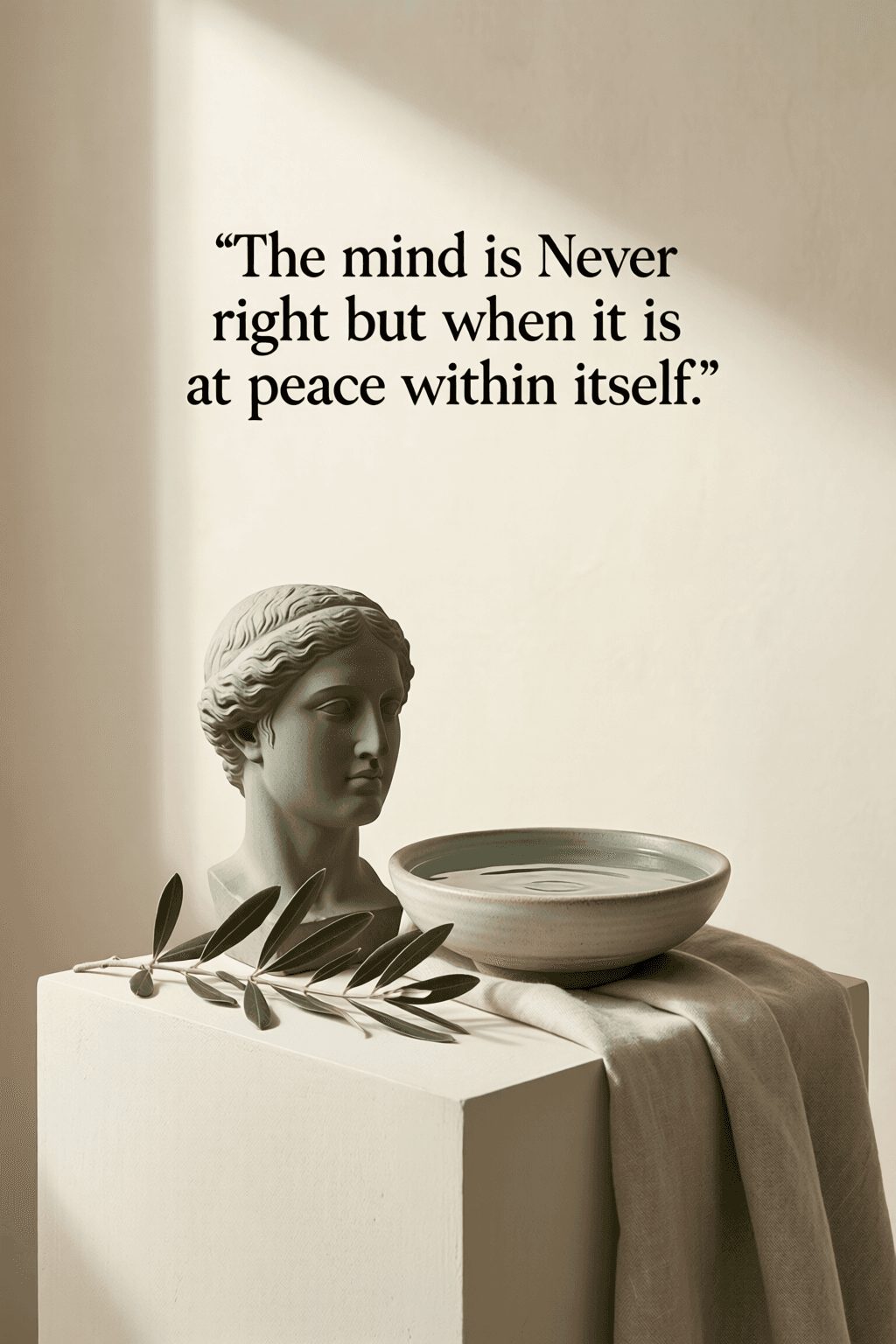
The mind is never right but when it is at peace within itself. — Seneca the Younger
—What lingers after this line?
Inner Calm as True Judgment
At first glance, Seneca the Younger ties correctness of mind not to cleverness or external success, but to inward tranquility. In this Stoic view, a mind is not truly ‘right’ when it merely wins arguments; rather, it is right when it is settled, ordered, and free from needless turmoil. Peace becomes a sign that one’s thoughts, values, and reactions are aligned. This idea reflects Seneca’s broader moral philosophy in works like Letters to Lucilius (c. AD 65), where he repeatedly argues that inner stability is the foundation of wisdom. Thus, the quote shifts our attention away from the noise of circumstance and toward the condition of the self that interprets it.
The Stoic Meaning of Peace
From there, it is important to see that Seneca’s peace is not passivity or emotional emptiness. Stoicism does not ask a person to feel nothing; instead, it teaches mastery over destructive passions that scatter attention and distort judgment. A peaceful mind remains capable of action, but it is no longer dragged about by fear, envy, or anger. In this way, peace within becomes a disciplined achievement rather than a lucky mood. Epictetus’s Enchiridion (c. AD 125) similarly insists that serenity comes from distinguishing what is under our control from what is not. Seneca’s line therefore points to an active inner order, one built through reflection and restraint.
Conflict Within Distorts Reality
Seen in contrast, an unpeaceful mind struggles to perceive things clearly. When resentment, panic, or vanity dominates, even ordinary events can feel like threats or insults. Seneca suggests that inner conflict bends reason itself, making the mind less reliable precisely when it believes it is defending truth. This observation remains strikingly modern. Psychologists studying stress and cognitive overload have shown that agitation narrows attention and encourages reactive thinking. In everyday life, a person who sends an angry message and regrets it an hour later offers a simple example: the facts may not have changed, yet the mind’s unrest produced faulty judgment. Seneca’s wisdom begins with that intimate recognition.
A Moral, Not Merely Mental, Condition
Moreover, Seneca implies that peace of mind is also an ethical state. One cannot easily be at peace while living dishonestly, pursuing excess, or depending entirely on public approval. A divided conscience breeds unrest, so inner calm requires a measure of integrity. The mind rests more securely when conduct and principle support one another. Here Seneca resembles Marcus Aurelius in Meditations (c. AD 180), where self-command and moral clarity are treated as conditions of serenity. Accordingly, peace within is not a retreat from responsibility; it is what becomes possible when a person lives in a way that gives the soul fewer reasons to quarrel with itself.
Why External Success Is Not Enough
Consequently, the quote also challenges common ideas of what it means to be well. Wealth, status, and recognition may create the appearance of a successful life, yet they do not guarantee a right mind. Seneca, who knew political power firsthand, understood that ambition often intensifies anxiety rather than resolving it. Without inner peace, achievement can become another form of captivity. This theme appears throughout Seneca’s On the Happy Life (c. AD 58), which argues that the good life depends on virtue more than fortune. His insight remains persuasive because many people discover, sometimes painfully, that outward gain cannot quiet inward disorder. The self must be reconciled before life feels sound.
A Practical Lesson for Modern Life
Finally, Seneca’s sentence speaks with unusual force to an age of constant stimulation. News alerts, social comparison, and perpetual urgency can leave the mind busy but not balanced. His remedy begins simply: pause, examine impressions, and refuse to let every disturbance become an inner command. Peace is cultivated through habits of attention. In practical terms, that may mean journaling, reflective solitude, or the Stoic exercise of testing whether a worry concerns something within one’s control. Seneca does not promise a life without difficulty; rather, he suggests that right-mindedness depends on the ability to remain inwardly composed amid difficulty. In that sense, peace is not the reward of wisdom but one of its clearest signs.
Recommended Reading
As an Amazon Associate, we earn from qualifying purchases.
One-minute reflection
What feeling does this quote bring up for you?
Related Quotes
6 selectedPeople think inner peace is about always being calm, when it's more about returning to calm. — Maxime Lagacé
Maxime Lagace
At first glance, inner peace is often imagined as a flawless stillness, as if a peaceful person never feels anger, fear, or confusion. Maxime Lagacé’s quote gently challenges that illusion by redefining peace as recovery...
Read full interpretation →Peace comes from within. Do not seek it without. — Buddha
Buddha
This quote emphasizes that true peace is a state of mind and heart, originating from within oneself. It encourages individuals to find tranquility by cultivating inner harmony rather than searching for it in external cir...
Read full interpretation →Do not let the behavior of others destroy your inner peace. — Dalai Lama
Dalai Lama
This quote emphasizes the importance of safeguarding one's inner peace regardless of external circumstances or the actions of others. It suggests that maintaining personal tranquility is a personal responsibility.
Read full interpretation →If it costs my peace, it's outside my boundary. — Adam J. Jackson
Adam J. Jackson
At its core, Adam J. Jackson’s line reframes boundaries as more than rules we impose on others; they become protections for our inner life.
Read full interpretation →Like water which can clearly mirror the sky and the trees only so long as its surface is undisturbed, the mind can only reflect the true image of the Self when it is tranquil and wholly relaxed. — Indra Devi
Indra Devi
Indra Devi begins with a simple natural image: calm water reflects the sky and trees only when its surface is still. In the same way, she suggests that the mind reveals truth not through strain or agitation, but through...
Read full interpretation →Sometimes, protecting your peace is the better choice. — Marcus Aurelius
Marcus Aurelius
At first glance, the saying frames peace not as passivity but as discipline. To protect one’s peace is to recognize that not every conflict deserves entry into the mind.
Read full interpretation →More From Author
More from Seneca the Younger →