
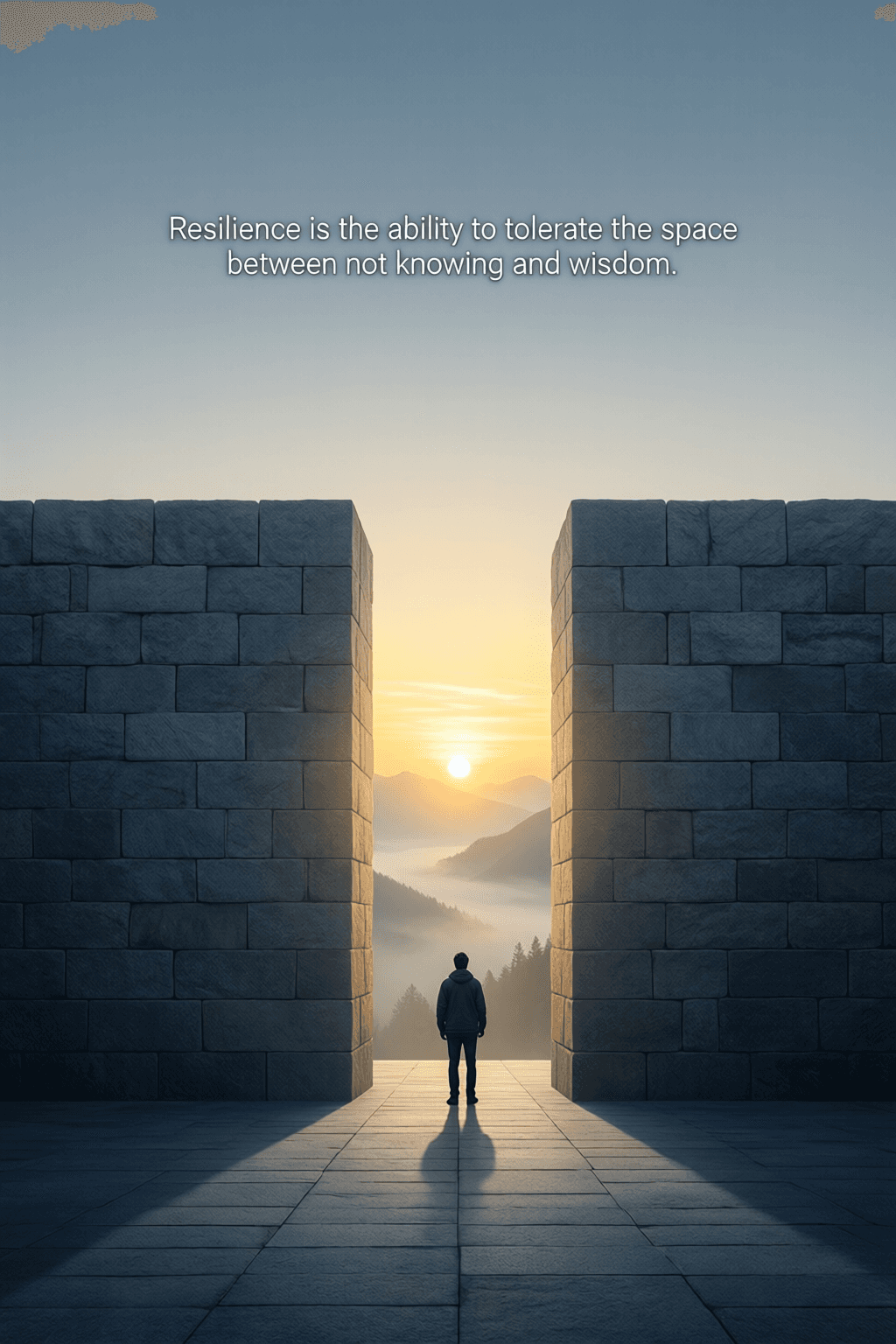
Resilience is the ability to tolerate the space between not knowing and wisdom. — Henkan
—What lingers after this line?
Enduring the Unfinished Moment
At its core, Henkan’s quote defines resilience not as hardness, but as endurance within ambiguity. The phrase “the space between not knowing and wisdom” suggests a difficult middle ground where answers have not yet arrived, yet life still demands movement. In that suspended interval, resilience becomes the quiet strength to remain present without collapsing into panic or false certainty. This idea matters because most growth does not happen at the moment of clarity, but before it. We often imagine wisdom as a finished state; however, Henkan shifts attention to the waiting itself. In doing so, the quote honors the emotional labor of surviving confusion long enough for understanding to form.
Why Uncertainty Tests Human Strength
From there, the quote also speaks to a universal psychological struggle: human beings naturally resist uncertainty. Research in psychology on ambiguity tolerance, such as the work of Else Frenkel-Brunswik in the mid-20th century, shows that unresolved situations often provoke anxiety because they deny us control. Resilience, then, is not the absence of discomfort, but the ability to bear that discomfort without surrendering judgment or hope. In everyday life, this can look deceptively ordinary—a parent waiting for medical results, a student unsure about the future, or a leader making decisions with incomplete information. In each case, strength lies less in knowing and more in continuing responsibly despite not knowing.
Wisdom as a Process, Not a Possession
Moreover, Henkan’s wording implies that wisdom is something one reaches through experience rather than something instantly owned. This perspective echoes philosophical traditions that value uncertainty as a teacher. Socrates in Plato’s Apology (c. 399 BC) famously grounded wisdom in recognizing the limits of one’s knowledge, suggesting that insight begins when certainty loosens its grip. Seen this way, resilience becomes the bridge between ignorance and understanding. One does not leap directly into wisdom; instead, one passes through doubt, error, revision, and patience. The quote therefore reframes confusion not as failure, but as a necessary stage in becoming more discerning.
The Emotional Discipline of Patience
As this process unfolds, resilience also requires emotional discipline. To tolerate the space Henkan describes is to resist impulsive reactions—the urge to force answers, numb fear, or pretend to know what is still unclear. Viktor Frankl’s Man’s Search for Meaning (1946) reflects a related insight: even in extreme uncertainty, meaning can be preserved through one’s stance toward suffering. That does not make patience passive. On the contrary, it is an active form of steadiness. A person who remains thoughtful in confusion is not doing nothing; they are practicing restraint, observation, and trust that deeper understanding may emerge in time.
Resilience in Stories of Recovery and Change
This becomes especially vivid in narratives of recovery, grief, and transformation. Consider memoirs such as Joan Didion’s The Year of Magical Thinking (2005), which captures the disorienting period after sudden loss. Didion does not present wisdom as immediate consolation; instead, she reveals how endurance through bewilderment slowly reshapes perception. Her account illustrates Henkan’s idea that resilience lives in the interval before meaning is fully restored. Likewise, people rebuilding after failure often describe a long season where lessons are incomplete and identity feels unstable. Yet, by staying with that instability rather than fleeing it, they develop the depth later called wisdom. The quote thus names a pattern many lives quietly confirm.
A Practical Philosophy for Everyday Life
Finally, Henkan offers more than a poetic observation; he offers a practical philosophy. In a culture that rewards quick answers and confident performances, the quote reminds us that maturity often appears as tolerance for incompleteness. Resilient people are not always the most certain in the room. Often, they are the ones most able to pause, learn, and continue without premature conclusions. That is why the statement feels both gentle and demanding. It asks us to honor the gap between question and insight instead of fearing it. In that gap, resilience becomes not merely survival, but the very condition through which wisdom is earned.
One-minute reflection
What feeling does this quote bring up for you?
Related Quotes
6 selectedJust because your light flickers does not mean it is about to go out. — Yohancé Salimu
Yohancé Salimu
At first glance, Yohancé Salimu’s line separates appearance from reality. A flicker suggests instability, fatigue, or interruption, yet it does not automatically signal extinction.
Read full interpretation →When something in your life dies—whether it be a job, a hobby, or a dream—I encourage you not to focus on what could have been but instead to look for the new life and the new opportunities that result. — Ryan Hall
Ryan Hall
Ryan Hall frames loss as a kind of death, and that metaphor immediately broadens the quote beyond grief in the literal sense. A job can end, a cherished hobby can fade, and a long-held dream can collapse; yet in each cas...
Read full interpretation →Dreams are made of sturdy stuff. — William Carlos Williams
William Carlos Williams
At first glance, William Carlos Williams’s line reverses a familiar assumption: dreams are often treated as airy, fleeting, and insubstantial, yet he insists they are made of “sturdy stuff.” In that compact phrase, he gi...
Read full interpretation →Confidence is not absence of fear; it is the quiet recognition that you have survived every hard day so far. — Michelle Obama
Michelle Obama
At first glance, confidence is often mistaken for boldness without hesitation, yet Michelle Obama’s words gently overturn that myth. She frames confidence not as the absence of fear, but as a steadier inner knowledge: yo...
Read full interpretation →The art of life is more like the wrestler's art than the dancer's; stand ready and firm to meet sudden and unexpected onsets. — Marcus Aurelius
Marcus Aurelius
Marcus Aurelius contrasts two arts to clarify what living well demands. A dancer suggests elegance, rhythm, and practiced beauty; a wrestler, by contrast, suggests balance under pressure, resistance, and constant readine...
Read full interpretation →Everything is a season, and this is just a chapter, not your whole story. — Glennon Doyle
Glennon Doyle
At its core, Glennon Doyle’s quote reframes hardship and change by comparing life to the natural cycle of seasons. Just as winter does not cancel spring, a painful or uncertain period does not define a person forever.
Read full interpretation →More From Author
More from Henkan →