
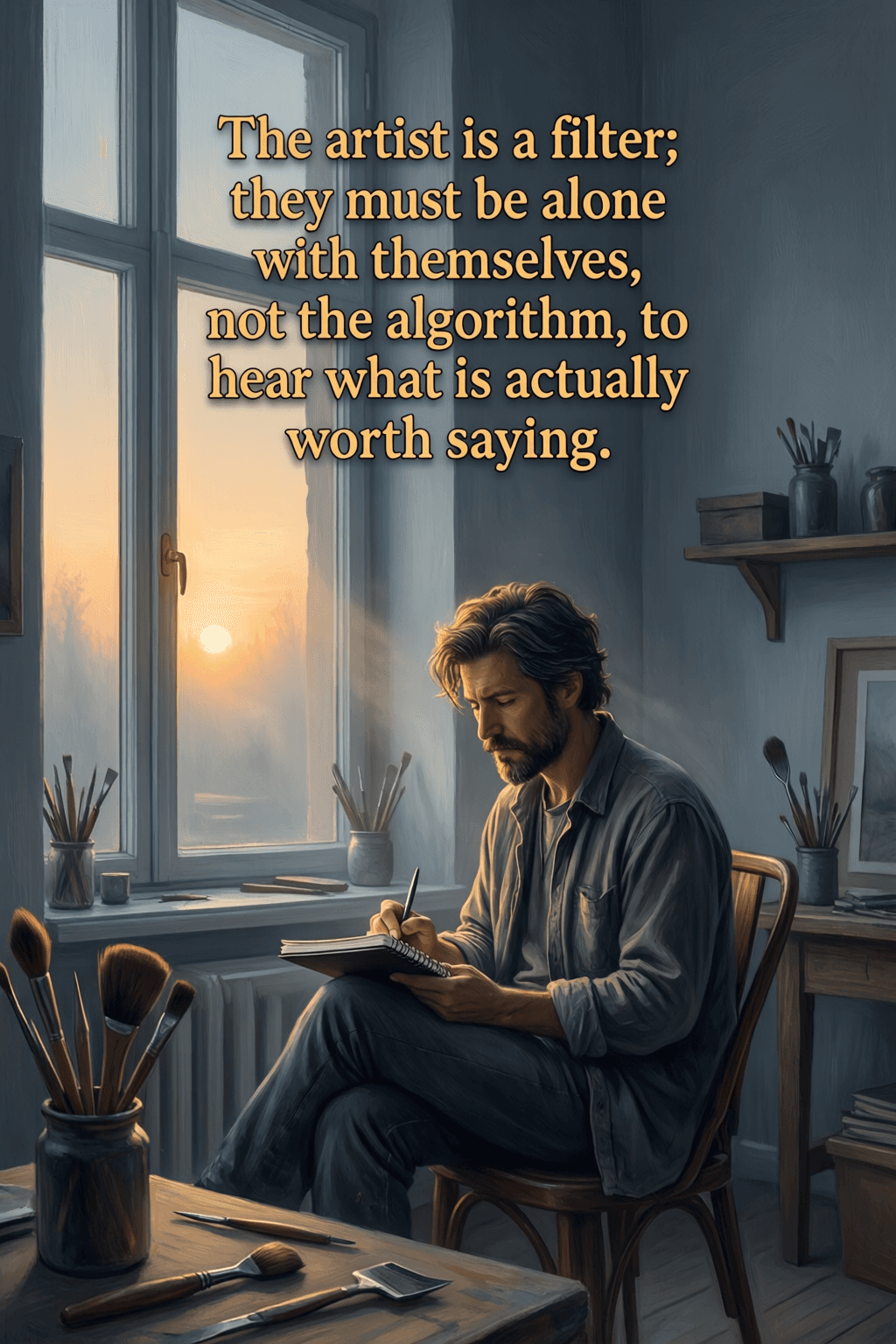
The artist is a filter; they must be alone with themselves, not the algorithm, to hear what is actually worth saying. — Twyla Tharp
—What lingers after this line?
Solitude as the Source of Voice
Twyla Tharp’s remark begins with a striking image: the artist as a filter rather than a loudspeaker. In that view, creative work does not emerge from sheer output but from a disciplined inward process that separates noise from meaning. To hear what is worth saying, the artist must first step away from the flood of external prompts and sit long enough with private thought for an authentic voice to rise. This emphasis on solitude is not anti-social; rather, it is protective. By creating distance from constant digital feedback, the artist preserves the fragile stage in which intuition forms before it is shaped by approval, trends, or imitation. Thus Tharp suggests that originality begins not in performance, but in listening.
The Algorithm as a Competing Influence
From there, the quote sharpens into a warning about the algorithm. Algorithms are designed to reward attention, predict preference, and amplify what already works, but art often begins precisely where predictability ends. If creators rely too heavily on systems that privilege repetition and immediate reaction, they may start producing what is optimized rather than what is necessary. In this sense, the algorithm becomes more than a tool; it can quietly become a collaborator with very different goals. Whereas the artist seeks truth, surprise, or emotional precision, the platform seeks engagement. That tension explains Tharp’s insistence on separation: unless artists periodically leave the machine’s logic behind, they risk mistaking popularity for insight.
Filtering Experience Into Meaning
Moreover, calling the artist a filter implies an act of transformation. Raw experience alone is not yet art; it must pass through memory, judgment, feeling, and form. Virginia Woolf’s A Room of One’s Own (1929) similarly argues that creative independence requires both literal and mental space, because only then can experience be shaped into something distinct rather than merely absorbed from the surrounding world. Seen this way, solitude is where the filtering happens. The artist sifts through impressions, discards the derivative, and keeps the resonant. What remains is not simply content but perspective—a way of seeing that belongs to no feed. Tharp’s point, therefore, is that meaningful art depends on this interior refining process.
The Cost of Constant Feedback
However, constant connection can interrupt that refinement. When every sketch, sentence, or melody is immediately exposed to metrics, the creator may begin editing too early, anticipating response before discovering intention. Psychologist Teresa Amabile’s research on creativity, including The Social Psychology of Creativity (1983), found that excessive focus on external rewards can diminish intrinsic motivation, which is often central to original work. As a result, artists may unconsciously flatten risk, choosing what is legible over what is true. The problem is not feedback itself but its timing and dominance. Tharp’s insight reminds us that some ideas need privacy before they can withstand public life, and some truths only appear when no audience is present.
Artistic Practice as an Inner Discipline
Finally, the quote points toward a larger ethic of practice. To be alone with oneself is not merely to withdraw; it is to cultivate the habits that let genuine expression emerge—attention, patience, and tolerance for uncertainty. Tharp’s own body of work, from Push Comes to Shove (1976) to her reflections in The Creative Habit (2003), reflects a belief that creativity is sustained by ritual and rigor, not by passively absorbing whatever the culture serves up. Therefore, her statement is both practical and philosophical. It asks artists to guard the inner room where ideas become clear, so that when they do return to the public sphere, they bring more than reaction. They bring something filtered, tested, and unmistakably their own.
One-minute reflection
Why might this line matter today, not tomorrow?
Related Quotes
6 selectedDreams have only one owner at a time. That’s why dreamers are lonely. — Erma Bombeck
Erma Bombeck
This quote highlights that personal dreams and aspirations are unique to each individual, belonging solely to the dreamer.
Read full interpretation →When you are in the middle of a creative block, remember that the work is not the point; the point is the practice of showing up. — Twyla Tharp
Twyla Tharp
Twyla Tharp’s quote shifts attention away from the finished product and toward the habit that makes creation possible in the first place. In the middle of a creative block, it is easy to believe that nothing matters unle...
Read full interpretation →Write a sentence that shocks your silence into belief. — Toni Morrison
Toni Morrison
Toni Morrison’s line is both instruction and provocation: write not merely to express, but to awaken. “Silence” here is the mute precinct of fear, habit, and erasure; “belief” is not doctrine but the felt recognition tha...
Read full interpretation →Sing yourself into being; let each line you speak make you more real. — Sappho
Sappho
Sappho’s imperative suggests that identity is not a static possession but a practice, continuously shaped by utterance. In Greek, poiesis means making; a poet (poiētēs) is literally a maker (Aristotle, Poetics).
Read full interpretation →It is through the process of creating that we discover who we are, not by waiting for a finished masterpiece to tell us. — Twyla Tharp
Twyla Tharp
Twyla Tharp’s insight begins with a reversal of a common assumption: we often imagine that identity arrives fully formed and then expresses itself through art, work, or achievement. Instead, she argues that we come to kn...
Read full interpretation →Sing in the key of effort until the world learns your melody. — Langston Hughes
Langston Hughes
To begin, the line urges perseverance as a musician’s fundamental key, suggesting that sustained effort is not background noise but the melody itself. Singing in that key means choosing practice over applause, process ov...
Read full interpretation →More From Author
More from Twyla Tharp →When you are in the middle of a creative block, remember that the work is not the point; the point is the practice of showing up. — Twyla Tharp
Twyla Tharp’s quote shifts attention away from the finished product and toward the habit that makes creation possible in the first place. In the middle of a creative block, it is easy to believe that nothing matters unle...
Read full interpretation →It is through the process of creating that we discover who we are, not by waiting for a finished masterpiece to tell us. — Twyla Tharp
Twyla Tharp’s insight begins with a reversal of a common assumption: we often imagine that identity arrives fully formed and then expresses itself through art, work, or achievement. Instead, she argues that we come to kn...
Read full interpretation →Creativity is a habit, and the best creativity is the result of good work habits. — Twyla Tharp
At first glance, Twyla Tharp’s quote challenges the popular myth that creativity arrives as a sudden flash of genius. Instead, she reframes it as something built through repetition, structure, and deliberate effort.
Read full interpretation →True mastery begins when you stop waiting for the feeling of inspiration and start relying on the engine of your own commitment. — Twyla Tharp
Twyla Tharp’s statement reframes mastery as a choice rather than a mood. At first glance, inspiration seems like the natural beginning of great work, yet Tharp argues that real progress starts later—when a person stops w...
Read full interpretation →