
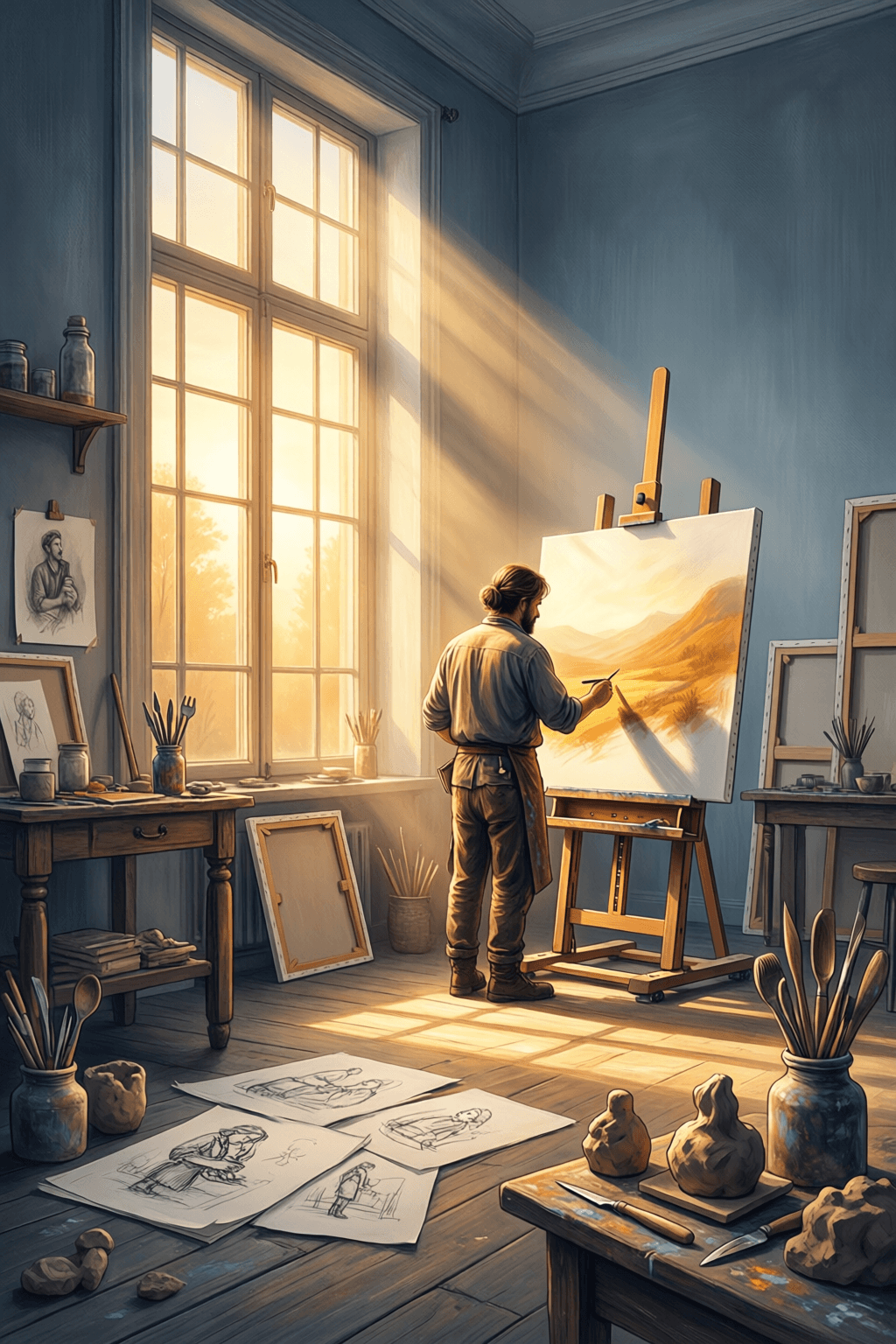
The desire to create is one of the deepest yearnings of the human soul. — Dieter F. Uchtdorf
—What lingers after this line?
Creation as a Fundamental Human Impulse
At its core, Dieter F. Uchtdorf’s statement presents creativity not as a luxury but as a profound human longing. To create is to reach beyond mere survival and participate in shaping the world, whether through art, ideas, relationships, or acts of service. In this sense, the urge to make something new becomes part of what gives life texture, meaning, and direction. From the beginning of civilization, this impulse has appeared wherever people have lived. Prehistoric cave paintings in Lascaux (c. 17,000 years ago) suggest that even early humans felt compelled to leave images behind, not simply for utility but for expression. Thus, Uchtdorf’s quote speaks to a desire woven deeply into human identity itself.
Why Creativity Feels So Personal
Because creation involves bringing something inward into outward form, it often feels intensely personal. A poem, a garden, a business, or even a carefully raised child carries the mark of its maker. For that reason, the desire to create is also a desire to be known—to say, in effect, “I was here, and this is what I saw or loved.” Moreover, psychology supports this connection between creativity and selfhood. Abraham Maslow’s later writings on self-actualization, including Toward a Psychology of Being (1962), describe human fulfillment as closely tied to expression, purpose, and growth. Seen this way, Uchtdorf’s observation captures why suppressed creativity can feel less like boredom and more like a quiet spiritual ache.
Creation as Meaning-Making
Building on that idea, creativity does more than produce objects; it helps people interpret experience. When individuals write music after grief, paint during upheaval, or design solutions in times of crisis, they are not just making things—they are making sense of life. Creation becomes a bridge between confusion and clarity. Literature repeatedly reflects this pattern. Viktor Frankl’s Man’s Search for Meaning (1946) argues that human beings can endure immense suffering when they find purpose within it. Although Frankl focused broadly on meaning rather than art alone, his insight aligns with Uchtdorf’s thought: the creative act often becomes one of the clearest ways people transform pain, hope, memory, and belief into something enduring.
The Spiritual Dimension of Making
Uchtdorf’s wording, especially his reference to the “human soul,” points beyond productivity into the spiritual realm. Here, creation is not merely efficient output; it is an echo of transcendence. Many religious traditions connect human dignity with the capacity to imagine, shape, and bring forth. In Genesis 1, for example, humanity is portrayed as made in the image of a Creator, suggesting that making and forming are sacred inheritances as well as practical talents. Consequently, creative work can feel holy even in ordinary settings. A person repairing a table, composing a hymn, or preparing a meal with care may experience the quiet satisfaction of participating in something larger than the self. The quote therefore honors creation as both an inner hunger and a spiritual calling.
Obstacles That Silence the Creative Urge
Yet if the desire to create runs so deep, it is striking how often it is buried. Fear of failure, social comparison, economic pressure, and the modern obsession with measurable success can all make creativity seem indulgent or risky. Over time, many people stop creating not because the longing disappears, but because they learn to distrust it. This tension appears in contemporary discussions of vulnerability. Brené Brown’s The Gifts of Imperfection (2010) notes that shame is one of the most powerful forces inhibiting expression and innovation. In that light, Uchtdorf’s quote also carries a quiet challenge: to honor the soul’s yearning, one must often resist the voices that reduce creativity to performance or profit alone.
Living Creatively in Everyday Life
Finally, the quote invites a broader definition of creation. Not everyone will write a symphony or paint a masterpiece, but everyone can create something—a tradition, a solution, a kindness, a home, a new way of thinking. Creativity belongs as much to the teacher designing a lesson or the parent inventing a bedtime ritual as to the sculptor in a studio. Therefore, Uchtdorf’s insight is ultimately hopeful. It reminds us that the creative life is not reserved for a gifted few; it is a deeply human mode of being. When people answer that inner yearning, even in small ways, they do more than produce results—they become more fully alive.
One-minute reflection
What does this quote ask you to notice today?
Related Quotes
6 selectedIn order to be open to creativity, one must have the capacity for constructive use of solitude. One must overcome the fear of being alone. — Rollo May
Rollo May
Rollo May’s insight begins with a quiet but demanding premise: creativity requires the ability to stand apart from constant noise, approval, and distraction. To be open to new ideas, a person must first become comfortabl...
Read full interpretation →The moment a man begins to talk about technique, that's proof that he is fresh out of ideas. — Dylan Thomas
Dylan Thomas
Dylan Thomas’s remark begins with a sharp suspicion: when an artist talks too much about technique, the living impulse behind the work may already be gone. Technique, in this sense, becomes a substitute language, a way o...
Read full interpretation →Imperfection inspires invention, imagination, and creativity. — Mary Sharratt
Mary Sharratt
Mary Sharratt’s insight begins with a reversal of ordinary expectations: imperfection is not merely something to fix, but something that awakens possibility. When a plan fails, a surface cracks, or an idea refuses to fit...
Read full interpretation →Don't think. Thinking is the enemy of creativity. It's self-conscious, and anything self-conscious is lousy. — Ray Bradbury
Ray Bradbury
At first glance, Ray Bradbury’s line sounds almost rebellious: “Don’t think. Thinking is the enemy of creativity.” Yet his target is not intelligence itself, but the paralyzing kind of self-awareness that makes an artist...
Read full interpretation →You can be cautious or you can be creative, but there's no such thing as a cautious creative. — George Lois
George Lois
George Lois draws a sharp line between two mindsets: caution protects what already exists, while creativity risks making something new. At first glance, the statement sounds absolute, yet that severity is exactly its poi...
Read full interpretation →Almost always, the creative dedicated minority has made the world better. — Martin Luther King, Jr.
Martin Luther King Jr.
Martin Luther King, Jr. distills a sweeping historical truth into a single sentence: progress is often driven not by the passive majority but by a small, committed group willing to imagine a better order.
Read full interpretation →More From Author
More from Dieter F. Uchtdorf →