
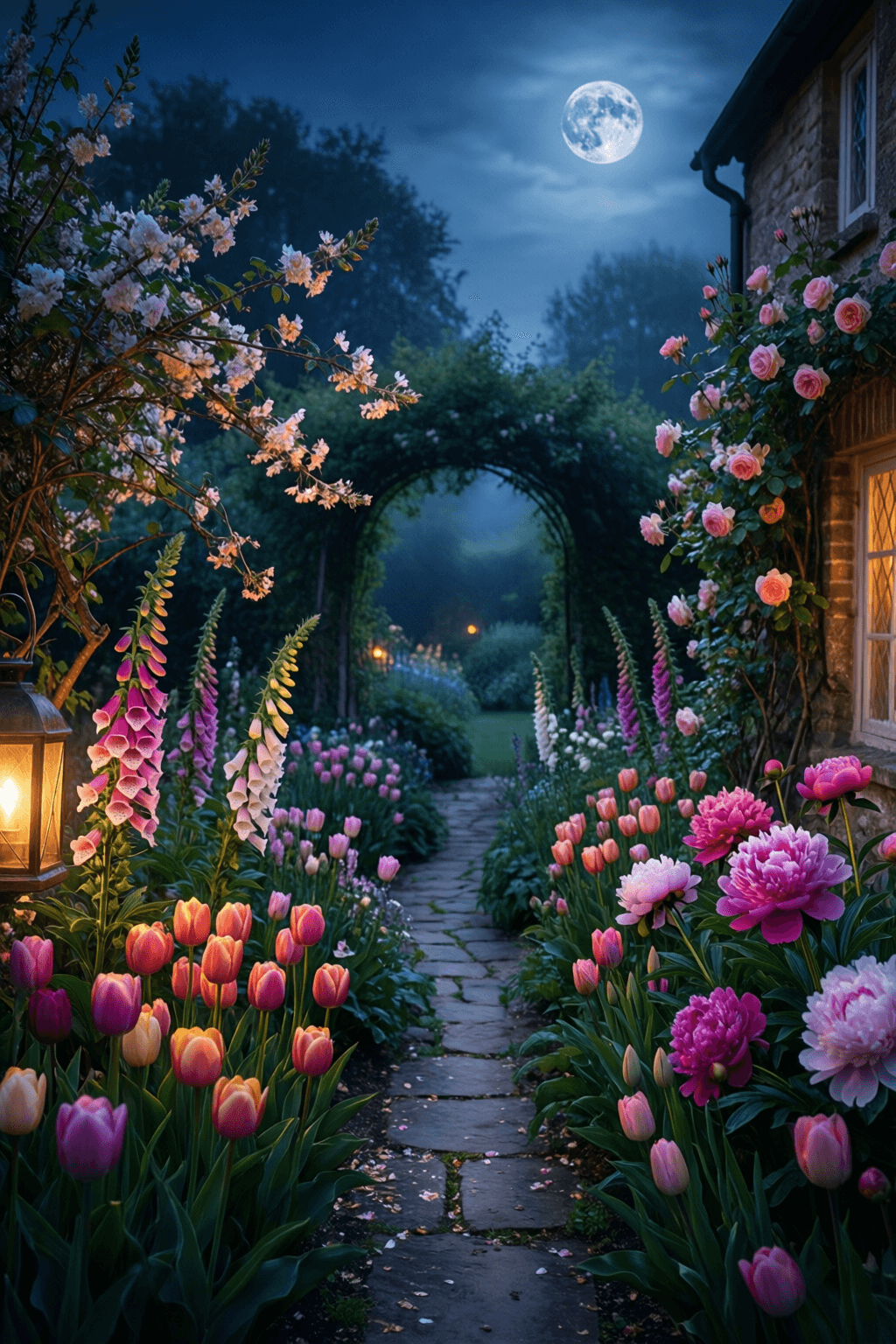
Everything is blooming most recklessly; if it were voices instead of colors, there would be an unbelievable shrieking into the heart of the night. — Rainer Maria Rilke
—What lingers after this line?
A World Overflowing With Life
At first glance, Rilke turns a peaceful image of blooming nature into something almost overwhelming. Flowers do not merely open; they burst forth “most recklessly,” suggesting a vitality so abundant that it exceeds calm beauty. In this way, spring becomes less a gentle season than a force of eruption, as if life itself can no longer remain contained. From there, the quotation invites us to feel nature not as decoration but as an event. Rilke, whose letters and poems often treat the natural world as spiritually charged, presents blossoming as an excess of existence. The scene is lovely, yet it also carries pressure, urgency, and a kind of ecstatic disorder.
When Color Becomes Imagined Sound
What makes the image unforgettable, however, is Rilke’s sudden shift from sight to sound. He imagines that if blossoms had voices rather than colors, the night would be filled with “unbelievable shrieking.” This startling comparison transforms visual beauty into an almost unbearable cry, suggesting that what appears serene may actually contain immense intensity. As a result, the reader experiences a kind of synesthesia, where one sense spills into another. Rilke uses this crossing of perception to deepen the emotional effect: colors are no longer passive surfaces but compressed expressions of feeling. Their silence, therefore, may hide a force too powerful for ordinary hearing.
Beauty at the Edge of Violence
Yet the word “shrieking” changes the mood entirely, because it introduces distress, excess, and even danger into the scene. Rather than describing blossoms as singing harmoniously, Rilke gives them a sound associated with pain or frenzy. This choice suggests that natural beauty is not always soft; sometimes it arrives with a violence of presence that unsettles the observer. In this respect, the line recalls the Romantic and post-Romantic tradition in which sublime beauty overwhelms rather than comforts. One might think of Vincent van Gogh’s letters (1888), where fields and cypresses seem almost electrically alive. Similarly, Rilke’s blooming world is so intense that it presses against the limits of what the heart can bear.
The Heart as the True Listener
Importantly, the imagined shrieking is directed not merely into the air but “into the heart of the night.” This phrase creates a double depth: the night has a heart, and so does the reader. Consequently, the scene becomes inward as well as outward, suggesting that nature’s excess speaks most directly to the emotional core of human experience. Rilke often wrote as though the external world awakens hidden chambers within the self, as seen in poems from the New Poems period (1907–1908). Here too, blooming is not just botanical fact; it is an inner event. The flowers seem to articulate emotions too large, raw, or mysterious to be spoken plainly by human beings.
Silence as a Form of Intensity
And yet, precisely because the blossoms do not literally shriek, their silence becomes meaningful. Rilke implies that color itself is a mute language, one capable of carrying passion without noise. The restraint of nature’s actual silence may be what allows its force to penetrate so deeply: what is unsaid can be more powerful than what is shouted. This idea connects closely to Rilke’s broader poetic sensibility, especially in Letters to a Young Poet (1903–1908), where he repeatedly values inwardness over easy expression. Thus the blooms remain quiet, but their quietness is dense with feeling. They do not need voices; their colors already contain a cry.
Rilke’s Vision of Ecstatic Existence
Ultimately, the quotation captures one of Rilke’s central insights: life is magnificent precisely because it is excessive, fleeting, and difficult to endure. Blooming is beautiful, but it is also reckless, as though every flower were spending itself completely in a brief blaze of being. The imagined shrieking simply reveals the emotional truth hidden inside that spectacle. Therefore, the line leaves us with more than an observation about spring. It becomes a meditation on existence itself, where beauty and anguish are inseparable. In Rilke’s hands, the natural world does not merely please the senses; it announces, with silent intensity, how overwhelming it is to be alive.
One-minute reflection
Where does this idea show up in your life right now?
Related Quotes
6 selectedEvery falling leaf is a whisper of nature.
Unknown
This quote suggests that nature communicates subtly and quietly. The falling of a leaf is portrayed as a gentle whisper, indicating that even the smallest events in nature have meaning and significance.
Read full interpretation →There is nothing pleasanter than spading when the ground is soft and damp. — John Steinbeck
John Steinbeck
At first glance, Steinbeck’s line seems almost modest, yet its pleasure is precise and deeply felt. Spading soft, damp ground turns labor into something nearly sensual: the tool enters easily, the earth yields without re...
Read full interpretation →Nature is not only all that is visible to the eye, it also includes the inner pictures of the soul. — Edvard Munch
Edvard Munch
At first glance, Munch’s statement expands the ordinary idea of nature beyond forests, skies, and seas. He argues that nature is not limited to what the eye can measure; it also includes the emotional and imaginative ima...
Read full interpretation →The glory of gardening: hands in the dirt, head in the sun, heart with nature. — Alfred Austin
Alfred Austin
Alfred Austin’s line condenses the appeal of gardening into one vivid scene: the body grounded in soil, the mind lifted by sunlight, and the emotions attuned to the natural world. At once physical and poetic, the quote s...
Read full interpretation →It is not the language of painters but the language of nature which one should listen to. — Pablo Picasso
Pablo Picasso
At first glance, Picasso’s remark challenges the authority of artistic convention. By contrasting ‘the language of painters’ with ‘the language of nature,’ he suggests that art should not merely imitate established techn...
Read full interpretation →Great art picks up where nature ends. — Marc Chagall
Marc Chagall
At its core, Marc Chagall’s remark suggests that art does not compete with nature but continues its unfinished conversation. Nature gives us raw forms—color, light, movement, emotion—while art reshapes them into meaning.
Read full interpretation →More From Author
More from Rainer Maria Rilke →To love is not about merging. It is a noble calling for the individual to ripen, to differentiate, to become a world in oneself in response to another. — Rainer Maria Rilke
At first glance, Rilke challenges one of romance’s most familiar ideals: the desire to ‘become one.’ Instead, he argues that genuine love is not a collapse of boundaries but a deepened encounter between two distinct peop...
Read full interpretation →And now let us believe in a long year that is given to us, new, untouched, full of things that have never been. — Rainer Maria Rilke
Rilke opens by shifting the tone from planning to believing: the year is “given to us,” implying something received rather than conquered. This framing matters because it replaces the pressure of achievement with the hum...
Read full interpretation →The purpose of life is to be defeated by greater and greater things. — Rainer Maria Rilke
Rainer Maria Rilke’s line treats “defeat” not as failure to avoid, but as a destination worth moving toward. The purpose of life, in this view, is measured by what can humble us—truths, beauties, responsibilities, or ide...
Read full interpretation →Dance with difficulty until it yields a new rhythm of strength. — Rainer Maria Rilke
Rilke’s line reframes difficulty from something to defeat into something to move with. To “dance” implies contact, attention, and responsiveness—an active relationship rather than a battle of will.
Read full interpretation →