
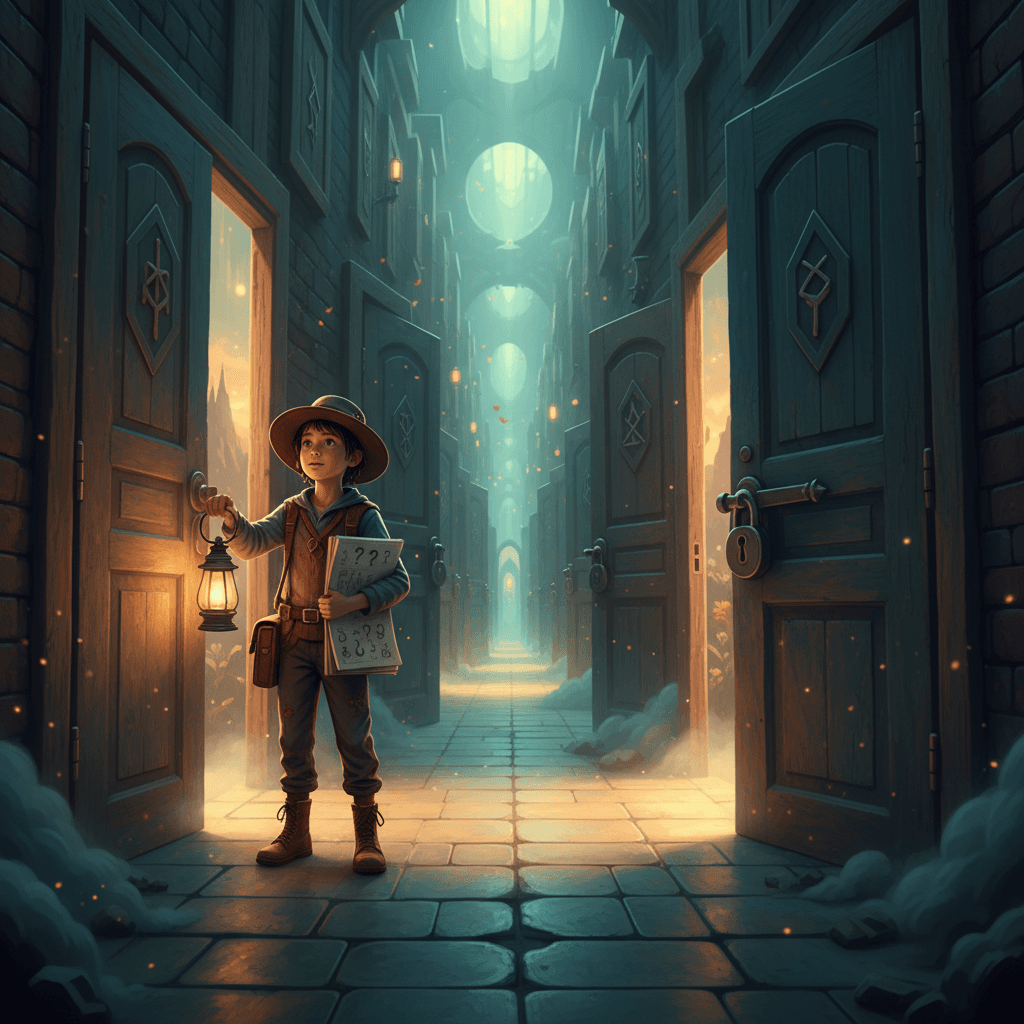
Stay curious like a child; questions open doors that answers try to lock — Rainer Maria Rilke
—What lingers after this line?
A Call to Live in Question Marks
Rilke’s line urges a posture toward life that favors inquiry over conclusion. To “stay curious like a child” is not to be naïve, but to remain receptive—willing to admit what you don’t know and to approach the familiar as if it could still surprise you. From there, the contrast becomes sharper: questions “open doors,” while answers can “lock” them. In other words, curiosity expands possibility, whereas premature certainty can shrink it, turning living problems into settled doctrines and freezing growth where exploration should continue.
Why Childhood Wonder Matters
Children ask in a way adults often forget: repeatedly, honestly, and without embarrassment. A child’s “why?” doesn’t merely seek information; it tests how the world hangs together, and it keeps the mind moving rather than arriving. This matters because adulthood often trains us to value competence—having the answer—over discovery. Yet the childlike stance Rilke praises can become a disciplined practice: noticing details, tolerating ambiguity, and allowing curiosity to lead before judgment steps in.
When Answers Become Locks
Rilke doesn’t condemn answers outright; he warns about answers that pretend to be final. The “lock” is the moment we treat an explanation as the end of thought: labeling someone as “just lazy,” a culture as “always that way,” or a personal failure as “who I am.” Once locked, a question stops generating new angles, and the mind stops revising. This is how stereotypes, dogmas, and even self-defeating narratives gain power: they feel like knowledge, but they function like closures that prevent more truthful understanding from unfolding.
Questions as a Spiritual and Artistic Practice
The quote echoes Rilke’s broader sensibility about living patiently with uncertainty. In Letters to a Young Poet (1903), he advises, “live the questions now,” suggesting that meaning ripens over time rather than being forced into quick conclusions. Seen this way, questioning is not only intellectual—it’s existential. Artists, writers, and seekers often work by staying open long enough for deeper patterns to emerge. Instead of demanding immediate clarity, they inhabit the unknown until it begins to speak in more nuanced forms.
Curiosity, Learning, and the Growth Mindset
Modern psychology helps explain why Rilke’s metaphor feels so accurate. A question-oriented stance aligns with what Carol Dweck calls a “growth mindset” (Mindset, 2006): the belief that abilities can develop invites experimentation, feedback, and persistence. By contrast, certainty can mimic a “fixed mindset,” where labels and conclusions shut down effort: “I’m not a math person,” “I’m bad at relationships,” “That’s not for people like me.” The difference isn’t merely motivational; it shapes what we notice, attempt, and ultimately become.
Keeping Doors Open in Daily Life
In practice, Rilke’s advice can be as simple as replacing verdicts with investigations. When conflict arises, “Who’s right?” locks quickly, while “What’s each person protecting?” opens space. In learning, “What’s the correct method?” can narrow too soon, while “What happens if I try three approaches?” keeps the room well-lit. The deeper transition is internal: letting curiosity lead before ego defends. When we treat questions as invitations rather than threats, answers stop being cages and become temporary tools—useful, revisable, and always secondary to the living openness that made them possible.
One-minute reflection
What feeling does this quote bring up for you?
Related Quotes
6 selectedLet curiosity be your compass; wonder opens doors to new effort. — Kōbō Abe
Kōbō Abe
Kōbō Abe frames curiosity as a “compass,” suggesting not a fixed destination but a reliable way to keep moving. A compass doesn’t provide certainty about the terrain; it provides orientation amid ambiguity.
Read full interpretation →Let curiosity break the lock of your habits. — Rumi
Rumi
Rumi’s line, “Let curiosity break the lock of your habits,” invites us to see our routines not merely as comforting patterns, but as potential prisons. While daily habits can steady us, the poet hints that they may also...
Read full interpretation →Turn every question into a step forward; curiosity is the first motion of progress. — Rumi
Rumi
Rumi’s line, “Turn every question into a step forward,” reframes questioning from a sign of doubt into an engine of movement. Instead of treating questions as obstacles or sources of anxiety, he urges us to translate the...
Read full interpretation →Nurture your curiosity; it paves the way to innovation. — Albert Schweitzer
Albert Schweitzer
This quote highlights that curiosity is essential for personal and intellectual growth. By actively seeking knowledge and exploring new ideas, individuals can develop innovative solutions and expand their understanding.
Read full interpretation →Don't be intimidated by what you don't know. That can be your greatest strength. — Sara Blakely
Sara Blakely
At first glance, Sara Blakely’s quote sounds like a simple encouragement, yet it points to a deeper truth: ignorance is not always a weakness. When people are not trapped by assumptions about how things are “supposed” to...
Read full interpretation →Be a loner. That gives you time to wonder, to search for the truth. Have holy curiosity. Make your life worth living. — Albert Einstein
Albert Einstein
At first glance, Einstein’s advice to “be a loner” may sound like a rejection of society, yet his deeper point is about protecting the inner space where thought can mature. Solitude gives a person room to hear their own...
Read full interpretation →More From Author
More from Rainer Maria Rilke →To love is not about merging. It is a noble calling for the individual to ripen, to differentiate, to become a world in oneself in response to another. — Rainer Maria Rilke
At first glance, Rilke challenges one of romance’s most familiar ideals: the desire to ‘become one.’ Instead, he argues that genuine love is not a collapse of boundaries but a deepened encounter between two distinct peop...
Read full interpretation →Everything is blooming most recklessly; if it were voices instead of colors, there would be an unbelievable shrieking into the heart of the night. — Rainer Maria Rilke
At first glance, Rilke turns a peaceful image of blooming nature into something almost overwhelming. Flowers do not merely open; they burst forth “most recklessly,” suggesting a vitality so abundant that it exceeds calm...
Read full interpretation →And now let us believe in a long year that is given to us, new, untouched, full of things that have never been. — Rainer Maria Rilke
Rilke opens by shifting the tone from planning to believing: the year is “given to us,” implying something received rather than conquered. This framing matters because it replaces the pressure of achievement with the hum...
Read full interpretation →The purpose of life is to be defeated by greater and greater things. — Rainer Maria Rilke
Rainer Maria Rilke’s line treats “defeat” not as failure to avoid, but as a destination worth moving toward. The purpose of life, in this view, is measured by what can humble us—truths, beauties, responsibilities, or ide...
Read full interpretation →