
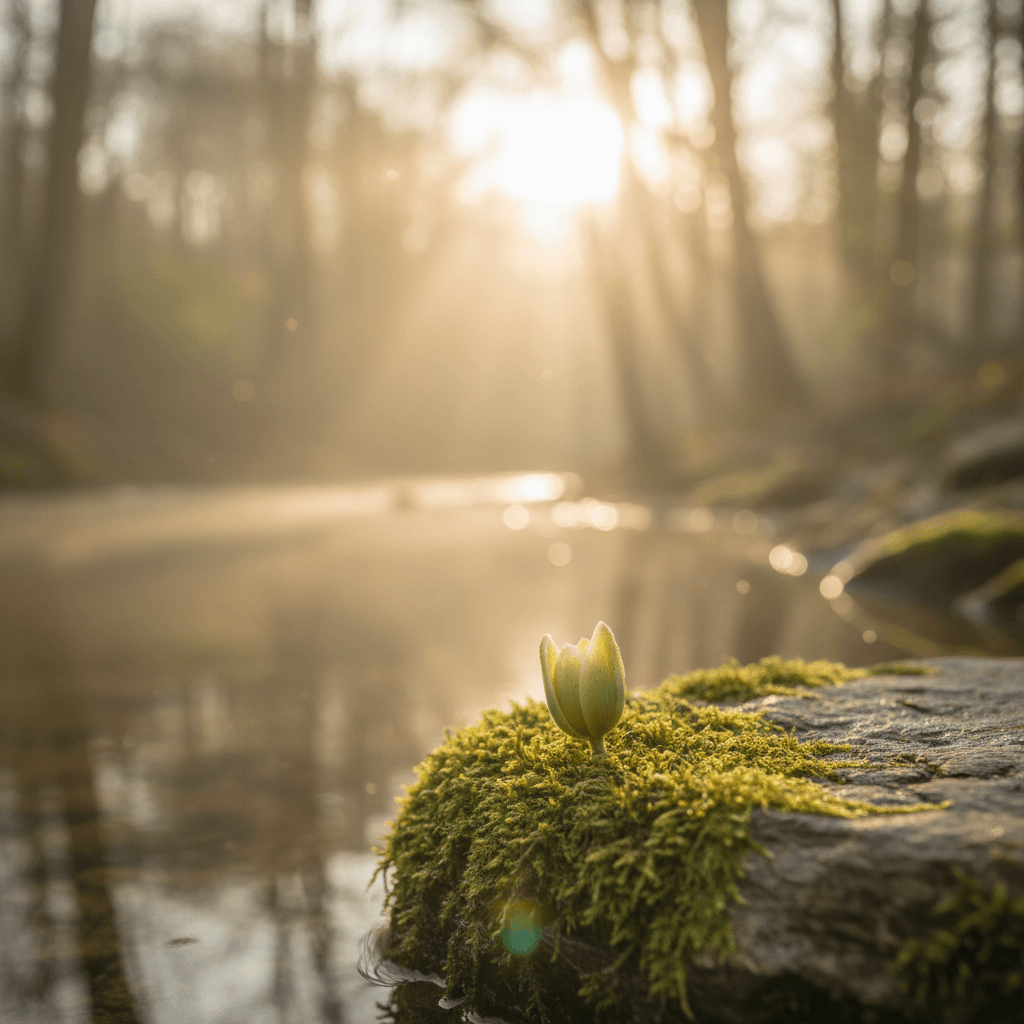
Approach your inner work with patience; the soul unfolds in its own season. — Rainer Maria Rilke
—What lingers after this line?
Rilke’s Invitation to Slow Becoming
Rainer Maria Rilke frames inner work not as a project to finish, but as a process to inhabit. By urging patience, he implies that the self is not engineered through sheer effort; it is revealed through sustained attention and time. The phrase “in its own season” signals that transformation follows rhythms we can cooperate with, but not command. From the start, this reframes impatience as a subtle form of resistance—an attempt to force clarity, healing, or meaning before the psyche is ready. In that light, patience becomes an active discipline: staying present with uncertainty long enough for insight to ripen.
The Soul’s Timing Versus the Ego’s Deadlines
Building on this, Rilke contrasts natural unfolding with the ego’s preference for quick results and measurable milestones. The ego tends to ask, “How long until I’m better?” whereas the soul asks, “Can you remain with what is true right now?” That mismatch in tempo is often where frustration and self-judgment begin. Rilke’s broader counsel echoes this stance; in his Letters to a Young Poet (1903–1908), he famously advises living the questions rather than demanding immediate answers. The continuity is clear: inner maturation is less like solving a puzzle and more like growing into a larger capacity to hold complexity.
Seasons as a Map for Psychological Growth
The metaphor of seasons adds a practical lens: there are times for breaking ground, times for waiting, and times for harvest. Winter-like phases—when motivation dips or progress seems invisible—may actually be periods of consolidation, where the psyche integrates what it cannot yet articulate. In the same way that roots grow unseen, much of inner work happens below the surface. This metaphor also normalizes unevenness. Rather than interpreting setbacks as failure, a seasonal view suggests cycling and return: grief, courage, doubt, and renewal can each be part of a coherent pattern, even when they arrive out of order.
Patience as a Skill, Not Passive Waiting
Moreover, patience here is not resignation; it is a way of engaging without forcing. It can look like revisiting a painful memory in smaller doses, practicing compassion when progress stalls, or choosing consistency over intensity. In everyday terms, it resembles tending a garden: you water, protect, and observe, but you do not tug on the stems to make them taller. Because inner work often touches fear and vulnerability, urgency can become a coping mechanism—“If I fix this fast, I won’t have to feel it.” Patience interrupts that reflex and makes room for a steadier, more durable kind of change.
Learning to Trust Unseen Integration
As the process continues, Rilke’s line encourages trust in what cannot yet be proven. Many shifts are first detectable only in hindsight: a calmer response, a softer inner voice, a longer pause before reacting. These are signs of integration—when insight moves from an idea into a habit of being. Psychologically, this resembles the way learning consolidates over time: the mind revises patterns through repetition and rest, not just breakthroughs. What feels like “nothing is happening” may be the very period when new internal pathways are stabilizing.
Practicing a Season-Respecting Inner Life
Finally, approaching inner work with patience means designing a life that respects timing. That might include journaling without demanding conclusions, therapy paced to tolerance, or contemplative practices that emphasize returning rather than achieving. Even a small ritual—ten minutes of quiet each morning—can become a way of honoring slow unfolding. In the end, Rilke’s counsel is both gentle and demanding: it asks for humility before the mystery of growth. By letting the soul unfold in its own season, we trade frantic self-improvement for a deeper fidelity to what is becoming true within us.
One-minute reflection
What's one small action this suggests?
Related Quotes
6 selectedLet patience be your brush and persistence your color; create a life that astonishes you. — Rainer Maria Rilke
Rainer Maria Rilke
Rilke frames life as a studio where time and tenacity become creative tools. By calling patience a brush and persistence a color, he reimagines success as the quiet accumulation of strokes rather than a single grand gest...
Read full interpretation →Be patient toward all that is unsolved in your heart. — Rainer Maria Rilke
Rainer Maria Rilke
The quote encourages embracing questions or difficulties that don’t have immediate answers.
Read full interpretation →To have patience is not to passively endure; it is to look at the thorn and see the rose. — Rainer Maria Rilke
Rainer Maria Rilke
Rilke’s insight challenges the common misconception that patience is merely passive suffering. Instead of simply enduring hardship, true patience involves a purposeful mindset shift.
Read full interpretation →But patience can't be acquired overnight. It's just like building up a muscle. Every day you need to work on it, to push its limits. — Eknath Easwaran
Eknath Easwaran
Eknath Easwaran frames patience not as a fixed personality trait but as a capacity that develops over time. From the outset, his comparison to building muscle changes the way we think about self-control: instead of waiti...
Read full interpretation →Patience is not passive waiting; it is the courage to stand in the middle of a process and trust that the bloom is coming. — Mary Oliver
Mary Oliver
At first glance, patience is often mistaken for mere delay or resignation, yet Mary Oliver overturns that assumption immediately. In her view, patience is not passive waiting but an active inner stance: a decision to rem...
Read full interpretation →Patience is the ability to be present with your own heart. — Pema Chödrön
Pema Chödrön
Pema Chödrön’s line shifts patience from something we perform for the outside world into something we practice within. Instead of merely “waiting well” while life changes, patience becomes the willingness to stay close t...
Read full interpretation →More From Author
More from Rainer Maria Rilke →To love is not about merging. It is a noble calling for the individual to ripen, to differentiate, to become a world in oneself in response to another. — Rainer Maria Rilke
At first glance, Rilke challenges one of romance’s most familiar ideals: the desire to ‘become one.’ Instead, he argues that genuine love is not a collapse of boundaries but a deepened encounter between two distinct peop...
Read full interpretation →Everything is blooming most recklessly; if it were voices instead of colors, there would be an unbelievable shrieking into the heart of the night. — Rainer Maria Rilke
At first glance, Rilke turns a peaceful image of blooming nature into something almost overwhelming. Flowers do not merely open; they burst forth “most recklessly,” suggesting a vitality so abundant that it exceeds calm...
Read full interpretation →And now let us believe in a long year that is given to us, new, untouched, full of things that have never been. — Rainer Maria Rilke
Rilke opens by shifting the tone from planning to believing: the year is “given to us,” implying something received rather than conquered. This framing matters because it replaces the pressure of achievement with the hum...
Read full interpretation →The purpose of life is to be defeated by greater and greater things. — Rainer Maria Rilke
Rainer Maria Rilke’s line treats “defeat” not as failure to avoid, but as a destination worth moving toward. The purpose of life, in this view, is measured by what can humble us—truths, beauties, responsibilities, or ide...
Read full interpretation →