
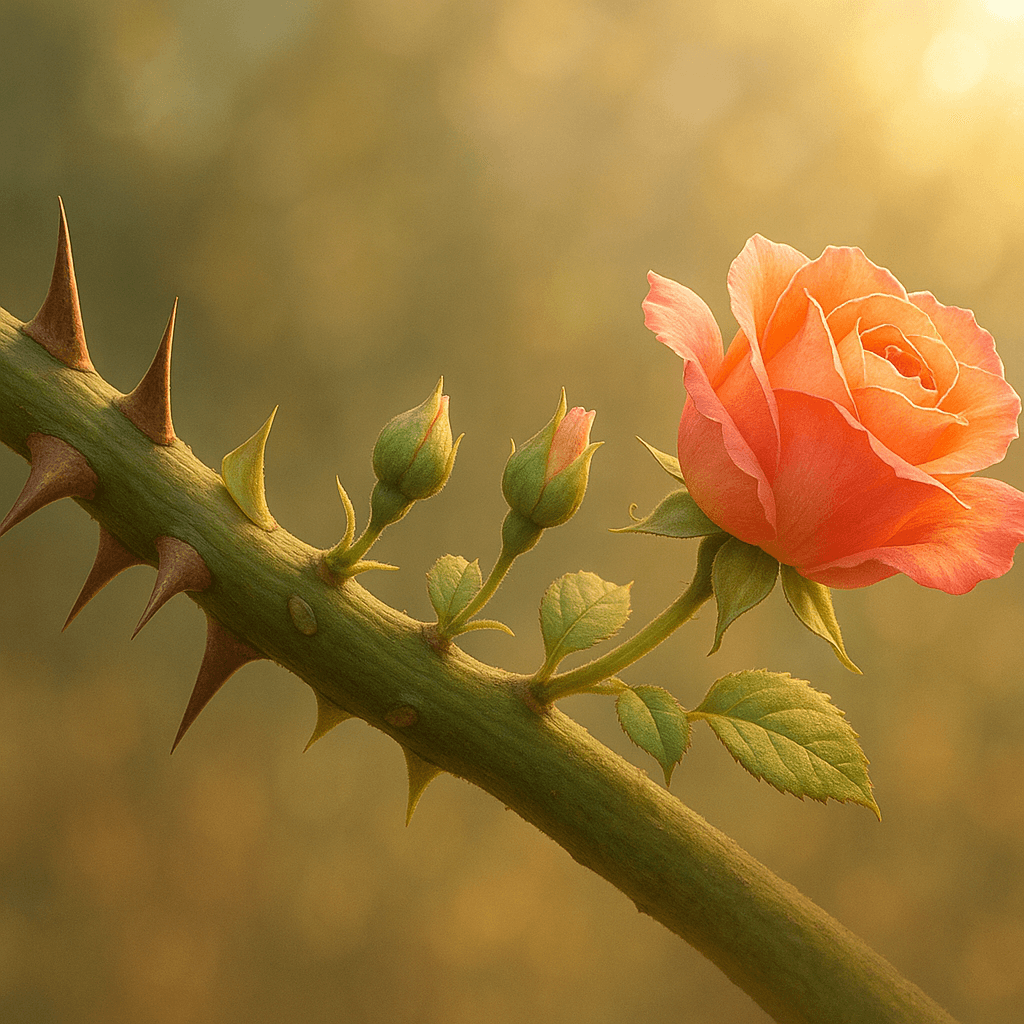
To have patience is not to passively endure; it is to look at the thorn and see the rose. — Rainer Maria Rilke
—What lingers after this line?
Redefining Patience Beyond Endurance
Rilke’s insight challenges the common misconception that patience is merely passive suffering. Instead of simply enduring hardship, true patience involves a purposeful mindset shift. In this view, patience transforms from waiting helplessly for pain to end into a conscious act of hope. This redefinition sets the stage for understanding how patience can actually empower us to face adversity with strength.
The Metaphor of Thorns and Roses
Carrying the metaphor forward, Rilke’s juxtaposition of ‘the thorn’ and ‘the rose’ is particularly evocative. Thorns represent life’s difficulties, while the rose symbolizes beauty and possibility within those challenges. This echoes a perennial motif in literature—think of the Persian poet Saadi, who wrote about roses and their thorns centuries earlier. Both writers invite us to recognize potential for growth, even when encircled by hardship.
Active Patience and Mindful Perception
Flowing from this metaphor, Rilke advocates for an active form of patience rooted in mindful attention. Rather than ignoring pain, we are called to observe it closely—to see beyond the sting and glimpse the rewards hidden within. This perspective aligns with contemporary mindfulness teachings, which encourage individuals to acknowledge discomfort while remaining open to positive transformation.
Historical Parallels in Philosophy and Faith
Looking back, this theme resonates with Stoic philosophy. Marcus Aurelius, in his *Meditations* (c. 180 AD), advises readers to accept adversity and seek virtue amidst trials. Similarly, Buddhist teachings emphasize patience (kshanti) as the art of bearing hardship while cultivating compassion and wisdom. Rilke’s view stands alongside these traditions, highlighting patience as an active virtue—not resignation.
Courage and Creativity in Adversity
Building on these ideas, Rilke suggests that to ‘see the rose’ requires courage and creativity. It is the bold act of envisioning beauty or meaning when surrounded by difficulty. Artists and visionaries throughout history—Frida Kahlo, for example, who painted through immense pain—embodied this principle. Their experiences remind us that patience is not merely survival but a creative force, enabling us to discover hope in even the harshest circumstances.
One-minute reflection
What feeling does this quote bring up for you?
Related Quotes
6 selectedLet patience be your brush and persistence your color; create a life that astonishes you. — Rainer Maria Rilke
Rainer Maria Rilke
Rilke frames life as a studio where time and tenacity become creative tools. By calling patience a brush and persistence a color, he reimagines success as the quiet accumulation of strokes rather than a single grand gest...
Read full interpretation →Approach your inner work with patience; the soul unfolds in its own season. — Rainer Maria Rilke
Rainer Maria Rilke
Rainer Maria Rilke frames inner work not as a project to finish, but as a process to inhabit. By urging patience, he implies that the self is not engineered through sheer effort; it is revealed through sustained attentio...
Read full interpretation →Patience is not passive waiting; it is the courage to stand in the middle of a process and trust that the bloom is coming. — Mary Oliver
Mary Oliver
At first glance, patience is often mistaken for mere delay or resignation, yet Mary Oliver overturns that assumption immediately. In her view, patience is not passive waiting but an active inner stance: a decision to rem...
Read full interpretation →Patience is the ability to be present with your own heart. — Pema Chödrön
Pema Chödrön
Pema Chödrön’s line shifts patience from something we perform for the outside world into something we practice within. Instead of merely “waiting well” while life changes, patience becomes the willingness to stay close t...
Read full interpretation →Sometimes you have to slow down to go fast. — Jeff Olson
Jeff Olson
Jeff Olson’s line begins with a practical paradox: speed is not always created by rushing. Sometimes the quickest path forward requires pausing long enough to see the road clearly, correct mistakes early, and choose acti...
Read full interpretation →Everything that is great in life is the product of slow growth; the newer, and greater, and higher, and nobler the work, the slower is its growth. — William George Jordan
William George Jordan
William George Jordan’s reflection begins with a quiet but demanding truth: the most meaningful achievements rarely arrive quickly. He suggests that greatness is not manufactured in sudden bursts but cultivated through t...
Read full interpretation →More From Author
More from Rainer Maria Rilke →To love is not about merging. It is a noble calling for the individual to ripen, to differentiate, to become a world in oneself in response to another. — Rainer Maria Rilke
At first glance, Rilke challenges one of romance’s most familiar ideals: the desire to ‘become one.’ Instead, he argues that genuine love is not a collapse of boundaries but a deepened encounter between two distinct peop...
Read full interpretation →Everything is blooming most recklessly; if it were voices instead of colors, there would be an unbelievable shrieking into the heart of the night. — Rainer Maria Rilke
At first glance, Rilke turns a peaceful image of blooming nature into something almost overwhelming. Flowers do not merely open; they burst forth “most recklessly,” suggesting a vitality so abundant that it exceeds calm...
Read full interpretation →And now let us believe in a long year that is given to us, new, untouched, full of things that have never been. — Rainer Maria Rilke
Rilke opens by shifting the tone from planning to believing: the year is “given to us,” implying something received rather than conquered. This framing matters because it replaces the pressure of achievement with the hum...
Read full interpretation →The purpose of life is to be defeated by greater and greater things. — Rainer Maria Rilke
Rainer Maria Rilke’s line treats “defeat” not as failure to avoid, but as a destination worth moving toward. The purpose of life, in this view, is measured by what can humble us—truths, beauties, responsibilities, or ide...
Read full interpretation →