
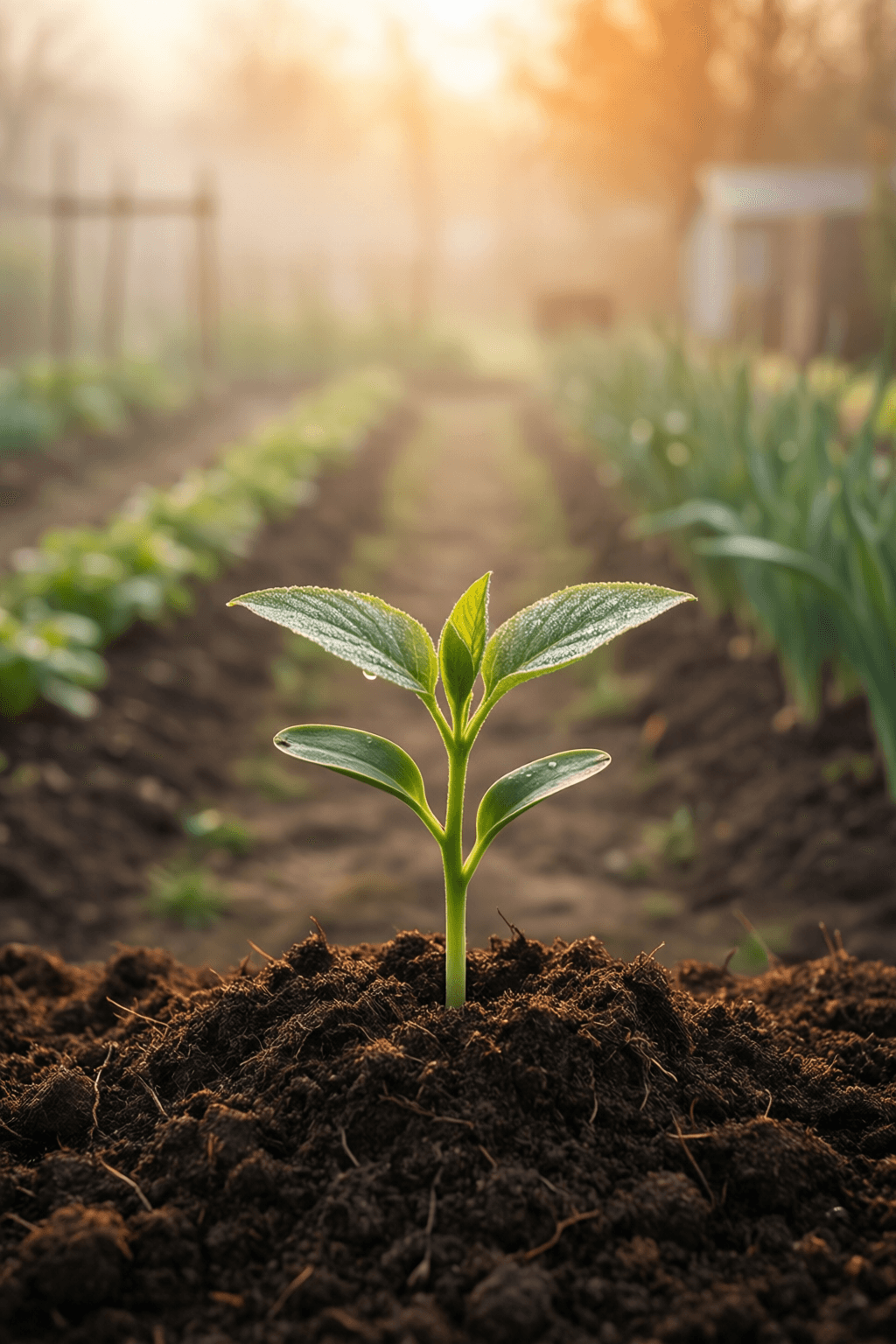
A seed doesn't burst through the earth and decide to hop to another spot because it looks better, easier, or more comfortable in someone else's garden. It grows right in the dirt where it has been planted. — Lara Casey
—What lingers after this line?
Growth Begins with Staying Put
Lara Casey’s image of a seed offers a simple but demanding truth: real growth starts with accepting where we are. A seed does not waste energy wishing for different soil; instead, it pushes roots downward and life upward from the very place it has been given. In that sense, the quote challenges the habit of imagining that fulfillment always exists somewhere else. More importantly, this metaphor reframes discomfort as part of development rather than proof of failure. Just as dirt is not an obstacle to the seed but the medium through which it grows, the ordinary limits of our current circumstances may be the very conditions that shape resilience, patience, and depth.
The Temptation of Comparison
From there, the quote quietly confronts one of modern life’s strongest pressures: comparison. It is easy to look into “someone else’s garden” and assume their life is richer, easier, or more promising. Yet that perspective usually hides the unseen labor, waiting, and hardship beneath the surface. What looks effortless in another person’s life may have required years of unseen rooting. This idea echoes Theodore Roosevelt’s well-known line, “Comparison is the thief of joy,” often cited from late nineteenth-century commentary on character and effort. Casey’s metaphor sharpens that warning by suggesting that comparison does more than steal joy—it can interrupt growth by persuading us to distrust our own ground.
The Hidden Work Beneath the Surface
Naturally, the seed metaphor also draws attention to invisible progress. Before any green shoot appears, a seed breaks open in darkness. That unseen rupture is not failure but transformation. In much the same way, seasons of obscurity, repetition, or struggle often prepare a person for later strength, even when nothing outwardly impressive seems to be happening. In this respect, the quote recalls the agricultural wisdom found in the New Testament, such as 1 Corinthians 15:36, which notes that a seed must first die before new life emerges. Whether read spiritually or metaphorically, the lesson is similar: the buried stage is not the end of the story but the beginning of becoming.
Faithfulness in Ordinary Places
As the image develops, it becomes clear that Casey is not merely praising endurance but faithfulness. To grow where one is planted means giving attention to present responsibilities, relationships, and possibilities instead of postponing purpose until conditions feel ideal. The quote suggests that meaning is often cultivated locally—in the tasks, communities, and commitments already at hand. This perspective appears in many traditions. Voltaire’s Candide (1759) closes with the memorable advice, “We must cultivate our garden,” a line often read as a call to practical responsibility in an imperfect world. Similarly, Casey’s seed does not wait for a perfect field; it answers life by growing in the place available to it.
Resilience Rather Than Restlessness
Consequently, the quote offers a corrective to a culture that often prizes constant movement over steady formation. Restlessness can masquerade as ambition, making every new environment seem like the answer. Yet a plant repeatedly uprooted cannot flourish. Stability, by contrast, allows roots to deepen, identity to strengthen, and fruit to emerge over time. Modern psychology supports this insight indirectly through research on grit, notably Angela Duckworth’s Grit (2016), which emphasizes perseverance and sustained commitment over quick shifts in pursuit of success. Casey’s metaphor captures that same principle in organic form: flourishing depends less on chasing ideal conditions than on developing endurance in real ones.
A Hopeful Vision of Becoming
Ultimately, the quote is hopeful rather than restrictive. It does not deny that some people may need to move, change, or begin again; instead, it resists the illusion that growth is impossible until everything changes. A seed grows by responding to the light available, drawing nourishment from the soil beneath it, and trusting the process of becoming. Therefore, Casey’s words invite a mature kind of hope—one rooted not in escape but in cultivation. They remind us that beauty often emerges slowly, right in the unglamorous ground we once doubted. What seems like mere dirt today may, in time, prove to have been exactly where life was meant to begin.
One-minute reflection
Where does this idea show up in your life right now?
Related Quotes
6 selectedWe are powerful because we have survived, and that is what it is all about—survival and growth. — Audre Lorde
Audre Lorde
At its core, Audre Lorde’s statement redefines power not as domination, status, or control, but as the hard-won strength that comes from continuing despite adversity. To survive is already to have resisted erasure, and L...
Read full interpretation →If you aren't in over your head, how do you know how tall you are? — T. S. Eliot
T. S. Eliot
At first glance, Eliot’s question turns self-knowledge into a matter of pressure rather than comfort. We do not truly learn our limits while standing safely on familiar ground; instead, we discover our height only when c...
Read full interpretation →Today's tears water tomorrow's gardens. — Matshona Dhliwayo
Matshona Dhliwayo
At first glance, Matshona Dhliwayo’s line transforms grief into something unexpectedly fertile. Tears, usually seen as signs of pain or loss, become water for a future garden, suggesting that suffering is not merely endu...
Read full interpretation →Whatever challenge you might find yourself in has a solution. It is very much possible that it is not an obvious one, but it is an opportunity—to grow, to create, to transform. — Dalai Lama
Dalai Lama
At its core, this reflection insists that no challenge is entirely closed off from resolution. The Dalai Lama does not promise that every answer will be easy or immediate; instead, he shifts attention toward possibility...
Read full interpretation →I have learned that to be with those I like is enough. — Walt Whitman
Walt Whitman
Whitman’s line reduces happiness to something disarmingly plain: the presence of beloved company. Rather than chasing wealth, status, or elaborate pleasures, he suggests that being with people one genuinely likes can alr...
Read full interpretation →I will get there, but now I'm here, and here is wonderful. — Jenny Offill
Jenny Offill
Jenny Offill’s line gently overturns the modern obsession with destinations. At first, “I will get there” acknowledges ambition and movement, yet the sentence immediately returns us to the present: “but now I’m here.” In...
Read full interpretation →More From Author
More from Lara Casey →