
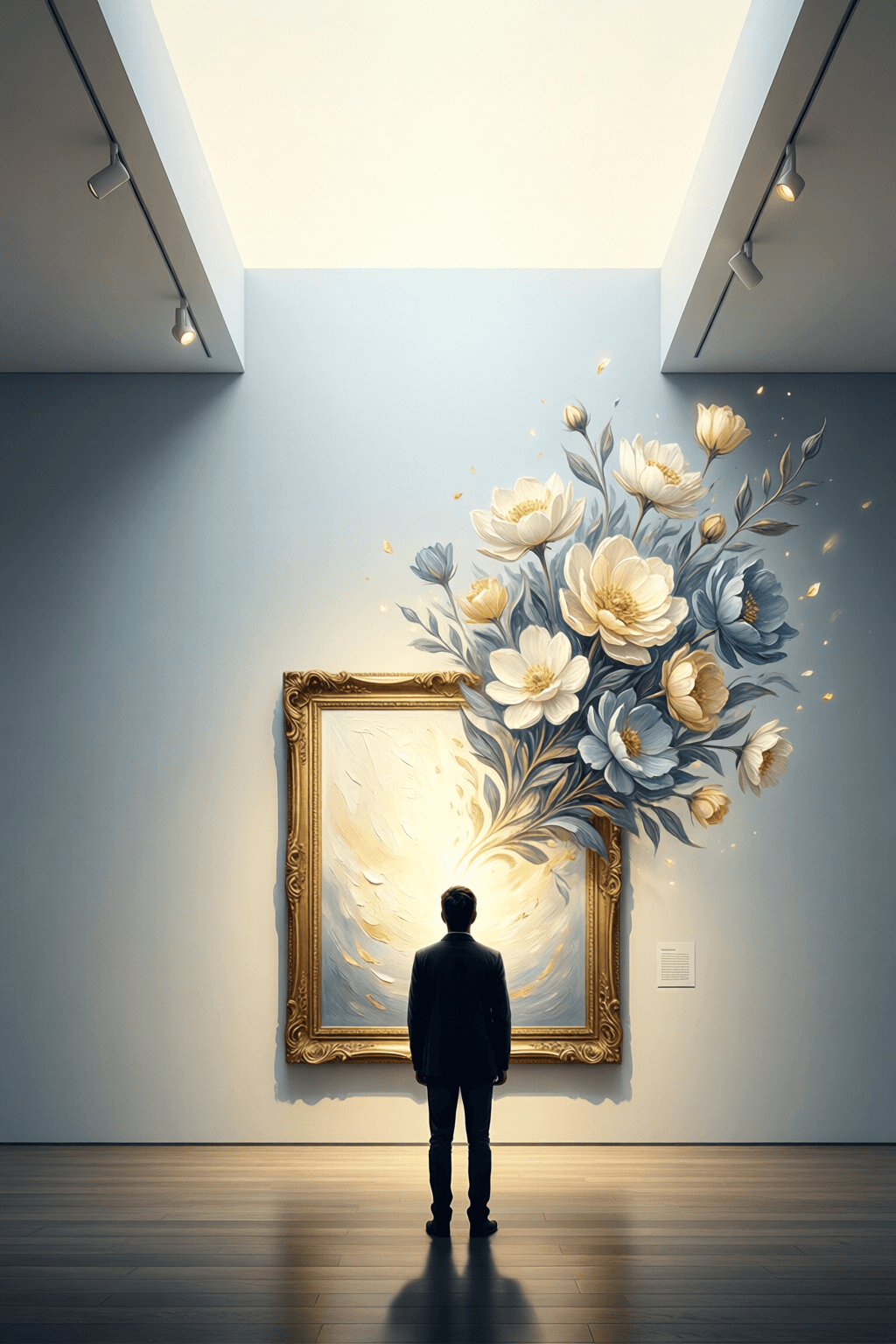
The artist performs only one part of the creative process. The onlooker completes it, and it is the onlooker who has the last word. — Marcel Duchamp
—What lingers after this line?
Creation Does Not End with the Artist
At first glance, Duchamp’s statement seems to reduce the artist’s authority, yet it actually expands the meaning of art itself. He argues that making an artwork is not a closed act completed in the studio; rather, it remains unfinished until someone encounters it. In this view, the artist offers a form, a gesture, or a provocation, but the onlooker supplies interpretation, emotion, and judgment. As a result, art becomes a shared event instead of a solitary declaration. What hangs on the wall or sits in a gallery is only part of the story. The final significance emerges through viewing, questioning, and responding, which is why Duchamp can say the onlooker has “the last word.”
Duchamp’s Radical Reversal of Artistic Authority
This idea becomes clearer when placed beside Duchamp’s own work. His readymades, especially Fountain (1917), challenged the belief that artistic value lies mainly in skilled fabrication. By presenting an ordinary urinal as art, Duchamp shifted attention away from craftsmanship alone and toward interpretation: why does this object provoke outrage, laughter, or thought? The answer depends heavily on the viewer. Consequently, Duchamp did not merely make unusual objects; he changed the location of art’s meaning. Instead of residing fully in the artist’s intention, meaning began to circulate between object, context, and audience. That reversal helps explain why his quote still feels central to modern and contemporary art.
The Viewer as Active Interpreter
From there, Duchamp’s claim invites us to reconsider what looking really involves. An onlooker is not a passive consumer absorbing a fixed message, but an active interpreter shaped by memory, culture, taste, and expectation. Two people can stand before the same painting and leave with entirely different understandings, each one legitimate in its own way. In that sense, the artwork behaves less like a statement and more like a conversation. A viewer may notice irony where another sees sincerity, or beauty where another finds discomfort. Because perception is never neutral, the onlooker does not simply receive meaning; they participate in producing it.
Echoes in Literary and Critical Theory
Moreover, Duchamp’s insight anticipates later critical ideas about interpretation. Roland Barthes’s essay “The Death of the Author” (1967) argues that a text should not be limited to the intentions of its maker; instead, meaning comes alive in the act of reading. Although Barthes wrote about literature, the parallel is striking: both thinkers relocate authority from creator to audience. Similarly, reader-response critics such as Wolfgang Iser in The Implied Reader (1974) emphasize that the audience completes the work through interpretation. These theories reinforce Duchamp’s larger point that creative meaning is not delivered whole from one mind to another. It is co-produced through encounter.
Why Context Changes What We See
At the same time, the onlooker’s “last word” is never spoken in isolation. Museums, labels, social norms, and historical moments all influence how an artwork is received. Fountain (1917) in a plumbing store would not function the same way it does in an art historical discussion; context teaches viewers what questions to ask and what boundaries are being tested. Therefore, completion is not merely personal but cultural. The audience brings private feeling, yet institutions and eras also shape interpretation. Duchamp’s remark thus reveals a larger truth: art is completed not only by individual eyes, but by the social world in which those eyes learn to see.
Art as an Open, Ongoing Exchange
Finally, Duchamp’s quote remains powerful because it describes art as fundamentally unfinished. Every new viewer, generation, or setting can alter the work’s meaning without changing its physical form. Leonardo’s Mona Lisa (c. 1503–1506), for example, has been read as a portrait, a mystery, a masterpiece, and even a pop-cultural icon—each era adding another layer to what the work becomes. Seen this way, the onlooker’s last word is never truly the last in a final sense; it is simply the latest contribution to an ongoing exchange. Duchamp transforms art from an object into a living process, one completed again and again whenever someone stops to look.
One-minute reflection
What does this quote ask you to notice today?
Related Quotes
3 selectedTo grasp the full significance of life is the actor’s duty; to interpret it the artist’s privilege. — Marlon Brando
Marlon Brando
Brando highlights that actors must deeply understand the human experience in order to portray it authentically.
Read full interpretation →The artist is a person who has invented an artist. — Marcel Duchamp
Marcel Duchamp
At first glance, Duchamp’s remark sounds playful, yet it carries a radical idea: an artist is not simply born with a fixed essence but actively constructs the figure the world comes to recognize as “the artist.” In this...
Read full interpretation →An artist never really finishes his work, he merely abandons it. — Paul Valéry
Paul Valéry
At first glance, Paul Valéry’s remark sounds severe, yet it captures a familiar truth about artistic labor: a work rarely reaches a perfect, final state in the artist’s mind. Instead, there comes a moment when revision m...
Read full interpretation →More From Author
More from Marcel Duchamp →