
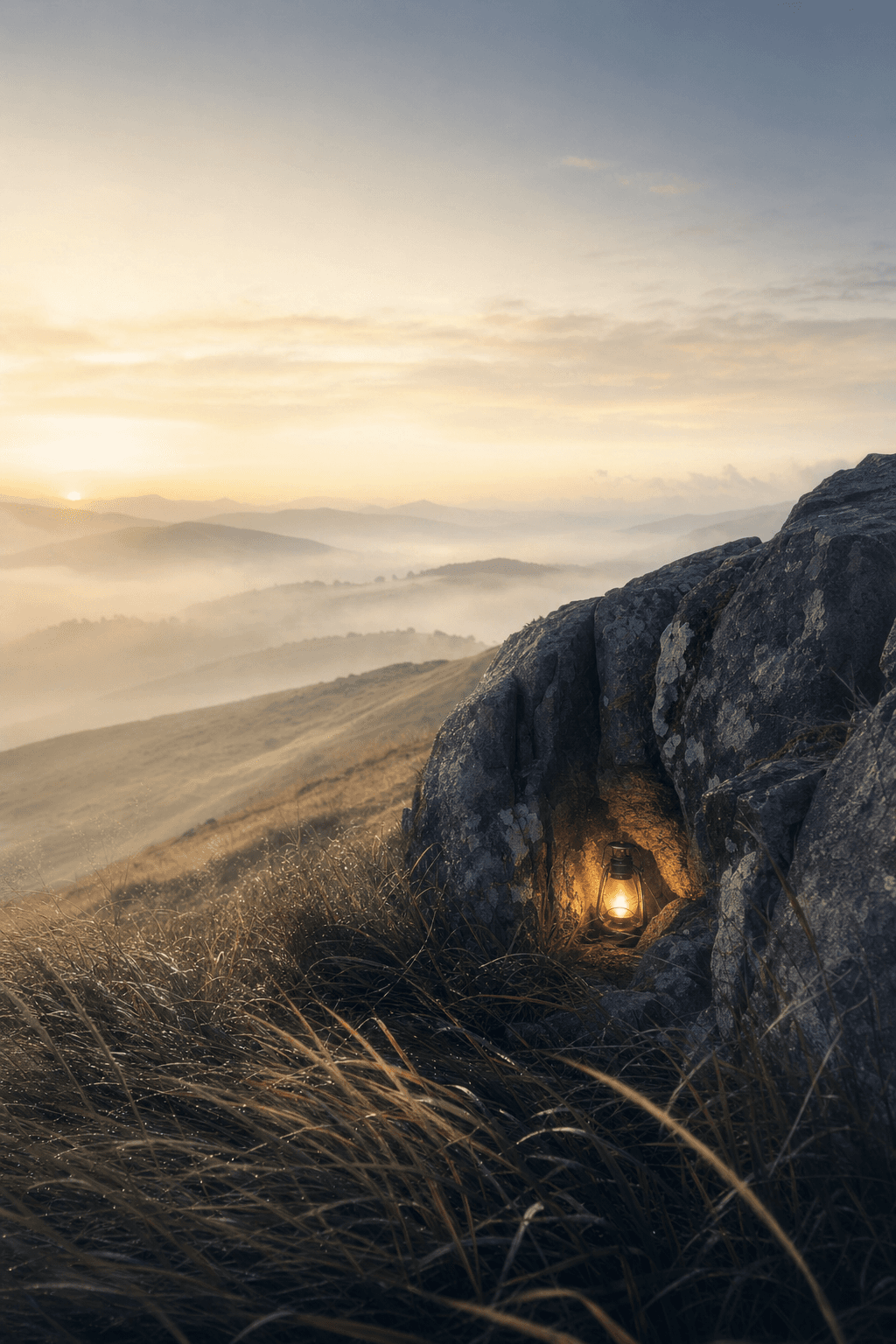
Courage is found in unlikely places. — J. R. R. Tolkien
—What lingers after this line?
A Quiet Challenge to Heroic Stereotypes
Tolkien’s line gently overturns the usual image of courage as something reserved for warriors, rulers, or legendary heroes. Instead, it suggests that bravery often appears in ordinary people and modest settings, where no one expects greatness to arise. In that sense, the quote invites us to look beyond spectacle and recognize that true courage is frequently understated. This idea runs through Tolkien’s own fiction. In The Lord of the Rings (1954–1955), the small and comfort-loving hobbits repeatedly become the moral center of the story. Their strength is not physical dominance but the willingness to keep going despite fear, which makes Tolkien’s observation feel less like a slogan and more like a deeply tested truth.
The Hobbit as the Unlikely Hero
From that perspective, Bilbo and Frodo become perfect illustrations of courage found in unlikely places. Neither begins as a conventional champion; both prefer peace, routine, and the familiar comforts of home. Yet when danger arrives, they do not become fearless—they become steadfast, and that distinction matters. Tolkien shows that courage is not the absence of fear but action taken in spite of it. As the story unfolds, the contrast becomes even sharper. A towering warrior may seem brave by nature, but a hesitant hobbit choosing one more step into darkness reveals a different, perhaps deeper kind of valor. Thus, Tolkien teaches that the measure of courage lies less in appearance than in endurance.
Moral Strength Over Physical Power
Moreover, the quote points toward a moral understanding of bravery. Courage can mean resisting corruption, telling the truth, showing mercy, or carrying responsibility that no one else can bear. In Tolkien’s world, Samwise Gamgee embodies this beautifully: a gardener rather than a knight, he persists through exhaustion and terror out of loyalty and love. His example in The Return of the King (1955) demonstrates that humble devotion can outshine grand displays of force. Because of this, Tolkien broadens the very definition of heroism. The strongest person in the room is not always the bravest; often, the bravest is the one who quietly chooses goodness when the cost is personal and the reward uncertain.
A Theme Rooted in History
Seen in a wider context, Tolkien’s belief likely reflects more than literary imagination. Having served in World War I, including at the Battle of the Somme in 1916, he witnessed how endurance and sacrifice often came from young soldiers who would never have called themselves heroic. That historical experience helps explain why his writing so often honors unnoticed resilience rather than triumphant glory. Consequently, the quote carries a sober realism. It does not romanticize courage as a shining quality possessed by a rare few; instead, it recognizes that under pressure, unexpected people can reveal astonishing strength. In this way, Tolkien speaks not only as a storyteller but also as someone who had seen ordinary lives tested by extraordinary circumstances.
Why the Idea Still Resonates
Finally, the line remains powerful because it applies so easily to everyday life. Courage may appear in a child admitting a mistake, a patient facing illness, a worker defending a colleague, or a person beginning again after failure. These moments rarely look epic, yet they demand the same inner resolve that Tolkien celebrates in his fiction. For that reason, the quote offers both comfort and challenge. It comforts us by suggesting that bravery is not limited to the obviously strong, and it challenges us to notice—and perhaps become—the unlikely bearer of courage ourselves. What seems small from the outside may, in truth, be the place where the greatest strength begins.
One-minute reflection
Where does this idea show up in your life right now?
Related Quotes
6 selectedForge ahead where maps end; the brave craft new paths as they go. — J.R.R. Tolkien
J.R.R. Tolkien
Tolkien’s line evokes the moment when the comfort of the known world runs out—when the map quite literally ends. At such boundaries, most people turn back, trusting only what has been charted before.
Read full interpretation →Courage is the daily practice of showing up for what matters. — Toni Morrison
Toni Morrison
Toni Morrison’s line shifts courage away from grand, cinematic heroics and into the realm of repetition. Rather than a single decisive moment, courage becomes something you rehearse—like a craft—through ordinary choices...
Read full interpretation →To be courageous is to act with the heart. — Molière
Molière
Molière’s line suggests that courage is not merely the absence of fear, but the decision to move despite it. By connecting courage with the heart, he frames bravery as an emotional and moral act rather than a simple disp...
Read full interpretation →The best people possess a feeling for beauty, the courage to take risks, the discipline to tell the truth, the capacity for sacrifice. — Ernest Hemingway
Ernest Hemingway
Hemingway’s line presents goodness not as politeness or success, but as a demanding inner code. The “best people” are those who combine sensitivity, bravery, honesty, and self-denial—qualities that do not always coexist...
Read full interpretation →If you are not willing to look stupid, nothing great is ever going to happen to you. — Julia Cameron
Julia Cameron
Julia Cameron’s remark begins with a hard truth: many people do not fail because they lack talent, but because they fear embarrassment. In that sense, ‘looking stupid’ becomes shorthand for being seen trying, stumbling,...
Read full interpretation →You don't have to bully yourself out of feeling fear. You just have to move while it's still there. — Annie Wright
Annie Wright
At its core, Annie Wright’s quote challenges the common belief that courage begins only after fear has disappeared. Instead, it reframes fear as something that can accompany action rather than prevent it.
Read full interpretation →More From Author
More from J.R.R. Tolkien →It is not our part here to take thought only for a season, or for a few lives of men, or for a passing age of the world. — J.R.R. Tolkien
At its core, Tolkien’s line rejects narrow, short-term thinking. He urges us to look beyond a single season, a generation, or even an era, and to measure our actions against a far larger horizon.
Read full interpretation →Faithless is he that says farewell when the road darkens. — J.R.R. Tolkien
Tolkien’s line draws a sharp boundary between affection that is convenient and fidelity that is real. Saying farewell “when the road darkens” suggests abandoning a person, cause, or duty precisely at the moment it demand...
Read full interpretation →Forge ahead where maps end; the brave craft new paths as they go. — J.R.R. Tolkien
Tolkien’s line evokes the moment when the comfort of the known world runs out—when the map quite literally ends. At such boundaries, most people turn back, trusting only what has been charted before.
Read full interpretation →Shape wonder into shelter; imagination becomes home when it is shared. — J.R.R. Tolkien
Tolkien’s image of shaping wonder into shelter echoes his idea of “sub-creation,” the human craft of making secondary worlds within the primary one. In On Fairy-Stories (1939), he argues that stories offer recovery, esca...
Read full interpretation →