
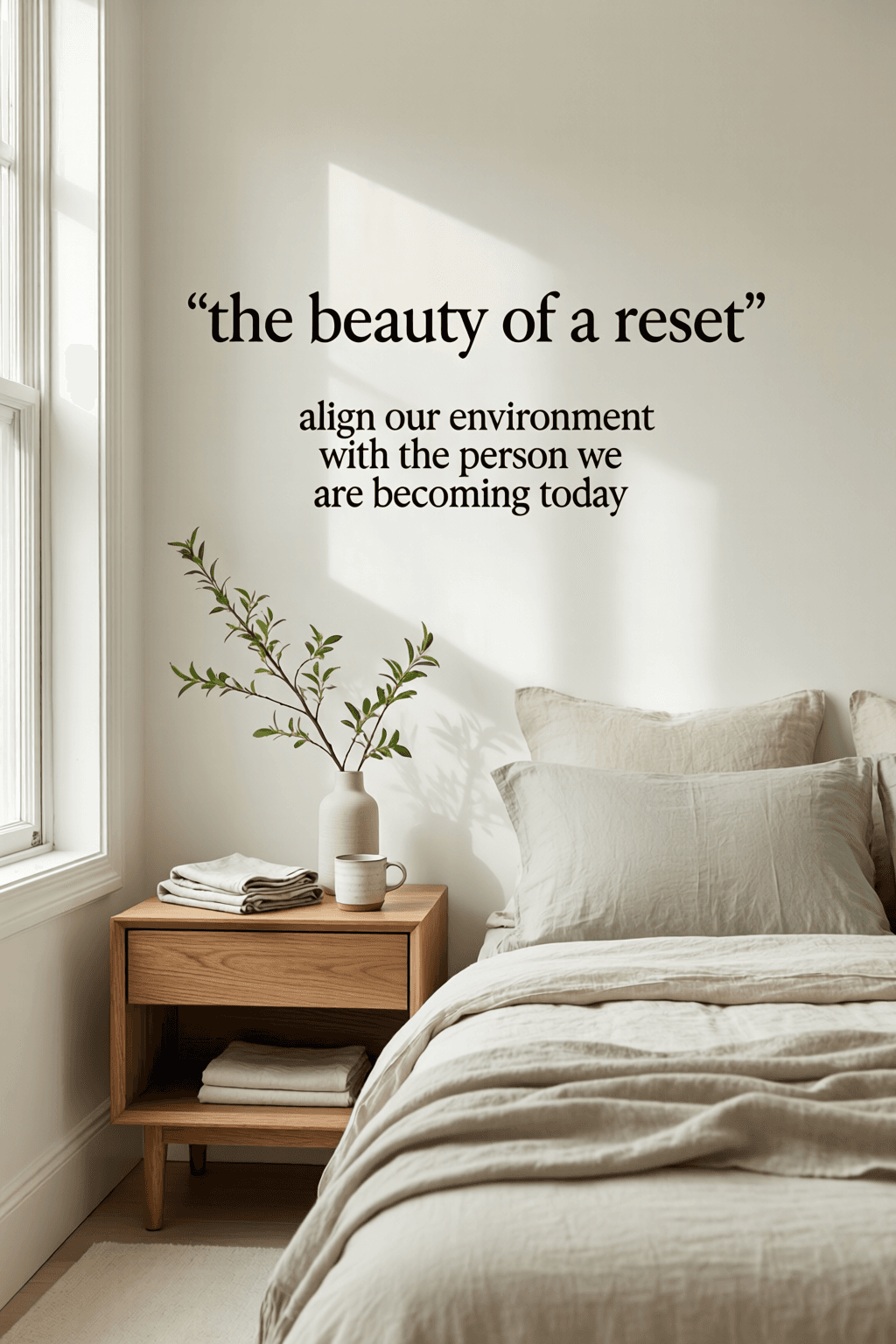
The beauty of a reset is that it allows us to align our environment with the person we are becoming today. — James Clear
—What lingers after this line?
A Reset as a Fresh Alignment
James Clear’s quote reframes a reset as something more meaningful than simply starting over. Instead, it becomes an act of alignment: a chance to reshape our surroundings so they support who we are now, rather than who we used to be. In that sense, change is not only internal; it is also built into the spaces, routines, and cues that guide daily life. From there, the quote suggests that personal growth often requires external adjustment. A person may develop new values, goals, or habits, yet still live inside an environment designed for an older version of the self. A reset closes that gap, allowing the outer world to catch up with inner transformation.
Why Environment Shapes Identity
This idea becomes especially powerful when we consider how much behavior is influenced by context. Clear’s broader work in Atomic Habits (2018) argues that habits are rarely driven by willpower alone; they are reinforced by visible cues and repeated patterns in one’s environment. A desk, a phone screen, a kitchen shelf, or a social circle can quietly encourage one identity while discouraging another. Consequently, a reset is not cosmetic. Rearranging a room, deleting distracting apps, or setting out a notebook the night before are small environmental decisions that make a future self easier to inhabit. In this way, identity is supported not just by intention, but by design.
Letting Go of an Outdated Self
At the heart of the quote is a gentle but important truth: becoming someone new often requires releasing what no longer fits. That may mean abandoning routines, possessions, or expectations tied to a previous chapter of life. Although this can feel uncomfortable, it also creates the space necessary for growth. For example, many people experience this after major transitions—graduation, recovery, parenthood, or a career change. The old environment may still reflect former priorities, making progress feel strangely resisted. A reset, therefore, is not a rejection of the past; rather, it is an acknowledgment that the past should not dictate the future.
The Emotional Power of Starting Again
Beyond practicality, resets carry emotional force. They signal permission to begin without being imprisoned by yesterday’s mistakes or habits. This is why rituals like New Year’s resolutions, moving into a new home, or even cleaning a workspace can feel unexpectedly energizing: they create a psychological break between what was and what could be. Research on the “fresh start effect,” discussed by Hengchen Dai, Katherine Milkman, and Jason Riis in Management Science (2014), helps explain this appeal. Their work shows that temporal landmarks can motivate renewed effort by helping people separate themselves from past failures. Thus, a reset is both a structural and emotional invitation to change.
Designing Life for the Person Emerging
Seen together, the quote offers a practical philosophy of self-renewal. It implies that growth is not fully real until it is embodied in everyday conditions. If someone is becoming healthier, calmer, more disciplined, or more creative, then their environment should reflect and reinforce those traits through accessible, repeatable choices. Ultimately, the beauty of a reset lies in its hopefulness. It reminds us that transformation does not depend on dramatic reinvention alone; often, it begins with adjusting what surrounds us so that our present life matches our emerging identity. In that quiet alignment, becoming starts to feel possible.
One-minute reflection
What does this quote ask you to notice today?
Related Quotes
6 selectedDiscipline is the bridge between your current reality and the person you are becoming. It is not about punishing yourself; it is about choosing your future self over your present impulses. — James Clear
James Clear
At its core, James Clear’s quote frames discipline as a connection between who you are now and who you hope to become. Rather than treating growth as a sudden transformation, it presents change as a gradual crossing buil...
Read full interpretation →Learning to love yourself is like learning to walk – essential, life-changing, and the only way to stand tall. — Vironika Tugaleva
Vironika Tugaleva
Vironika Tugaleva’s comparison begins with a simple but powerful truth: self-love is not a luxury, but a basic human necessity. Just as walking allows a child to move through the world with growing independence, learning...
Read full interpretation →The most gifted members of the human species are at their creative best when they cannot have their way, and must compensate for what they miss by realizing and cultivating their capacities. — Bryant H. McGill
Bryant H. McGill
Bryant H. McGill’s observation begins with a striking reversal: gifted people may not reach their highest potential when everything comes easily, but when something blocks their path.
Read full interpretation →A mind grows by staying with difficulty long enough for the experience to change it. — Mary Catherine Bateson
Mary Catherine Bateson
Mary Catherine Bateson’s observation begins with a quiet but demanding truth: the mind does not grow merely by encountering difficulty, but by remaining with it. Challenge becomes transformative only when we resist the u...
Read full interpretation →Consistency is a superpower. — Ryan Holiday
Ryan Holiday
Ryan Holiday’s line begins with a deceptively simple idea: greatness is rarely built through dramatic gestures. More often, it emerges from repeated actions that seem ordinary in isolation but become extraordinary over t...
Read full interpretation →Confidence is silent. Insecurities are loud. — Unknown (Wait—skip/replace with: True nobility is being superior to your former self. — Ernest Hemingway)
Ernest Hemingway
At its core, Hemingway’s line redefines nobility as an inward achievement rather than a social rank. Instead of measuring worth by wealth, pedigree, or dominance over others, it points to a quieter standard: becoming bet...
Read full interpretation →More From Author
More from James Clear →Self-mastery rarely looks impressive. It simply holds. — James Clear
James Clear’s observation begins by stripping self-mastery of glamour. It is not usually a heroic moment, a public triumph, or a dramatic display of willpower.
Read full interpretation →You cannot fully reset your life without adjusting your environment. — James Clear
James Clear’s observation begins with a simple but often overlooked truth: personal change is rarely just a matter of willpower. Our habits are shaped by the rooms we live in, the people we spend time with, the apps we o...
Read full interpretation →Consistency is the quiet answer to overwhelm. — James Clear
At first glance, James Clear’s line reframes overwhelm not as a dramatic crisis but as a condition that can be softened by steady action. Rather than calling for bursts of motivation, he points to consistency as a quiete...
Read full interpretation →Don't worry about being brilliant; just be consistent. The world is built by people who showed up even when they didn't feel like it. — James Clear
At its core, James Clear’s quote pushes back against the modern obsession with exceptional talent. Rather than glorifying brilliance, it elevates consistency—the humble act of returning to the work again and again.
Read full interpretation →