
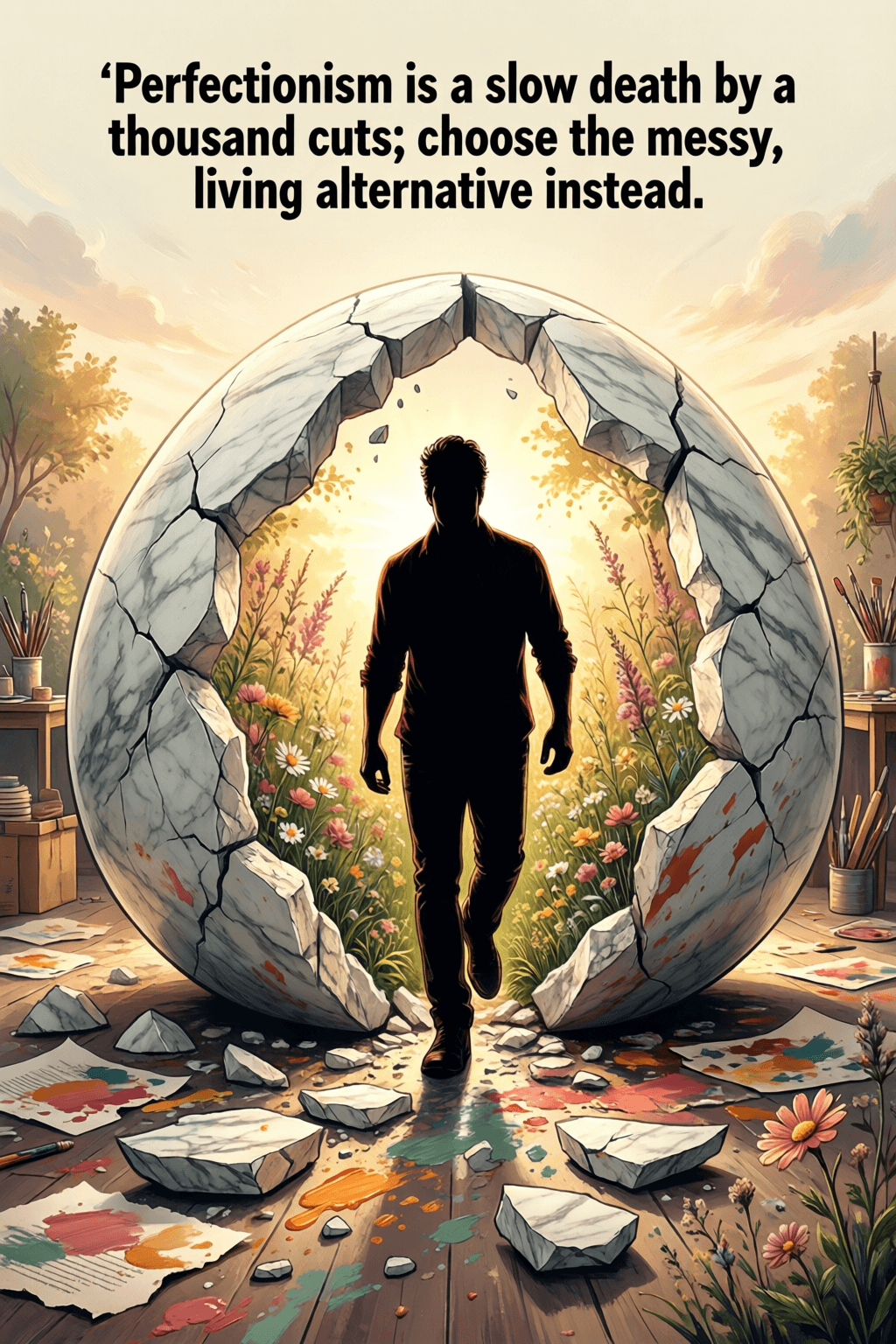
Perfectionism is a slow death by a thousand cuts; choose the messy, living alternative instead. — Anne Lamott
—What lingers after this line?
Perfectionism as Quiet Self-Destruction
At first glance, Anne Lamott’s line sounds sharp, but its force comes from accuracy: perfectionism rarely ruins us in one dramatic collapse. Instead, it works through accumulation—tiny hesitations, private shaming, delayed starts, and abandoned efforts. The image of “a thousand cuts” captures how the habit wounds creativity and confidence little by little, until the person looks functional from the outside while feeling diminished within. In that sense, Lamott reframes perfectionism not as high standards but as a life-draining mindset. What appears disciplined may actually be fear in elegant clothing. Rather than helping us produce better work or become better people, perfectionism can slowly separate us from momentum, joy, and even self-trust.
Why the Messy Alternative Feels Frightening
From there, the quote turns toward its real challenge: choosing the “messy, living alternative.” That phrase matters because life itself is untidy—relationships misfire, drafts wobble, plans change, and growth looks awkward before it looks graceful. To choose messiness, then, is not to choose carelessness; it is to accept the conditions under which anything authentic is actually made. Naturally, this feels frightening because mess exposes us to judgment. A flawed first attempt can be seen, criticized, or misunderstood, whereas an unfinished ideal remains safely imaginary. Yet Lamott suggests that the risk of being imperfect is still better than the sterile safety of never fully living.
Creativity Requires Imperfect Beginnings
This insight is especially powerful in creative work. Anne Lamott herself made the idea famous in Bird by Bird (1994), where she defended the necessity of “shitty first drafts.” Her point was not merely humorous; it was practical. Nearly every worthwhile piece of writing, art, or invention begins in disorder, and only later becomes refined through revision. Seen this way, perfectionism blocks the very process it claims to protect. A novelist who cannot tolerate a weak opening may never finish chapter one. A student who fears a less-than-brilliant paper may procrastinate until the deadline passes. By contrast, the messy beginning keeps the work alive long enough to improve.
The Psychological Cost of Flawlessness
Moreover, psychology has repeatedly linked maladaptive perfectionism with anxiety, depression, and chronic self-criticism. Research by Gordon Flett and Paul Hewitt, for example, has shown how perfectionistic tendencies can become tied to self-worth, making any mistake feel like a personal failure rather than a normal part of learning. In this light, Lamott’s “slow death” is not just metaphorical; it reflects a genuine emotional erosion. As a result, the pursuit of flawlessness often narrows a person’s world. They may avoid challenges they cannot guarantee mastering, refuse opportunities that involve uncertainty, or measure their value by impossible standards. What dies first is often spontaneity, and after that, resilience.
Messiness as a Form of Courage
For that reason, the “living alternative” is best understood as courage rather than compromise. To act before feeling fully ready, to publish the draft, to apologize imperfectly, to begin the new skill badly—these are not signs of lowered ambition. They are signs that a person values participation in life over the fantasy of invulnerability. Many ordinary examples make this clear: a parent improvising through a difficult day, an entrepreneur launching a rough prototype, or a painter letting visible brushstrokes remain. In each case, vitality comes from engagement, not polish. Messiness, then, becomes evidence that someone is still in motion, still learning, still alive to possibility.
A Healthier Standard for Living Well
Finally, Lamott’s quote invites a redefinition of excellence itself. Instead of asking whether something is perfect, we might ask whether it is honest, useful, generous, or real. That shift does not abolish standards; rather, it places them in service of life instead of fear. Even Aristotle’s Nicomachean Ethics (4th century BC), with its emphasis on practice and habit, suggests that virtue is formed through doing, not through waiting for immaculate performance. Ultimately, the quote argues that an unfinished, imperfect, fully inhabited life is richer than a polished life never truly entered. The messy alternative may include errors, but it also includes movement, discovery, and change—and that is what keeps the spirit from being cut down piece by piece.
One-minute reflection
What does this quote ask you to notice today?
Related Quotes
6 selectedOver the years I've grown more comfortable with making people uncomfortable because that is when growth can happen. You need a little conflict. — Jamie Lee Curtis
Jamie Lee Curtis
Jamie Lee Curtis’s reflection begins with a hard-won realization: discomfort is not always a sign that something has gone wrong. Often, it signals that a person, group, or relationship has reached the edge of its familia...
Read full interpretation →Everything that is great in life is the product of slow growth; the newer, and greater, and higher, and nobler the work, the slower is its growth. — William George Jordan
William George Jordan
William George Jordan’s reflection begins with a quiet but demanding truth: the most meaningful achievements rarely arrive quickly. He suggests that greatness is not manufactured in sudden bursts but cultivated through t...
Read full interpretation →Perfectionism is a twenty-ton shield we lug around thinking it will protect us, when in fact, it's the thing that's really preventing us from taking flight. — Brené Brown
Brené Brown
Brené Brown’s metaphor turns perfectionism into something heavy, defensive, and exhausting: a twenty-ton shield. At first, that shield seems useful because it promises protection from criticism, failure, and shame.
Read full interpretation →We are powerful because we have survived, and that is what it is all about—survival and growth. — Audre Lorde
Audre Lorde
At its core, Audre Lorde’s statement redefines power not as domination, status, or control, but as the hard-won strength that comes from continuing despite adversity. To survive is already to have resisted erasure, and L...
Read full interpretation →If you aren't in over your head, how do you know how tall you are? — T. S. Eliot
T. S. Eliot
At first glance, Eliot’s question turns self-knowledge into a matter of pressure rather than comfort. We do not truly learn our limits while standing safely on familiar ground; instead, we discover our height only when c...
Read full interpretation →Today's tears water tomorrow's gardens. — Matshona Dhliwayo
Matshona Dhliwayo
At first glance, Matshona Dhliwayo’s line transforms grief into something unexpectedly fertile. Tears, usually seen as signs of pain or loss, become water for a future garden, suggesting that suffering is not merely endu...
Read full interpretation →More From Author
More from Anne Lamott →Recovery is not a race. You don't have to feel guilty if it takes you longer than you thought it would. — Anne Lamott
Anne Lamott’s reminder begins by challenging one of the quiet cruelties of recovery: the belief that healing should follow a predictable schedule. Whether the wound is physical, emotional, or spiritual, people often comp...
Read full interpretation →Do not mistake your digital silence for peace. Real strength is found in the courage to speak the truth to the people who hold your heart. — Anne Lamott
At first glance, Anne Lamott’s quote challenges a familiar illusion: silence can resemble peace without actually creating it. Choosing not to speak may keep conflict out of sight, yet beneath that quiet surface, hurt, co...
Read full interpretation →Your worth is not a spreadsheet. You are not a project to be completed, but a life to be experienced. Stop measuring and start breathing. — Anne Lamott
Anne Lamott’s quote begins by confronting a habit many people barely notice: treating human value as if it could be tabulated. A spreadsheet symbolizes order, productivity, and comparison, yet it also reduces complexity...
Read full interpretation →The art of living is not about being a finished masterpiece; it is about being a work in progress that still knows how to laugh at its own paint spills. — Anne Lamott
At its heart, Anne Lamott’s remark reframes life from a quest for perfection into an ongoing act of creation. Instead of imagining ourselves as polished masterpieces, she invites us to see our days as brushstrokes still...
Read full interpretation →