
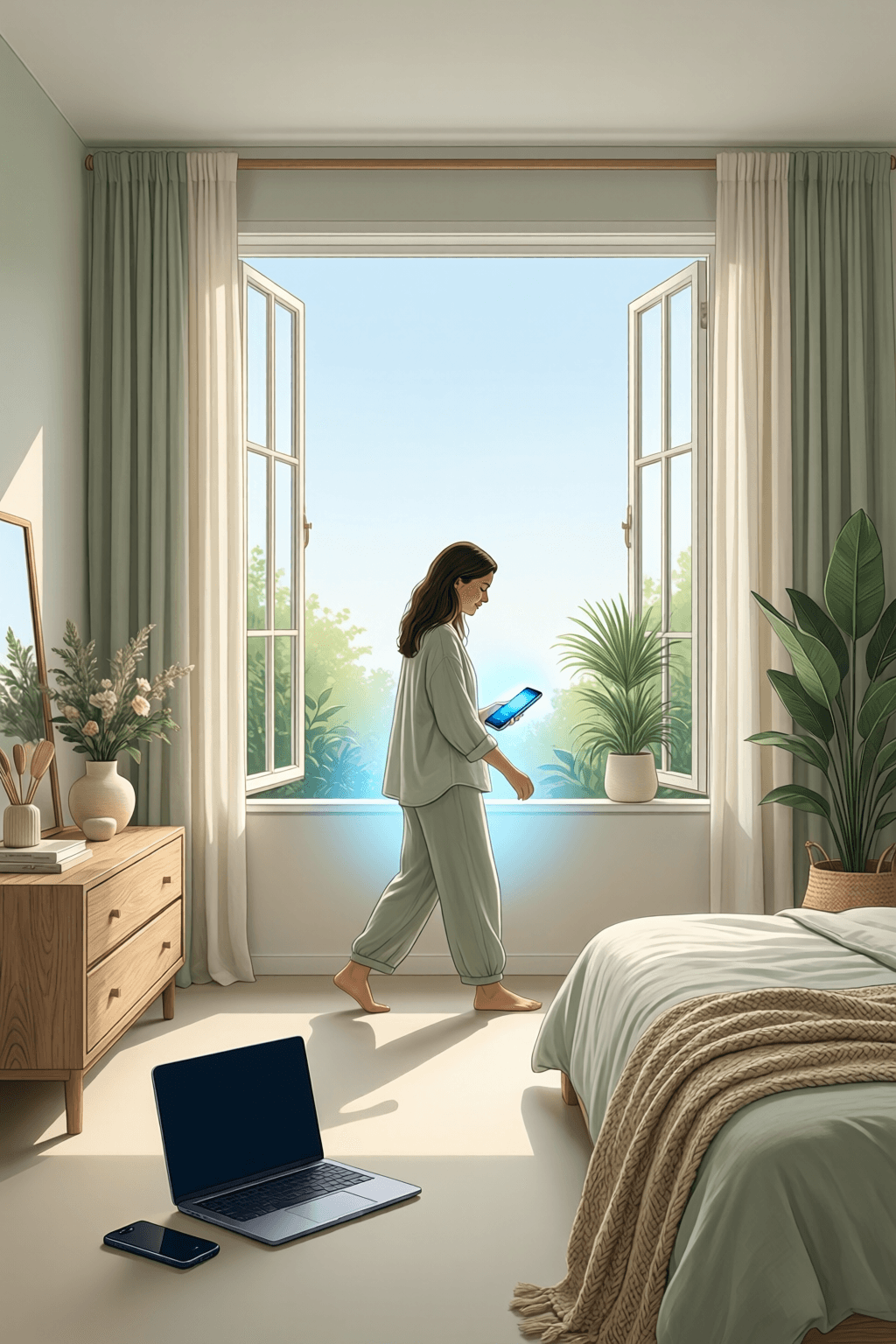
Something really helpful for stress reduction is to simply consume less — less news, less social media, less information, less noise, less screen time. — Valentina Ogaryan
—What lingers after this line?
The Wisdom of Deliberate Reduction
Valentina Ogaryan’s statement begins with a deceptively simple idea: stress often grows not only from what happens to us, but from how much we continuously take in. By recommending less news, less social media, and less noise, she reframes stress reduction as an act of subtraction rather than acquisition. Instead of adding another productivity tool or wellness habit, we may first need to remove the constant inputs that keep the mind overstimulated. This insight feels especially timely because modern life rewards perpetual connection. Yet the brain does not experience endless updates as harmless background material; it experiences them as demands. In that sense, Ogaryan’s advice is not anti-information but pro-recovery, urging us to protect attention before it becomes exhaustion.
Why Constant Input Becomes Mental Clutter
From there, the quote points to a broader psychological truth: the mind has limits. Cognitive load theory, developed in educational psychology by John Sweller (1988), shows that too much incoming material can overwhelm our ability to process effectively. While the theory emerged in learning contexts, its relevance to daily life is clear when notifications, headlines, and competing streams of content leave us mentally scattered. As a result, information stops being useful and starts becoming clutter. A person who reads breaking news every hour may feel informed, yet also increasingly agitated and less able to think deeply. Ogaryan’s phrasing captures this tipping point well, suggesting that peace often returns not when the world becomes quieter, but when we stop inviting every signal into our inner life.
News, Social Media, and the Stress Cycle
More specifically, news and social media can create a feedback loop of vigilance. News platforms emphasize urgency, while social media amplifies comparison, outrage, and novelty. Together, they train attention toward what is alarming or emotionally charged. Research discussed by the American Psychological Association’s reports on stress and media exposure has repeatedly noted that heavy media consumption during crises can heighten anxiety rather than relieve uncertainty. Consequently, what begins as a search for control often becomes a source of helplessness. A person checks one headline to feel prepared, then scrolls through twenty more and ends up carrying the emotional weight of events far beyond their influence. Ogaryan’s advice interrupts that cycle by proposing a boundary: staying informed is useful, but saturation is costly.
Screen Time and the Erosion of Rest
The quote also wisely links information overload with screen time, because devices are the channels through which most modern noise arrives. Screens compress work, entertainment, communication, and crisis updates into one glowing surface, making it hard for the nervous system to distinguish between engagement and rest. Studies on sleep, including work summarized by Harvard Medical School on blue light and evening device use, suggest that prolonged screen exposure can interfere with both sleep quality and mental recovery. In practical terms, this means stress does not end when the day ends if the screen remains our final companion. Even passive scrolling can keep the mind activated. Thus, reducing screen time is not merely a nostalgic preference for offline life; it is a concrete way to restore the pauses in which emotional regulation becomes possible.
Choosing Silence as a Form of Care
Once this pattern is recognized, consuming less becomes an act of self-respect rather than deprivation. Silence, in this context, is not emptiness but nourishment. Many people notice that after even a short break from digital input—a quiet walk, an unread afternoon, a phone-free meal—their thoughts become less fragmented and their body less tense. The relief can feel surprisingly immediate because the mind is finally allowed to complete a thought without interruption. This is why Ogaryan’s advice carries a subtle compassion. She does not demand total withdrawal from society; instead, she invites intentional limits. By choosing fewer inputs, we make room for reflection, conversation, and genuine presence—qualities that stress often pushes aside.
A Sustainable Path to Inner Balance
Ultimately, the power of the quote lies in its realism. Stress reduction is often marketed as something elaborate, yet Ogaryan points toward a quieter and more sustainable practice: let less in. This approach aligns with broader traditions of simplicity, from Seneca’s letters in Stoic philosophy, which caution against distraction, to contemporary digital minimalism, as explored by Cal Newport (2019). Across eras, the principle remains consistent: attention is precious, and peace depends on how carefully we spend it. Therefore, the quote is not merely advice about media habits; it is a philosophy of mental stewardship. By consuming less noise, we do not become less engaged with life. Rather, we become more capable of meeting life with steadiness, clarity, and calm.
One-minute reflection
Why might this line matter today, not tomorrow?
Related Quotes
6 selectedThe greatest luxury in a modern world is not things, but the ability to disconnect and reclaim your own attention. — Cal Newport
Cal Newport
At first glance, Newport’s statement overturns the traditional idea of luxury as something material. Instead of wealth being measured by rare objects, he suggests it is now measured by the freedom to step away from noise...
Read full interpretation →The real flex is not looking busy. It is having the audacity to enjoy silence without reaching for your phone. — Pema Chödrön
Pema Chödrön
At first glance, the quote challenges a modern status symbol: busyness. In many workplaces and social circles, looking overloaded can seem like proof of importance.
Read full interpretation →Sometimes you need to disconnect to reconnect with what truly matters. — Emma Green
Emma Green
At first glance, Emma Green’s quote sounds like a simple call to unplug, yet it carries a deeper truth about attention and meaning. To disconnect is not merely to withdraw from devices, noise, or obligations; rather, it...
Read full interpretation →Depth is the new status symbol. Be so well-read and well-rested that people think you've gone offline for good. — Unknown
Unknown
The quote reframes status away from conspicuous consumption and toward something quieter: depth. Instead of broadcasting busyness, it proposes that the most enviable life is one marked by substance—clear thinking, cultiv...
Read full interpretation →Going offline is a small act of rebellion; a return to the quiet parts of ourselves the world cannot reach. — Unknown
Unknown
The quote begins by framing “going offline” not as a mere lifestyle tweak, but as a conscious refusal of constant availability. In a culture that rewards rapid replies and perpetual updates, disconnecting becomes a way t...
Read full interpretation →Almost everything will work again if you unplug it for a few minutes—including you. — Anne Lamott
Anne Lamott
Anne Lamott’s line reads like a piece of homespun tech advice, but it lands as something closer to wisdom: when systems get overloaded, the simplest intervention is to stop and reset. By placing “you” beside a machine, s...
Read full interpretation →More From Author
More from Valentina Ogaryan →Adults can benefit from play as much as children—not just as a reward, but something that helps regulate. — Valentina Ogaryan
Valentina Ogaryan’s quote opens by challenging the common assumption that play is primarily for children or reserved for leisure after “real work” is done. Instead, it proposes that adults benefit just as deeply—suggesti...
Read full interpretation →When the world feels larger than life, make your world a little bit smaller. — Valentina Ogaryan
Valentina Ogaryan’s line begins with a familiar sensation: moments when life expands beyond our capacity to hold it—news, responsibilities, uncertainty, and expectation all swelling at once. In that state, “the world” is...
Read full interpretation →