
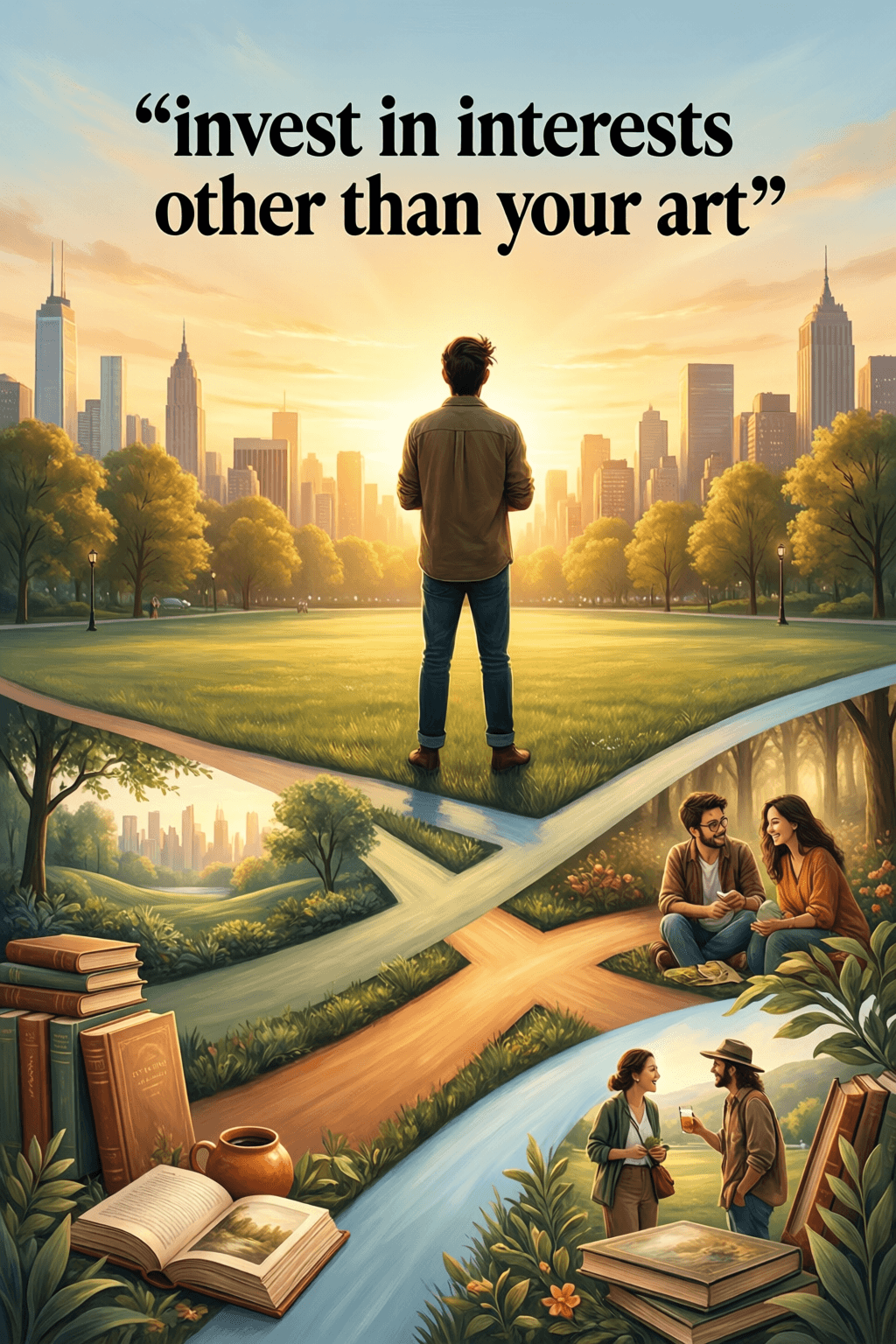
It is important to invest in interests other than your art. You can't be an art-making machine, and artists who live interesting lives make more interesting art anyhow. — Grace Netanya
—What lingers after this line?
Art Needs More Than Constant Output
Grace Netanya’s remark begins with a gentle warning: art cannot thrive if the artist becomes a machine for production. At first glance, endless making may seem like discipline, yet creativity often weakens when it is forced into repetition without renewal. In that sense, the quote argues that art depends not only on labor, but also on living. From there, her point broadens into a philosophy of creative sustainability. An artist who never steps outside the studio may keep producing objects, but those works can lose surprise, texture, and emotional range. By contrast, a fuller life supplies the raw material that technique alone cannot generate.
Experience Becomes Creative Fuel
Once we accept that making art is not enough by itself, the next question is what replenishes it. Netanya suggests that other interests—friendships, travel, reading, gardening, politics, cooking, even boredom—become sources of artistic energy. These experiences deepen perception and give the artist more varied ways to see the world. Indeed, many great creators have drawn from lives lived expansively. Virginia Woolf’s essays and novels, for example, were shaped not only by literary craft but by social observation, intellectual debate, and psychological introspection. As a result, her work feels inhabited by life rather than merely arranged by technique.
Interesting Lives Create Richer Work
Netanya’s second sentence sharpens the claim: artists who live interesting lives make more interesting art. This does not mean every artist must pursue drama or spectacle. Rather, it suggests that curiosity, engagement, and openness enlarge the artist’s imaginative world, allowing the work to carry greater nuance and depth. For instance, Pablo Picasso’s shifts across periods were tied not just to formal experimentation but to changing relationships, politics, places, and encounters with other traditions. Therefore, the richness of art often reflects the richness of attention behind it. A life fully noticed tends to produce work that feels equally alive.
The Danger of Artistic Isolation
At the same time, the quote quietly criticizes a romantic myth: that total isolation and relentless sacrifice automatically produce better art. While solitude can be necessary, a life narrowed only to output may leave the artist emotionally depleted or creatively stale. The problem is not dedication itself, but dedication stripped of balance. This concern appears repeatedly in artists’ biographies. Sylvia Plath’s journals reveal how intensely artistic ambition can intertwine with exhaustion and pressure, reminding us that the inner life needs nourishment as much as discipline. Consequently, stepping away from the work is not always avoidance; sometimes it is preservation.
Other Passions Protect the Self
Following that idea, having interests beyond art also protects the artist from becoming entirely defined by success or failure. If every hour and identity rests on the work, rejection can feel catastrophic and praise can become dangerously addictive. A broader life creates steadier ground. This is why many artists keep close ties to ordinary routines and parallel passions. The poet Mary Oliver’s devotion to walking and observing the natural world was not separate from her writing so much as quietly supportive of it. In this way, outside interests do more than inspire art; they help preserve the person who makes it.
A More Human Model of Creativity
Ultimately, Netanya offers a more humane vision of artistic practice. She rejects the fantasy of the artist as an inexhaustible producer and replaces it with something wiser: a creator who alternates between making and experiencing, discipline and discovery. The art, in turn, becomes a record of that exchange. Seen this way, investing in life beyond art is not a distraction from serious work but part of serious work itself. The more fully an artist inhabits the world, the more substance the world gives back. Thus the quote ends up defending not less commitment to art, but a deeper and more life-giving kind.
Recommended Reading
As an Amazon Associate, we earn from qualifying purchases.
One-minute reflection
Where does this idea show up in your life right now?
Related Quotes
3 selectedTo be an artist is to believe in life. — Henry Moore
Henry Moore
This quote implies that creating art is an inherently optimistic act. Artists must have faith in the value and potential of life in order to interpret, express, and celebrate it through their work.
Read full interpretation →There are two men inside the artist, the poet and the craftsman. One is born a poet. One becomes a craftsman. — Emile Zola
Émile Zola
At first glance, Zola’s remark divides the artist into two figures: the poet and the craftsman. Yet the contrast is not meant to split art into separate worlds, but to show that creation depends on both impulse and disci...
Read full interpretation →It is art that makes life, makes interest, makes importance... and I know of no substitute whatever for the force and beauty of its process. — Henry James
Henry James
Henry James’s statement begins with a bold reversal of ordinary thinking: rather than life producing art as a decorative afterthought, art is what gives life shape, interest, and importance. In this view, existence does...
Read full interpretation →More From Author
More from Grace Netanya →