
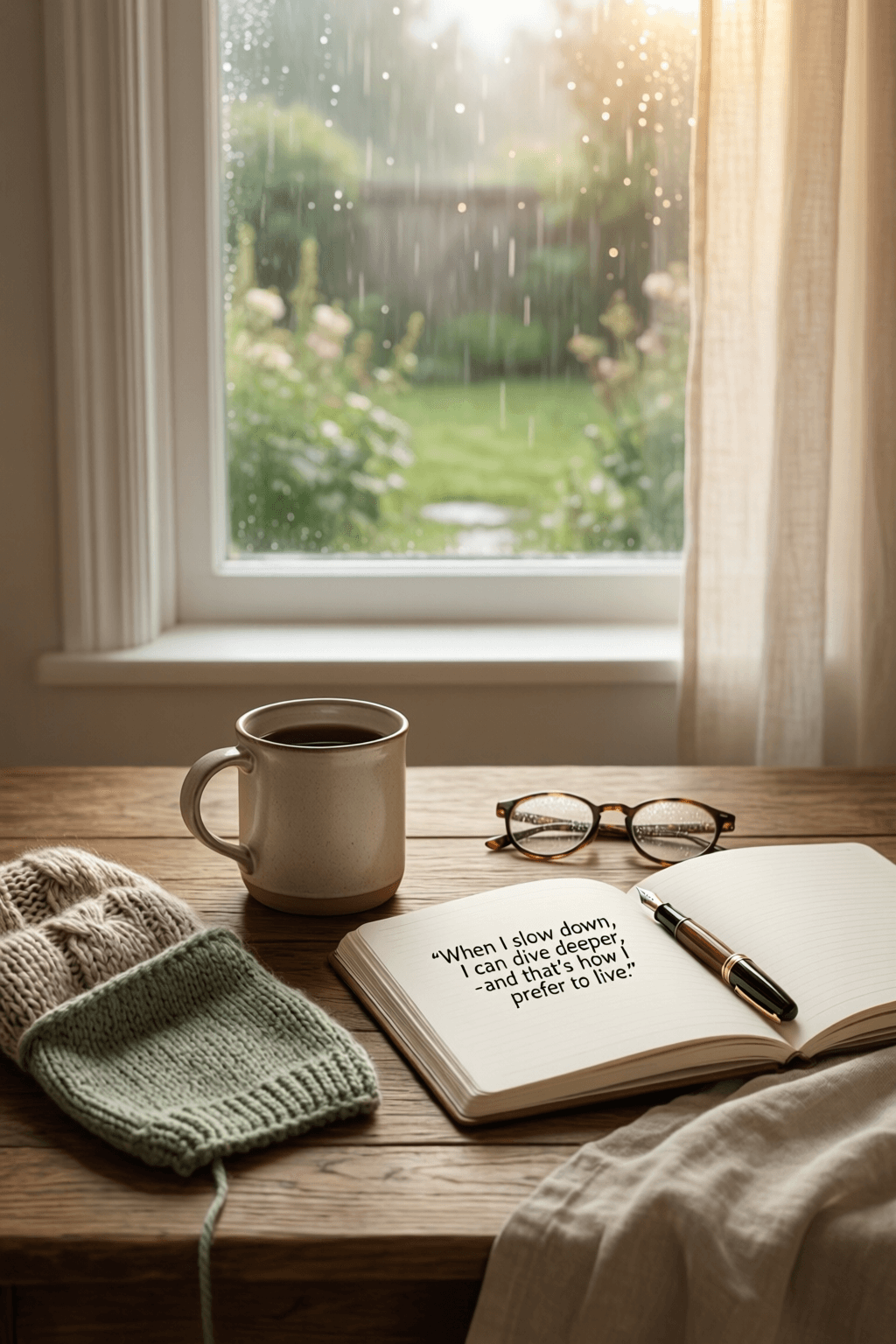
When I slow down, I can dive deeper—and that's how I prefer to live. — Carl Honoré
—What lingers after this line?
A Philosophy of Deliberate Living
At its core, Carl Honoré’s reflection presents slowness not as laziness but as a conscious way of inhabiting life more fully. By saying that slowing down allows him to “dive deeper,” he suggests that speed often keeps us skimming the surface of our own experiences. In this sense, the quote becomes a quiet argument for depth over haste, urging us to value richness of attention rather than sheer quantity of activity. This idea aligns with Honoré’s broader work in In Praise of Slow (2004), where he critiques the cult of speed that dominates modern culture. Rather than rejecting ambition or productivity altogether, he proposes a better rhythm—one in which presence, reflection, and meaning are not sacrificed to urgency.
Why Speed Can Thin Out Experience
From there, the quote invites us to consider what is lost when life is lived too quickly. Constant acceleration can make our days efficient, yet strangely flat: meals are swallowed, conversations are abbreviated, and even rest becomes another task to optimize. As a result, we may do more while feeling less connected to what we do. Honoré’s insight suggests that depth requires time because understanding rarely appears instantly. Just as a novel reveals its layers through careful reading, life discloses its meaning when we linger with it. In other words, slowness creates the mental and emotional space needed for experience to become insight.
Attention as a Form of Depth
Moreover, to “dive deeper” is really to pay fuller attention. When we slow our pace, we notice texture, nuance, and contradiction—the subtle qualities that rush conceals. A conversation with a friend becomes more than an exchange of updates; it becomes an encounter with another person’s inner world. Likewise, a walk turns from transit into observation, revealing details that hurried eyes would miss. This emphasis on attention recalls mindfulness traditions, from Buddhist practice to contemporary psychology, which often link awareness with well-being. Jon Kabat-Zinn’s work on mindfulness in the late 20th century similarly argues that presence transforms ordinary moments. Honoré’s line, therefore, speaks not only to time management but to the quality of consciousness itself.
Resistance to the Culture of Hurry
At the same time, the quote carries a subtle note of resistance. To say “that’s how I prefer to live” is to assert a personal ethic against social pressure. Modern life frequently rewards immediacy—faster replies, quicker decisions, constant availability—so choosing slowness can feel almost rebellious. Yet Honoré frames that choice as a path toward authenticity rather than withdrawal. This makes his statement especially powerful in an era shaped by digital acceleration. The preference for depth challenges the assumption that faster is always better. Instead, it proposes that a meaningful life may depend on recovering the freedom to set one’s own tempo.
The Human Benefits of Moving Gently
Consequently, slowing down has practical as well as philosophical value. It can improve listening, reduce stress, and foster better judgment because the mind is less trapped in reaction mode. Many people recognize this intuitively: a parent who lingers at bedtime, a cook who prepares food without rushing, or an artist who allows ideas to mature often finds greater satisfaction precisely because time was not forced. Even research on stress and cognition supports this broader intuition, showing that chronic urgency can impair focus and emotional balance. By contrast, a slower pace often restores clarity. Honoré’s preference, then, is not merely aesthetic; it reflects a way of living that can make us more humane, attentive, and whole.
Choosing Depth as a Way of Life
Finally, the quote ends not with a rule for everyone but with a declaration of identity: “that’s how I prefer to live.” This phrasing matters because it frames slowness as a sustained orientation, not a temporary retreat. Honoré is describing a life shaped by intention, where depth is chosen again and again in small daily acts. Seen this way, the statement becomes both personal and universal. It invites readers to ask where they have confused motion with meaning, and where a slower pace might restore depth. In the end, Honoré offers a simple but profound measure of a good life: not how fast we move through it, but how deeply we enter it.
One-minute reflection
What feeling does this quote bring up for you?
Related Quotes
6 selectedThe slow philosophy is not about doing everything in tortoise mode. It's about doing everything at the right speed. — Carl Honoré
Carl Honoré
Carl Honoré begins by dismantling a common caricature: that “slow” living is merely an aesthetic of delay, a kind of self-imposed sluggishness. By saying it’s not “tortoise mode,” he rejects the idea that slowness is a f...
Read full interpretation →The great benefit of slowing down is reclaiming the time and tranquility to make meaningful connections. — Carl Honoré
Carl Honoré
Carl Honoré frames slowing down not as laziness but as a practical recovery of something we constantly lose: usable time. When life is lived at full speed, hours get consumed by deadlines, notifications, and “efficient”...
Read full interpretation →To be slow means that you govern the rhythms of your life. You are in control of deciding how fast you have to go. — Carl Honoré
Carl Honoré
Carl Honoré’s line challenges the modern assumption that faster is automatically better. Instead of treating urgency as an objective requirement, he frames speed as a choice—one that can be accepted, negotiated, or refus...
Read full interpretation →We are not defined by the speed of our output, but by the depth of our attention. — Cal Newport
Cal Newport
At first glance, Cal Newport’s line challenges one of modern life’s favorite assumptions: that worth is proven through visible speed. In many workplaces and social spaces, quick replies, rapid delivery, and constant acti...
Read full interpretation →In a society based on speed and productivity, moving slowly is a radical act. — Yung Pueblo
Yung Pueblo
Yung Pueblo’s line begins with an observation that can feel almost invisible because it is so normal: modern life often rewards speed, output, and constant availability. From rapid-fire communication to metrics-driven wo...
Read full interpretation →A rhythm of life that is too fast is a rhythm that is too shallow. — Thomas Merton
Thomas Merton
Thomas Merton’s line turns a common assumption upside down: that faster means fuller. Instead, he suggests that when life accelerates beyond our capacity to absorb it, experience becomes thin—skimmed rather than savored.
Read full interpretation →More From Author
More from Carl Honoré →Be fast when it makes sense to be fast, and be slow when slowness is called for. — Carl Honoré
Carl Honoré’s line begins with a practical admission: speed is not the enemy. There are moments when urgency, efficiency, and quick response are exactly what life requires.
Read full interpretation →When we are calm, ununrried, and free from stress and distractions, the brain slips into a richer, more nuanced mode of thought. — Carl Honoré
At its core, Carl Honoré’s observation suggests that the mind does not always think best at high speed. When we are calm, unhurried, and mentally unburdened, thought becomes less reactive and more reflective.
Read full interpretation →There is a kind of vitality that is not about speed, but about the depth of our attention to the things we choose to cultivate. — Carl Honoré
At first glance, vitality is often mistaken for motion, speed, or constant productivity. Carl Honoré challenges that assumption by suggesting that real aliveness comes not from rushing through life, but from how fully we...
Read full interpretation →Slow living is not about leaving technology behind, but finding a balance. It is a way of engaging more deeply with whatever it is you are doing. — Carl Honoré
At first glance, Carl Honoré’s statement challenges a common misunderstanding: slow living is not laziness, nostalgia, or a rejection of modern life. Instead, it is a deliberate shift in attention.
Read full interpretation →