
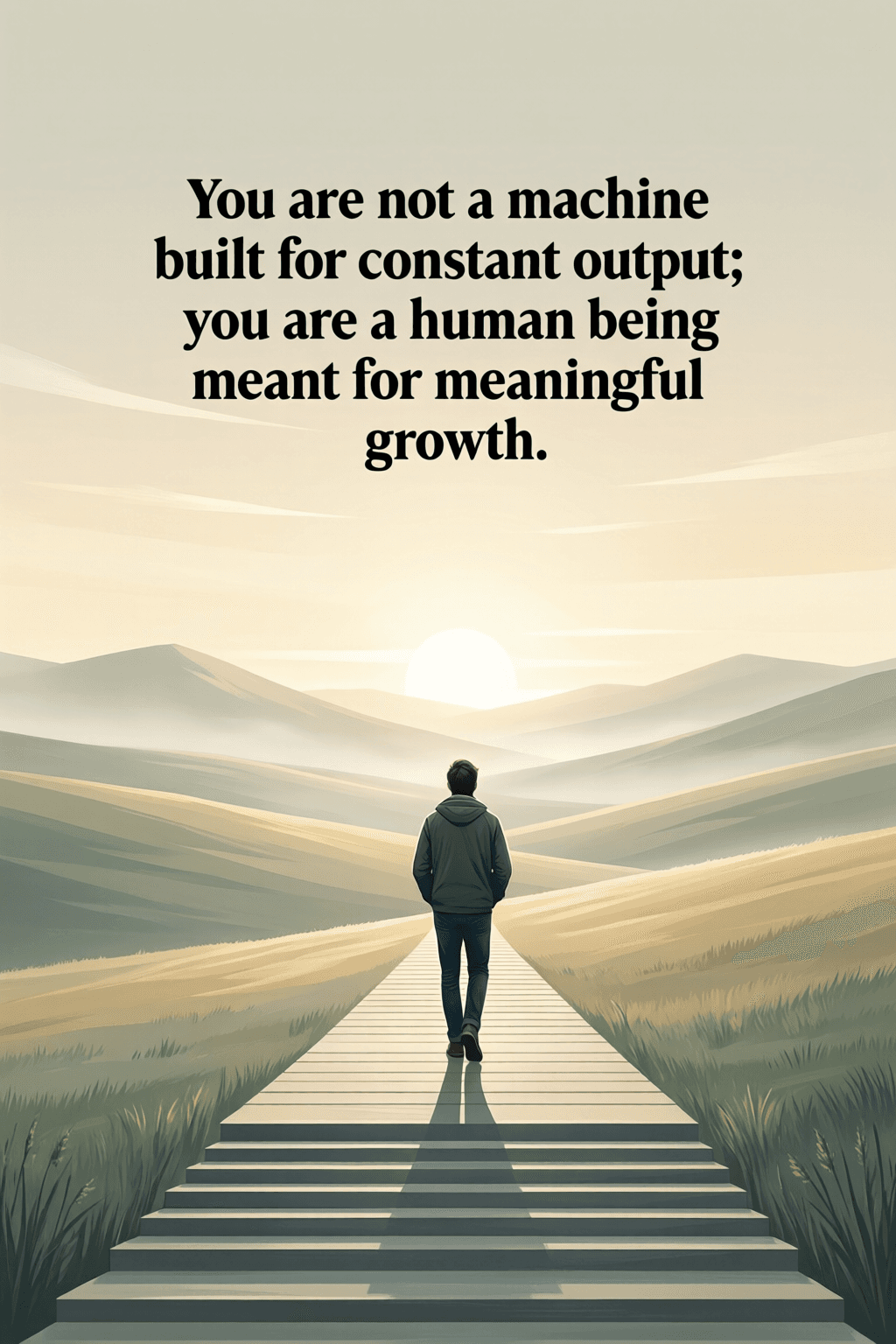
You are not a machine built for constant output; you are a human being meant for meaningful growth. — Maya Angelou
—What lingers after this line?
Rejecting the Machinery of Constant Output
At its core, Maya Angelou’s statement challenges a culture that often measures worth by visible productivity alone. By contrasting a machine with a human being, she exposes the danger of treating life as an endless cycle of performance, efficiency, and exhaustion. The quote insists that people are not designed merely to produce, but to develop inwardly, emotionally, and morally. In this way, her words push back against modern habits of overwork and self-quantification. Rather than asking only, “What did you finish today?” Angelou invites a more searching question: “Who are you becoming?” That shift transforms the entire meaning of success.
Growth as the True Measure of Living
From there, the quote opens into a richer idea of human purpose: meaningful growth. Growth here is not simply career advancement or external achievement, but the gradual deepening of wisdom, compassion, resilience, and self-understanding. Angelou’s own memoir, I Know Why the Caged Bird Sings (1969), reflects this broader vision by portraying growth as a hard-won unfolding of voice and dignity through suffering. As a result, the quote reframes personal development as something more profound than optimization. A life well lived is not one packed with output, but one shaped by reflection, learning, and transformation.
The Cost of Constant Performance
At the same time, Angelou’s words imply a warning: when people live as if they were machines, they risk losing their humanity. Constant output can flatten emotional life, erode relationships, and turn rest into guilt. In that sense, burnout is not just fatigue; it is often the consequence of confusing productivity with identity. This concern echoes social criticism such as Byung-Chul Han’s The Burnout Society (2010), which argues that modern individuals increasingly exploit themselves in the name of achievement. Seen in that light, Angelou’s quote is not merely comforting advice, but a sharp moral correction.
Rest, Reflection, and Inner Renewal
Consequently, if human beings are meant for growth, then rest is not a weakness but a condition for becoming whole. Reflection, silence, and even periods of apparent inactivity allow experience to ripen into insight. Much like a field must lie fallow to remain fertile, a person needs pauses in order to recover imagination and depth. This idea appears in many traditions. For example, Aristotle’s Nicomachean Ethics suggests that the good life depends not on endless labor but on cultivating virtue and contemplation. Angelou’s insight belongs to that larger lineage: renewal is not separate from growth, but one of its essential pathways.
A More Humane Vision of Success
Ultimately, the quote leads toward a more humane standard for judging a life. Success, in Angelou’s sense, cannot be reduced to productivity metrics, public status, or perpetual busyness. Instead, it includes the quieter evidence of becoming more honest, more courageous, more loving, and more fully oneself. Thus the statement works as both reassurance and challenge. It reassures those exhausted by constant demands that their value exceeds their output, and it challenges everyone to pursue growth that has meaning beyond applause. In the end, Angelou reminds us that to be human is not merely to do more, but to become more.
One-minute reflection
What does this quote ask you to notice today?
Related Quotes
6 selectedDo the best you can until you know better. Then when you know better, do better. — Maya Angelou
Maya Angelou
This quote emphasizes the importance of continuous self-improvement. It suggests that striving to do your best at any given moment, based on your current knowledge and abilities, is crucial.
Read full interpretation →Stepping onto a brand-new path is difficult, but not more difficult than remaining in a situation which is not nurturing. — Maya Angelou
Maya Angelou
Maya Angelou frames change as hard, but she refuses to let that difficulty dominate the decision. By comparing “a brand-new path” with “remaining in a situation which is not nurturing,” she shifts the question from comfo...
Read full interpretation →Learning to love yourself is like learning to walk – essential, life-changing, and the only way to stand tall. — Vironika Tugaleva
Vironika Tugaleva
Vironika Tugaleva’s comparison begins with a simple but powerful truth: self-love is not a luxury, but a basic human necessity. Just as walking allows a child to move through the world with growing independence, learning...
Read full interpretation →The most gifted members of the human species are at their creative best when they cannot have their way, and must compensate for what they miss by realizing and cultivating their capacities. — Bryant H. McGill
Bryant H. McGill
Bryant H. McGill’s observation begins with a striking reversal: gifted people may not reach their highest potential when everything comes easily, but when something blocks their path.
Read full interpretation →A mind grows by staying with difficulty long enough for the experience to change it. — Mary Catherine Bateson
Mary Catherine Bateson
Mary Catherine Bateson’s observation begins with a quiet but demanding truth: the mind does not grow merely by encountering difficulty, but by remaining with it. Challenge becomes transformative only when we resist the u...
Read full interpretation →Consistency is a superpower. — Ryan Holiday
Ryan Holiday
Ryan Holiday’s line begins with a deceptively simple idea: greatness is rarely built through dramatic gestures. More often, it emerges from repeated actions that seem ordinary in isolation but become extraordinary over t...
Read full interpretation →More From Author
More from Maya Angelou →We need joy as we need air. We need love as we need water. We need each other as we need the earth we share. — Maya Angelou
Maya Angelou’s words turn emotional needs into elemental ones, placing joy beside air, love beside water, and human connection beside the earth itself. By doing so, she refuses to treat happiness, affection, and communit...
Read full interpretation →The only way to exist in a world that feels increasingly cold is to be the warmth you wish to receive from others. — Maya Angelou
At its core, Maya Angelou’s line reframes loneliness as a call to action rather than a verdict on the world. If life feels impersonal, distant, or harsh, she suggests that waiting passively for kindness may only deepen t...
Read full interpretation →Home is the place where one finally allows the armor to drop and the spirit to breathe. — Maya Angelou
At its core, Maya Angelou’s reflection defines home not merely as a structure but as a sanctuary of emotional safety. The image of letting “the armor drop” suggests that daily life often requires protection—composure, re...
Read full interpretation →The true value of our journey is found in the people who walk beside us, turning simple moments into our most enduring milestones. — Maya Angelou
At its heart, this reflection suggests that life is not valued only by destinations reached, but by the companions who share the road. Maya Angelou’s thought reframes success away from solitary achievement and toward rel...
Read full interpretation →