
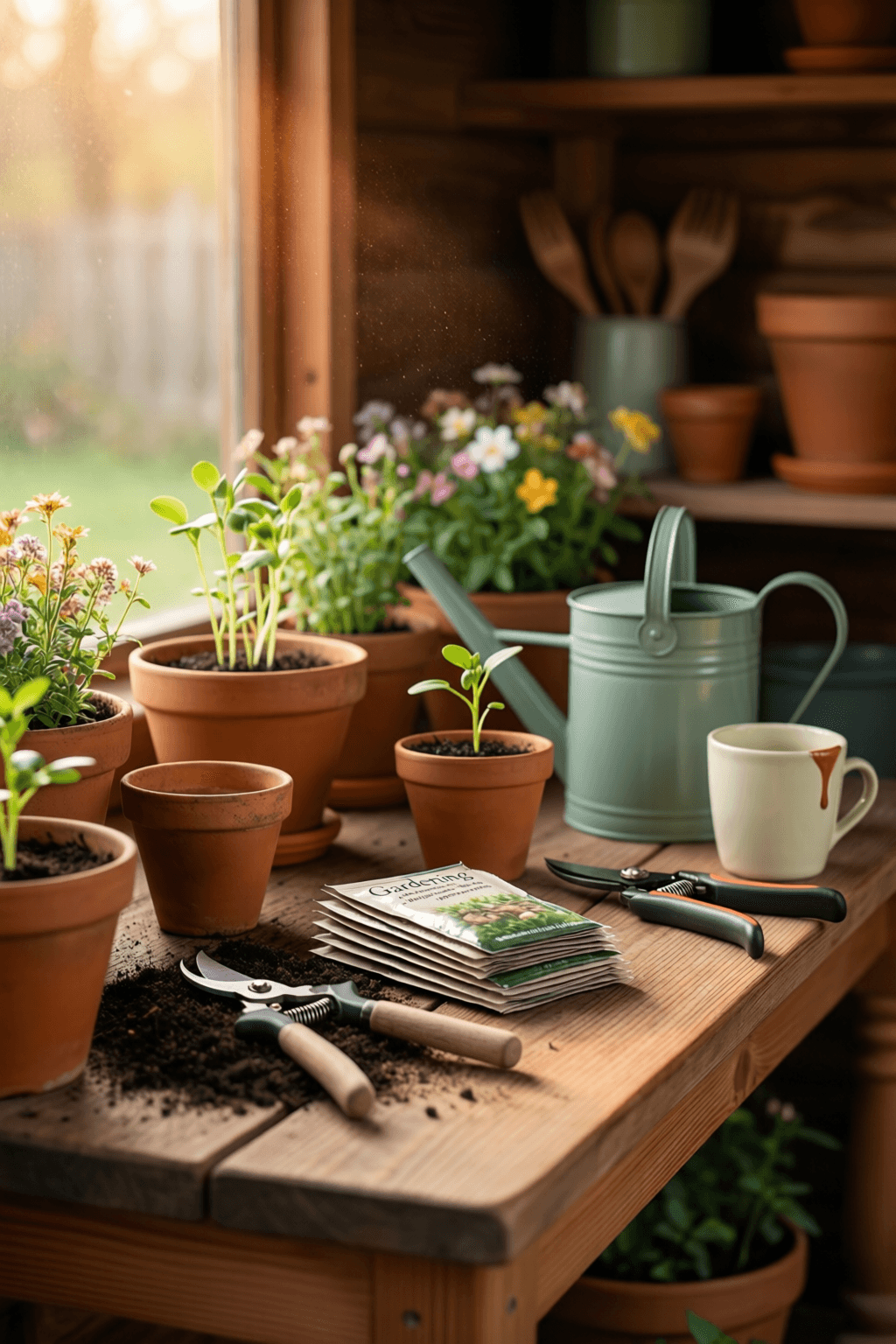
Gardening is the slowest of the performing arts. — Mac Griswold
—What lingers after this line?
A Living Performance in Time
Mac Griswold’s remark transforms gardening from a practical chore into a form of performance, one staged not on a theater floor but in soil, weather, and seasons. At first glance, the comparison seems surprising; yet the more one reflects, the more apt it becomes. Like a performance, a garden is never entirely finished. It unfolds before an audience—neighbors, visitors, pollinators, and even the gardener—through gestures of planting, pruning, and waiting. What makes it the slowest performing art, however, is its tempo. Unlike dance or music, which reveal themselves in minutes or hours, gardening demands months and years before its full expression appears. In this way, the garden teaches that beauty can be cumulative, built through patience rather than speed.
The Gardener as Artist and Director
From that perspective, the gardener resembles both artist and director. They choose color, structure, rhythm, and contrast much as a painter or choreographer would, but instead of controlling static materials, they work with living ones that grow unpredictably. Vita Sackville-West’s garden writings in The Observer (1940s) often reflect this dual role, showing how design begins in intention yet matures through collaboration with nature. Consequently, gardening is an art of guidance rather than domination. The gardener sets the stage, but wind, rain, insects, and time all become co-performers. This shared authorship gives the garden its peculiar vitality, making each season feel like a new interpretation of an old script.
Seasonality as Narrative Structure
Once gardening is seen as performance, the seasons become its narrative arc. Spring offers emergence and anticipation, summer provides fullness and drama, autumn introduces decline and richness, and winter strips the stage to essentials. This cyclical movement gives gardens a storyline that repeats yet never truly duplicates itself. In turn, that pattern helps explain why gardeners often return to the same beds year after year with renewed attention. The Japanese concept of mono no aware, developed in classical literature such as The Tale of Genji (11th century), captures this sensitivity to fleeting beauty. A blossom matters more because it will fade, and the performance feels poignant precisely because it cannot be frozen.
Patience, Labor, and Invisible Rehearsal
Still, the elegance of a garden can obscure the labor behind it. Much of gardening happens out of sight: seeds germinate underground, roots establish quietly, compost breaks down, and plans are revised after failure. In that sense, the slow performance depends on long rehearsals that the audience rarely sees. Moreover, this hidden work gives the quote a deeper truth. A theatrical production condenses preparation into opening night, but a garden keeps rehearsing even while it performs. Anyone who has waited for peonies to bloom or for a young tree to settle in understands that the art lies not only in display but in sustained care, repeated with faith before results are visible.
Beauty Shaped by Uncertainty
At the same time, gardening differs from other arts because uncertainty can never be fully removed. A late frost may erase blossoms overnight, deer may devour tender shoots, and drought may alter the entire composition. Rather than diminishing its artistry, this unpredictability heightens it, because the gardener must respond creatively to conditions beyond control. Here Griswold’s idea becomes especially rich: the performance is not merely slow but improvisational. Gertrude Jekyll’s garden books, especially Colour in the Flower Garden (1908), show careful planning, yet even the most disciplined designs had to accommodate natural surprise. The result is an art form where resilience becomes part of aesthetic skill.
Why the Metaphor Endures
Ultimately, calling gardening the slowest performing art honors both its beauty and its discipline. The phrase suggests that a garden is not just a collection of plants but an experience unfolding in real time, shaped by vision, repetition, and change. It invites us to watch more closely and to appreciate slowness as a creative force rather than a delay. For that reason, the metaphor endures. In a fast culture, gardening stands as a quiet rebuttal, reminding us that some of the most moving performances happen gradually. A tulip border opening over days or a climbing rose taking years to claim its wall can be as expressive as any stage production—only written in leaves, light, and time.
One-minute reflection
Where does this idea show up in your life right now?
Related Quotes
6 selectedEverything that slows us down and forces patience, everything that sets us back into the slow circles of nature, is a help. Gardening is an instrument of grace. — May Sarton
May Sarton
May Sarton’s quote begins with a quiet reversal of modern values: what slows us down is not necessarily an obstacle, but often a gift. In a culture that prizes speed, efficiency, and constant motion, she suggests that de...
Read full interpretation →Patience is not passive waiting. Patience is active acceptance of the process required to attain your goals and dreams. — Ray Davis
Ray Davis
Ray Davis’s words begin by correcting a common misunderstanding: patience is not the same as doing nothing. Passive waiting suggests resignation, as if time alone will deliver success.
Read full interpretation →Slow progress today is often stable progress tomorrow. Fast growth collapses easily. Slow growth holds. — Timeless Type
Timeless Type
At first glance, slow progress can feel discouraging, especially in a culture that praises speed, sudden breakthroughs, and visible success. Yet the quote reminds us that what seems unimpressive today may become the foun...
Read full interpretation →Sometimes you have to slow down to go fast. — Jeff Olson
Jeff Olson
Jeff Olson’s line begins with a practical paradox: speed is not always created by rushing. Sometimes the quickest path forward requires pausing long enough to see the road clearly, correct mistakes early, and choose acti...
Read full interpretation →Everything that is great in life is the product of slow growth; the newer, and greater, and higher, and nobler the work, the slower is its growth. — William George Jordan
William George Jordan
William George Jordan’s reflection begins with a quiet but demanding truth: the most meaningful achievements rarely arrive quickly. He suggests that greatness is not manufactured in sudden bursts but cultivated through t...
Read full interpretation →You cannot force ideas. Successful ideas are the result of slow growth. — Alexander Graham Bell
Alexander Graham Bell
Alexander Graham Bell’s statement begins with a quiet warning against impatience: ideas cannot be commanded into maturity simply because we desire results. Like plants, they require conditions, time, and repeated attenti...
Read full interpretation →More From Author
More from Mac Griswold →