
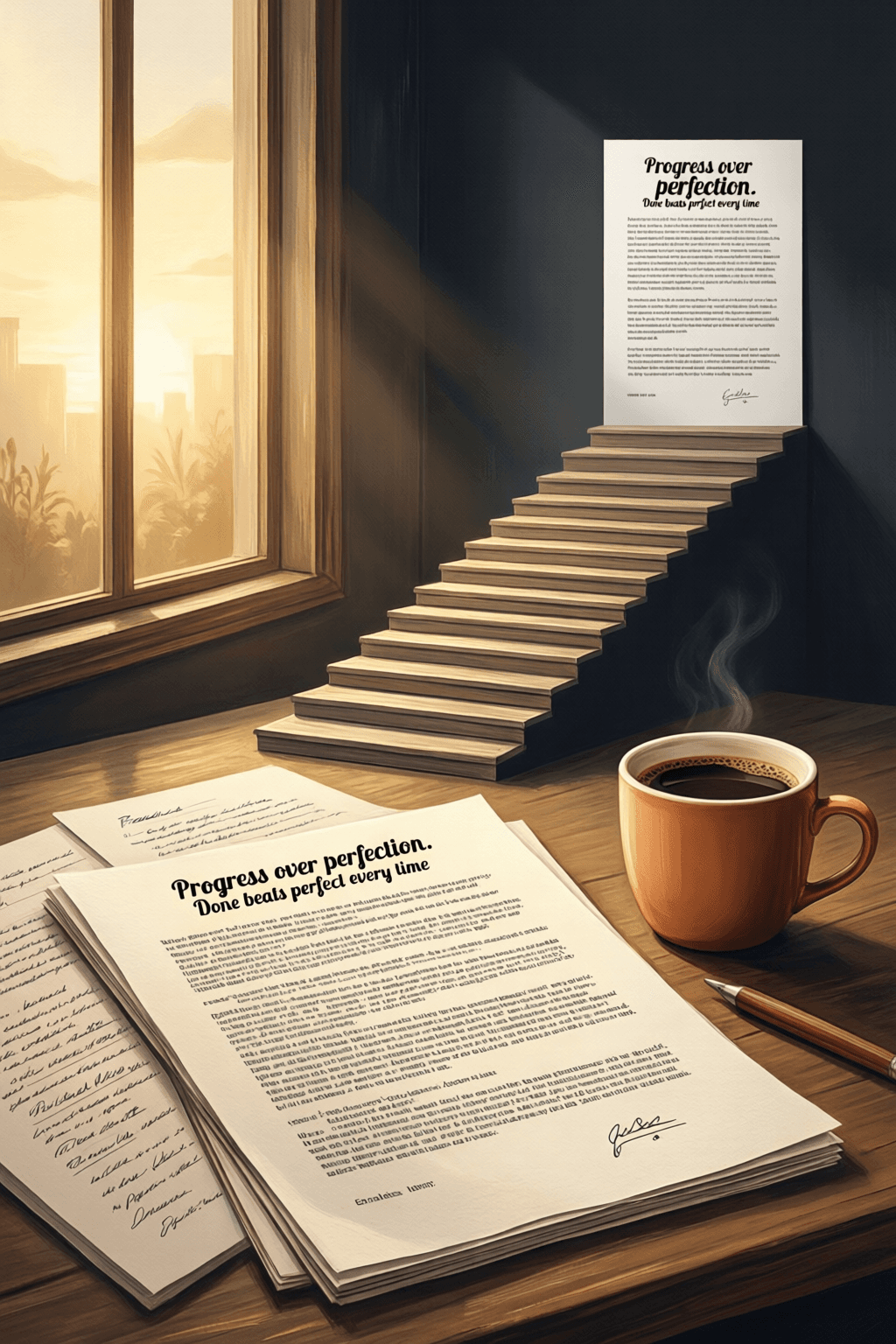
Progress over perfection. Done beats perfect every time. — The Table Read Magazine
—What lingers after this line?
The Core Message
At its heart, the quote argues that movement is more valuable than immaculate intentions. “Progress over perfection” rejects the habit of waiting for flawless conditions, while “done beats perfect every time” reminds us that real results come only from action. In that sense, the statement is less about lowering standards and more about overcoming paralysis. From there, its wisdom becomes practical. A finished draft, launched idea, or attempted solution creates something tangible to improve, whereas perfectionism often leaves potential trapped in planning. The Table Read Magazine’s phrasing captures a modern truth: completion is what allows growth to begin.
Perfectionism as a Hidden Barrier
Seen more closely, perfectionism often disguises itself as ambition, discipline, or high taste. Yet beneath that polished surface, it can become a form of fear—fear of criticism, failure, or being seen before one is fully ready. As a result, people postpone starting or endlessly revise what should have already been shared. This is why the quote feels liberating. It shifts the goal from proving worth to making progress, and that change in mindset can break cycles of hesitation. In other words, imperfect action is not a weakness; it is often the only path through self-doubt.
How Momentum Creates Improvement
Once action replaces hesitation, momentum begins to do its work. A completed task provides feedback, reveals flaws, and opens the door to refinement in ways that theory alone never can. Thomas Edison’s often-cited reflections on repeated attempts before practical success with the light bulb illustrate this broader principle: iteration, not instant perfection, drives advancement. Consequently, progress is not the opposite of excellence but its foundation. Each imperfect version teaches something the untouched ideal never could. By finishing one step, people gain the clarity needed for the next, and improvement becomes a living process rather than a distant standard.
Creative Work Thrives on Completion
This idea is especially visible in creative fields. Writers, artists, and designers rarely produce their best work in a single attempt; instead, they draft, revise, cut, and rebuild. Anne Lamott’s Bird by Bird (1994) famously defends the value of “shitty first drafts,” underscoring that creativity depends on getting something onto the page before it can become good. Accordingly, “done beats perfect” serves as a practical rule for makers of all kinds. A completed rough version has energy and possibility, while an unwritten masterpiece exists only in imagination. By choosing completion first, creators give themselves material they can actually shape.
A Mindset for Everyday Life
Beyond work and art, the quote applies to ordinary routines. A short walk is better than the perfect fitness plan never started; a simple conversation is better than the flawlessly rehearsed apology never spoken. In daily life, progress often arrives through modest, repeatable actions rather than dramatic breakthroughs. Ultimately, the saying encourages a healthier relationship with effort. It teaches that consistency outweighs polish and that small completed acts accumulate into meaningful change. By valuing movement over immaculate results, people become more resilient, more productive, and far more likely to reach the excellence they once delayed.
One-minute reflection
What feeling does this quote bring up for you?
Related Quotes
6 selectedThink progress, not perfection. — Ryan Holiday
Ryan Holiday
Ryan Holiday’s line cuts through a common self-deception: the belief that we must be flawless before we begin. In practice, “perfection” often becomes a socially acceptable excuse for delay—endless planning, tweaking, an...
Read full interpretation →Choose motion over perfect plans; progress prefers imperfect feet. — Søren Kierkegaard
Søren Kierkegaard
Kierkegaard’s line begins by naming a familiar trap: the belief that if we think long enough, we can design a flawless route through uncertainty. Yet perfection in planning often functions less as wisdom and more as a sh...
Read full interpretation →Seek not perfection before beginning; progress is the artisan of success. — Marie Curie
Marie Curie
At the outset, the aphorism—often attributed to Marie Curie—warns against letting the ideal stall the initial step. When we delay action until conditions are flawless, we trade momentum for mirages; by contrast, beginnin...
Read full interpretation →Trade perfection for progress and watch doors open. — Brené Brown
Brené Brown
Brené Brown’s line invites a brave exchange: let go of flawless performance and lean into forward motion. In The Gifts of Imperfection (2010) and Daring Greatly (2012), she argues that vulnerability—showing up before eve...
Read full interpretation →Progress, not perfection, is what we should be asking of ourselves. — Julia Cameron
Julia Cameron
This quote encourages individuals to prioritize continuous improvement over an unattainable standard of perfection. Growth and learning happen gradually through effort and persistence.
Read full interpretation →Seek progress, not perfection—movement conquers inertia. — Bell Hooks
bell hooks
Bell Hooks' exhortation to favor progress over perfection highlights a common struggle: the debilitating grip of perfectionism. When individuals aim for flawlessness, they often find themselves paralyzed, reluctant to ta...
Read full interpretation →More From Author
More from The Table Read Magazine →