
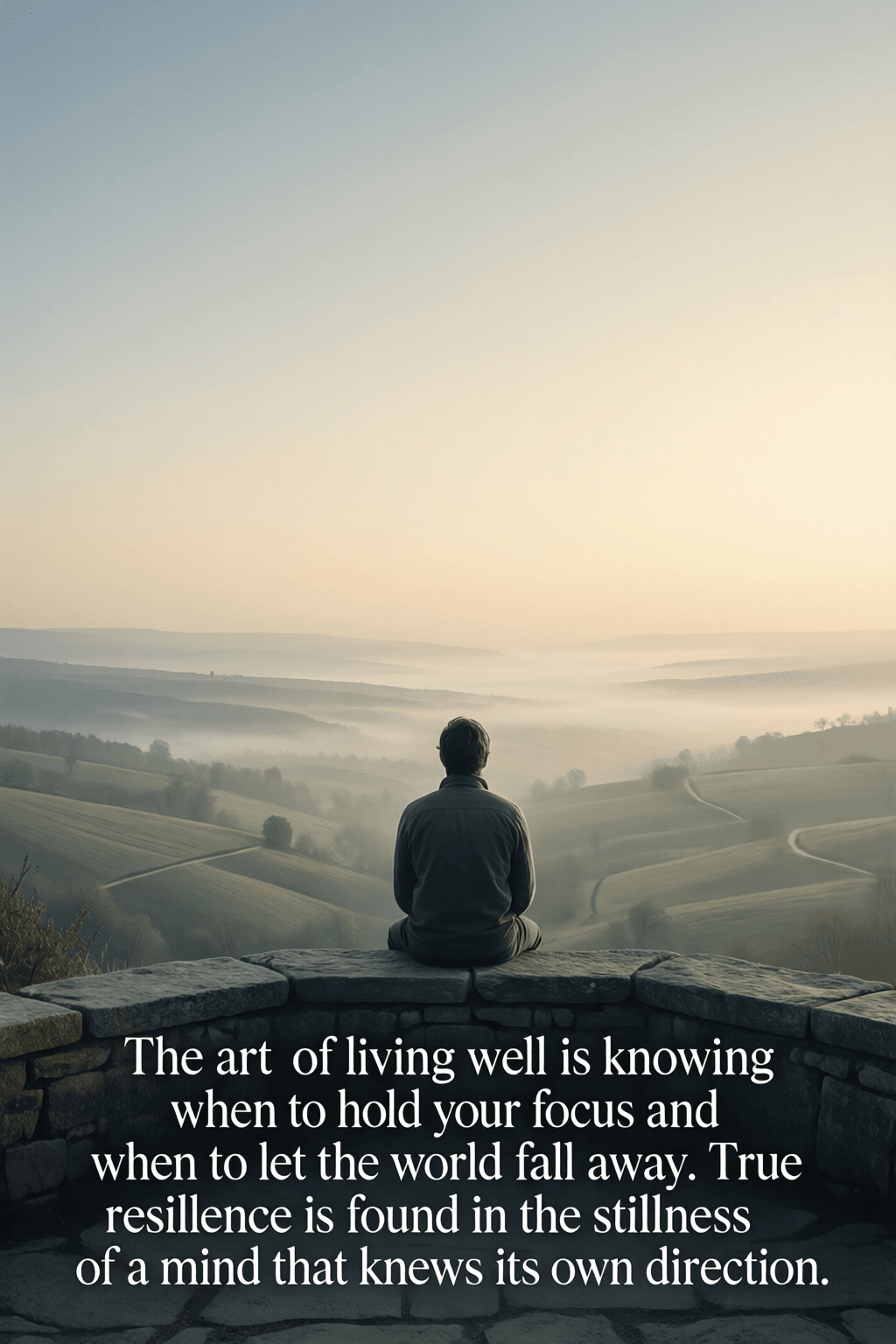
The art of living well is knowing when to hold your focus and when to let the world fall away. True resilience is found in the stillness of a mind that knows its own direction. — Marcus Aurelius
—What lingers after this line?
A Discipline of Inner Attention
At its core, this reflection presents living well as an act of disciplined attention. To ‘hold your focus’ is not merely to concentrate harder; rather, it means choosing what deserves the mind’s energy and refusing to be ruled by distraction. In that sense, the art of living becomes less about controlling the world and more about governing one’s response to it, a theme central to Marcus Aurelius’s Meditations (c. 180 AD). From this starting point, the quotation suggests that peace does not arise by accident. Instead, it emerges when a person learns to distinguish between what is essential and what is noise. That quiet act of selection becomes the first step toward resilience.
Letting the World Fall Away
Yet the saying does not praise relentless effort alone; it also honors release. Knowing when to let the world fall away implies a mature form of detachment, not indifference but clarity. Stoic writers such as Epictetus’s Enchiridion (c. 125 AD) repeatedly advise separating what lies within our control from what does not, and this quote echoes that same wisdom in gentler language. As a result, withdrawal here is not escape but restoration. A person who briefly steps back from noise, urgency, and public pressure can return with clearer judgment. In that way, letting go becomes the companion of focus rather than its opposite.
Stillness as Strength
From there, the quotation deepens its claim by locating resilience in stillness. This is striking because resilience is often imagined as force, endurance, or visible toughness. However, the line argues that true strength may look quieter: a mind that does not panic, scatter, or collapse when circumstances become unstable. This idea appears across traditions. In the Tao Te Ching, traditionally attributed to Laozi (c. 4th century BC), stillness is linked with alignment and power rather than passivity. Likewise, Marcus Aurelius often portrays the mind as a place that can remain orderly amid chaos. The resilient person, then, is not the one who never feels pressure, but the one who can remain inwardly composed within it.
Knowing One’s Own Direction
Stillness alone, however, is not enough; the mind must also ‘know its own direction.’ This phrase shifts the focus from calmness to purpose. Without a clear sense of values, even a quiet mind can drift. Marcus Aurelius’s Meditations repeatedly return to duty, virtue, and right action, suggesting that inner steadiness gains meaning only when it is tied to a moral compass. A simple modern example makes this vivid: a surgeon in an emergency room or a pilot in turbulence cannot afford emotional confusion. Their calm matters because it serves a clear aim. In the same way, the quote implies that resilience depends not just on serenity, but on a settled understanding of what one is trying to serve.
Resilience Beyond Reaction
Consequently, resilience here is not defined as mere recovery after hardship. It is a prior condition of the self: the cultivated ability to avoid being conquered by every passing event. Modern psychology often describes resilience as adaptive coping, but this quotation pushes further by emphasizing prevention through mental order. One survives difficulty better when one has already trained attention, detachment, and purpose. This interpretation also helps explain why stoic practice remains influential today. Journaling, reflection, and deliberate pauses before reacting all strengthen the ability to meet stress without surrendering to it. Resilience, in this view, is less a dramatic comeback than a daily habit of inward steadiness.
A Practical Philosophy for Daily Life
Finally, the quote speaks so powerfully because it transforms philosophy into a practical rhythm: focus, release, stillness, direction. These are not abstract ideals reserved for emperors or sages. They can shape ordinary life whenever someone ignores a needless provocation, steps back from digital noise, or returns attention to a chosen responsibility. Thus the message is both ancient and immediate. To live well is to know what deserves devotion, what can be relinquished, and how to preserve inner order while the world clamors for reaction. In that balance, the line suggests, resilience becomes not an emergency resource but a way of being.
One-minute reflection
What does this quote ask you to notice today?
Related Quotes
6 selectedThe spring that keeps running is more valuable than the jug which bottoms out each day. — Charlotte Joko Beck
Charlotte Joko Beck
At first glance, Charlotte Joko Beck’s image contrasts two simple things: a living spring and a finite jug. The spring matters more because it renews itself, while the jug, however useful, eventually runs dry.
Read full interpretation →Your home should be the place where the day softens around the edges. — Unknown (removed per constraints) -> Let's use: "Home is not a place; it is a feeling of being able to handle whatever the world throws at you." — Cheryl Richardson
Cheryl Richardson
At first glance, Cheryl Richardson’s quote shifts the meaning of home away from geography and architecture. Home is no longer merely a house, apartment, or hometown; instead, it becomes an emotional condition—a steady in...
Read full interpretation →Clarity isn't found in chaos but in the moments we focus, breathe, and choose purpose over pressure. — Anonymous (Replaced by: The best part of a holiday is perhaps not so much to be resting yourself, as to see all the other fellows busy working. — Kenneth Grahame)
Kenneth Grahame
At first glance, the original reflection suggests that clarity does not emerge from a crowded, frantic mind but from deliberate attention. By linking focus, breath, and purpose, it frames peace as an active choice rather...
Read full interpretation →Only to the extent that we expose ourselves over and over to annihilation can that which is indestructible in us be found. — Pema Chödrön
Pema Chödrön
Pema Chödrön’s line hinges on an unsettling premise: what lasts in us is not discovered by protecting ourselves, but by repeatedly meeting what feels like our end. “Annihilation” here is less a literal destruction than t...
Read full interpretation →Cultivate a private garden of resolve that flowers in quiet storms. — Emily Dickinson
Emily Dickinson
Emily Dickinson’s line invites us first to imagine the self as a walled garden, hidden from public view. In her poetry and letters, she often retreated to private spaces—her room, her Amherst home—as sites of intense inn...
Read full interpretation →In the depth of winter, I finally learned that within me there lay an invincible summer. - Albert Camus
Albert Camus
This quote highlights the idea of an inner strength that persists even during the most challenging times. No matter how tough the external circumstances (the 'winter') may be, there is an enduring, powerful force ('summe...
Read full interpretation →More From Author
More from Marcus Aurelius →Consistency is the sum that equals what we become. — Marcus Aurelius
Marcus Aurelius’ line frames becoming as a kind of moral mathematics: each repeated action adds to the total of a life. Rather than imagining identity as a single grand decision, the quote suggests that character is accu...
Read full interpretation →If anyone can refute me—show me I'm making a mistake or looking at things from the wrong perspective—I'll gladly change. — Marcus Aurelius
Marcus Aurelius begins from a position that appears modest but is actually deeply disciplined: he is willing to be corrected. Rather than treating disagreement as an insult, he frames it as an opportunity to see more cle...
Read full interpretation →The art of life is more like the wrestler's art than the dancer's; stand ready and firm to meet sudden and unexpected onsets. — Marcus Aurelius
Marcus Aurelius contrasts two arts to clarify what living well demands. A dancer suggests elegance, rhythm, and practiced beauty; a wrestler, by contrast, suggests balance under pressure, resistance, and constant readine...
Read full interpretation →How much time he gains who does not look to see what his neighbour says or does or thinks, but only at what he does himself, to make it just and holy. — Marcus Aurelius
Marcus Aurelius argues that a great deal of life is wasted in watching other people—what they say, what they do, and even what they might be thinking. Instead, he recommends a disciplined inward turn: focus on your own c...
Read full interpretation →