
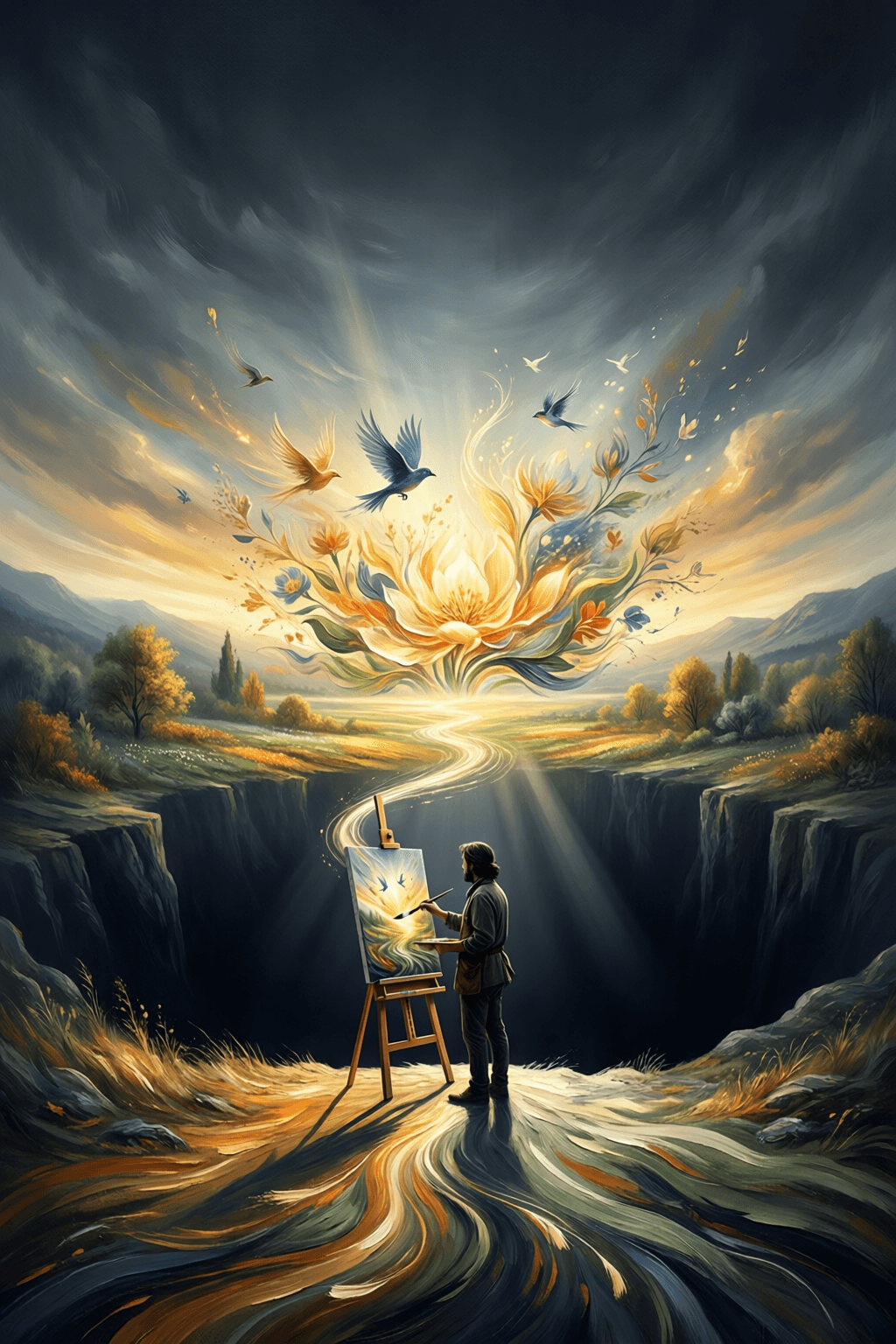
The artist's job is not to succumb to despair but to find an antidote for the emptiness of existence. — Aldous Huxley
—What lingers after this line?
Despair Is Not the Final Task
At its core, Huxley’s statement rejects the romantic notion that artists are meant merely to suffer and mirror despair back to the world. Instead, he assigns them a more demanding responsibility: to confront emptiness without surrendering to it. In this view, artistic creation becomes an act of resistance, transforming private anguish into something that can sustain human meaning. This shift is crucial because it moves art from passive witness to active remedy. Rather than glorifying hopelessness, Huxley suggests that the artist must shape experience into forms that help others endure it. As a result, the creative act becomes not an escape from existence, but a way of answering its hollowness with vision, order, and feeling.
Meaning Made Through Creation
From there, Huxley’s idea naturally connects to a broader existential tradition: if life often feels empty, meaning must be made rather than found ready-made. Albert Camus’ essay “The Myth of Sisyphus” (1942) similarly argues that the human response to absurdity is not surrender but revolt. Yet Huxley gives that revolt a specifically artistic form, suggesting that beauty, pattern, and imagination can become tools against the void. A simple example appears in the life of Vincent van Gogh, whose letters to Theo repeatedly frame painting as a way to wrest order and radiance from suffering. Thus, even when art begins in loneliness or confusion, it need not end there. Instead, creation can convert raw inner emptiness into shared significance.
The Artist as Cultural Healer
Moreover, Huxley implies that the artist serves not only the self but the wider community. When a novel, song, or painting gives shape to feelings people cannot articulate, it offers relief from isolation. In that sense, the antidote is communal: art reassures us that our unease is neither unique nor mute, but part of a human condition that can be expressed and therefore endured. This healing function appears vividly in Pablo Picasso’s “Guernica” (1937), which does not erase horror yet transforms collective trauma into a lasting public language. Likewise, Toni Morrison’s “Beloved” (1987) turns historical pain into narrative memory, making grief speakable. Consequently, the artist becomes a mediator between private emptiness and collective recognition.
Beauty Without Denial
Importantly, Huxley does not seem to call for sentimental optimism or decorative escape. An antidote is not the same as a distraction; it works precisely because it engages the wound it seeks to answer. Therefore, art can face suffering directly while still offering form, beauty, or insight that prevents despair from having the final word. This balance can be seen in T. S. Eliot’s “The Waste Land” (1922), a poem saturated with fragmentation and spiritual fatigue. Even so, its intricate structure and layered voices create meaning out of disarray. In other words, the artwork need not pretend the emptiness is unreal. Rather, by giving chaos shape, it demonstrates that consciousness can still respond creatively to ruin.
An Ethical Responsibility of Imagination
Finally, Huxley’s remark presents art as an ethical vocation. If the artist’s task is to find an antidote, then imagination carries responsibility: it must search for forms of truth, connection, and renewal that help life remain livable. This does not mean every artwork must be cheerful, but it does mean serious art should deepen our capacity to face existence rather than collapse before it. Seen this way, the artist resembles a guide more than a victim. James Baldwin’s essays, especially in “The Fire Next Time” (1963), confront terror and disillusionment while still insisting on the possibility of human honesty and transformation. Thus Huxley leaves us with a demanding hope: art matters because it can answer emptiness with a more habitable vision of being alive.
Recommended Reading
As an Amazon Associate, we earn from qualifying purchases.
One-minute reflection
What does this quote ask you to notice today?
Related Quotes
6 selectedIf you find me in my work, I haven't done my job. If you find yourself, then I'm an artist. — Louise Bourgeois
Louise Bourgeois
At first glance, Louise Bourgeois rejects the idea that art should function as a clear signature of its maker. When she says, “If you find me in my work, I haven't done my job,” she turns attention away from autobiograph...
Read full interpretation →There are things known and there are things unknown, and in between are the doors of perception. — Aldous Huxley
Aldous Huxley
Aldous Huxley’s line divides reality into three striking regions: what we know, what we do not know, and the mysterious passage between them. Rather than treating knowledge and ignorance as fixed opposites, he imagines p...
Read full interpretation →Lightly child, lightly. Learn to do everything lightly. — Aldous Huxley
Aldous Huxley
Huxley’s brief line reads like advice from someone who has watched people make life heavier than it needs to be. By repeating “lightly,” he turns a simple adverb into a philosophy: approach action, thought, and even diff...
Read full interpretation →It is dark because you are trying too hard. — Aldous Huxley
Aldous Huxley
Huxley’s line immediately turns a familiar assumption upside down: difficulty does not always arise from too little effort, but sometimes from too much. In this view, darkness is not merely an external condition imposed...
Read full interpretation →The more powerful and original a mind, the more it will incline towards the religion of solitude. — Aldous Huxley
Aldous Huxley
Huxley’s phrase “religion of solitude” reframes being alone as more than a preference: it becomes a disciplined devotion, a set of inner practices that gives meaning and structure to thought. By calling it a religion, he...
Read full interpretation →Experience is not what happens to you; it's what you do with what happens to you. — Aldous Huxley
Aldous Huxley
This quote redefines 'experience' as not merely the events or circumstances one goes through, but rather the actions, choices, and responses one makes in reaction to those events.
Read full interpretation →More From Author
More from Aldous Huxley →There are things known and there are things unknown, and in between are the doors of perception. — Aldous Huxley
Aldous Huxley’s line divides reality into three striking regions: what we know, what we do not know, and the mysterious passage between them. Rather than treating knowledge and ignorance as fixed opposites, he imagines p...
Read full interpretation →Lightly child, lightly. Learn to do everything lightly. — Aldous Huxley
Huxley’s brief line reads like advice from someone who has watched people make life heavier than it needs to be. By repeating “lightly,” he turns a simple adverb into a philosophy: approach action, thought, and even diff...
Read full interpretation →It is dark because you are trying too hard. — Aldous Huxley
Huxley’s line immediately turns a familiar assumption upside down: difficulty does not always arise from too little effort, but sometimes from too much. In this view, darkness is not merely an external condition imposed...
Read full interpretation →The more powerful and original a mind, the more it will incline towards the religion of solitude. — Aldous Huxley
Huxley’s phrase “religion of solitude” reframes being alone as more than a preference: it becomes a disciplined devotion, a set of inner practices that gives meaning and structure to thought. By calling it a religion, he...
Read full interpretation →