
If you find me in my work, I haven't done my job. If you find yourself, then I'm an artist. — Louise Bourgeois
—What lingers after this line?
A Shift from Artist to Audience
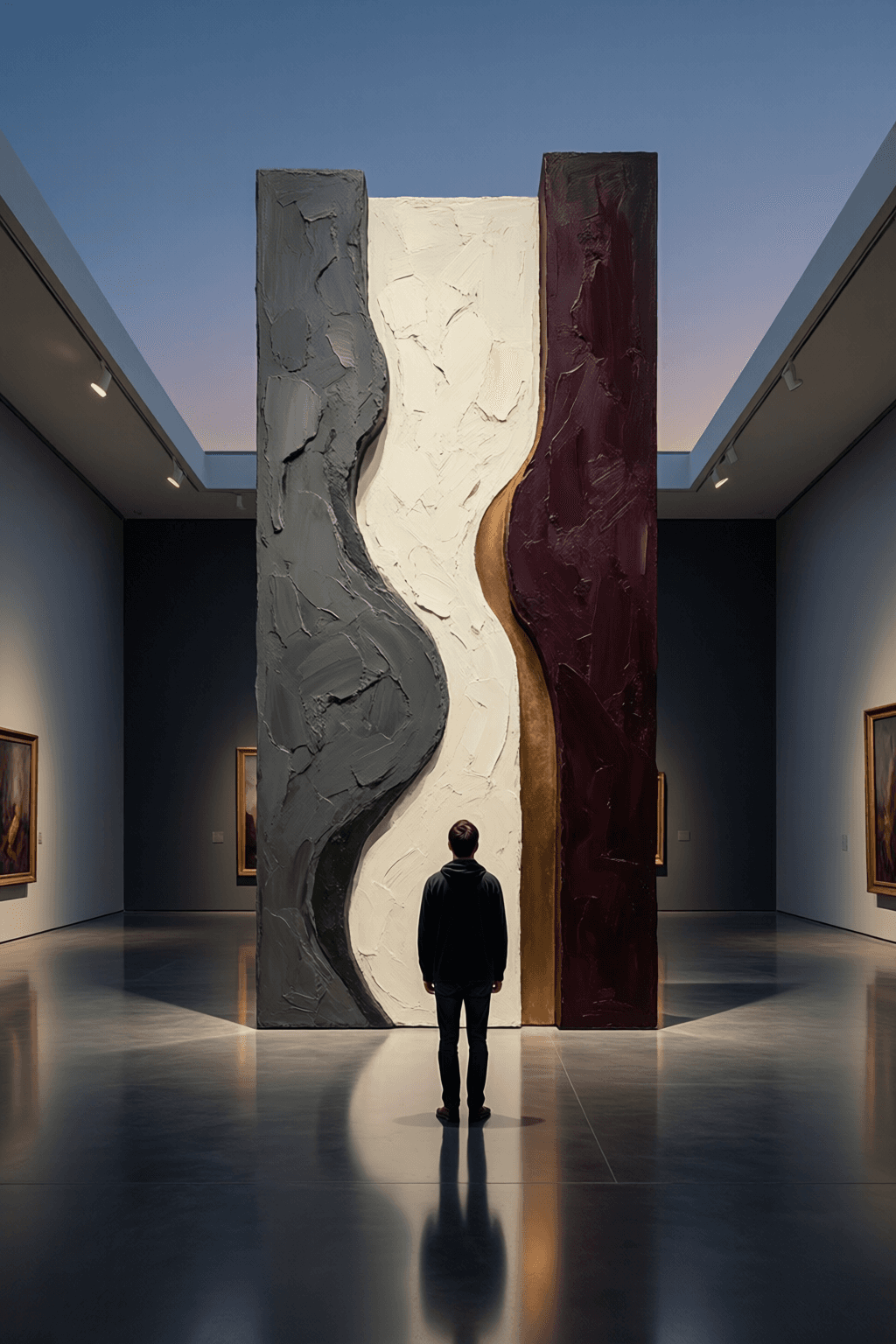
At first glance, Louise Bourgeois rejects the idea that art should function as a clear signature of its maker. When she says, “If you find me in my work, I haven't done my job,” she turns attention away from autobiography as the final destination. Instead, she proposes that the artwork should become a space where the viewer encounters something deeply personal in themselves. In this way, Bourgeois redefines artistic success. Rather than asking audiences to decode her private life, she asks them to feel, project, and recognize their own fears, memories, or desires. The artist’s role, then, is not simply to confess, but to create conditions for self-recognition.
Art as a Mirror, Not a Monument
From that starting point, the quote suggests that great art behaves less like a monument to the creator and more like a mirror for the observer. A monument says, “Look at me”; a mirror quietly asks, “What do you see?” Bourgeois implies that art reaches its highest purpose when it opens an inward journey rather than delivering a fixed message. This idea helps explain why certain works remain powerful across generations. Although Bourgeois drew on personal trauma and memory, her forms—fragile cells, looming spiders, bodily shapes—avoid narrow explanation. Consequently, viewers are invited to supply their own meanings, making the experience intimate rather than merely informative.
The Universal Hidden in the Personal
Yet Bourgeois does not mean that the artist’s self disappears entirely. Rather, the personal must be transformed so thoroughly that it becomes universal. Her own life undeniably informed works like Maman (1999), often linked to her memories of her mother as a weaver and protector. However, the sculpture’s scale and ambiguity allow it to evoke many responses at once—fear, shelter, awe, tenderness. Therefore, the private origin of a work is only the beginning, not the endpoint. Bourgeois suggests that art succeeds when it converts individual experience into a shared emotional language. What starts as one woman’s memory can become another person’s revelation.
A Psychological Encounter
Moreover, the quotation reflects Bourgeois’s long engagement with psychoanalysis and emotional excavation. Much of her work explores memory, childhood, sexuality, and anxiety, but not in a purely documentary way. Instead, she stages encounters with feeling, often through unsettling forms that bypass neat interpretation and go straight to the nervous system. Seen this way, “If you find yourself, then I'm an artist” becomes almost clinical in its precision. The artwork acts like a trigger for recognition, bringing buried material to the surface. In that sense, Bourgeois resembles artists and writers such as Marcel Proust, whose In Search of Lost Time (1913–1927) shows how external objects can suddenly unlock the inner life.
Why Ambiguity Matters
Because Bourgeois values self-discovery in the viewer, ambiguity becomes essential rather than accidental. If a work were too explicit, it would close off interpretation and return us to the artist’s own story. By leaving symbolic space—through suggestive shapes, emotional tension, and unresolved meanings—she allows each viewer to enter from a different angle. This is why difficult or unsettling art can feel strangely generous. It does not hand over a lesson; it offers room. Bourgeois trusts that confusion, discomfort, and fascination can become productive states, leading viewers toward truths they may not have articulated before they stood before the work.
An Ethics of Artistic Making
Finally, Bourgeois’s statement carries an ethical challenge for artists themselves. It suggests that making art is not merely self-expression in the raw, but an act of transformation. The artist must shape personal material so carefully that it becomes a vessel for others, not simply a display of personal identity. In this sense, her quote stands against narcissism without denying subjectivity. The artist begins with the self but should not trap the audience there. Instead, as Bourgeois implies, true artistry lies in turning private emotion into a shared human encounter—one in which the viewer leaves having discovered something unexpected within.
One-minute reflection
Why might this line matter today, not tomorrow?
Related Quotes
6 selectedThe artist is a sort of emotional archaeologist. Digging through the layers of the self is not just a process; it is a necessity for clarity. — bell hooks
bell hooks
bell hooks frames the artist as an “emotional archaeologist,” and the image is striking because archaeology is never casual digging. It requires patience, method, and a willingness to uncover what time has buried.
Read full interpretation →Your work is to discover your world and then with all your heart give yourself to it. — Buddha
Buddha
This quote emphasizes the importance of self-discovery. It encourages individuals to explore their unique paths and understand their true desires and aspirations.
Read full interpretation →Art enables us to find ourselves and lose ourselves at the same time. — Thomas Merton
Thomas Merton
Thomas Merton’s reflection begins with the revelation that art, in all its forms, acts as a profound mirror. When we engage with a painting, novel, or symphony, we often perceive our own inner feelings, values, and dream...
Read full interpretation →You will never be able to experience everything. So, please, do poetical justice to your soul and simply experience yourself. — Albert Camus
Albert Camus
Camus begins from a humbling truth: no person can live every possible life, see every landscape, or test every path. Because existence is finite, the dream of total experience becomes a source of restlessness rather than...
Read full interpretation →You cannot express something you have not first discovered. — Carl Jung
Carl Jung
At its core, Jung’s remark suggests that authentic expression begins not with performance but with discovery. A person cannot meaningfully speak, create, or reveal what has never been encountered within the self.
Read full interpretation →Sometimes losing everything is how you find yourself. — J.K. Rowling
J.K. Rowling
At first glance, J.K. Rowling’s line frames devastation not simply as an ending, but as a brutal kind of beginning.
Read full interpretation →More From Author
More from Louise Bourgeois →