
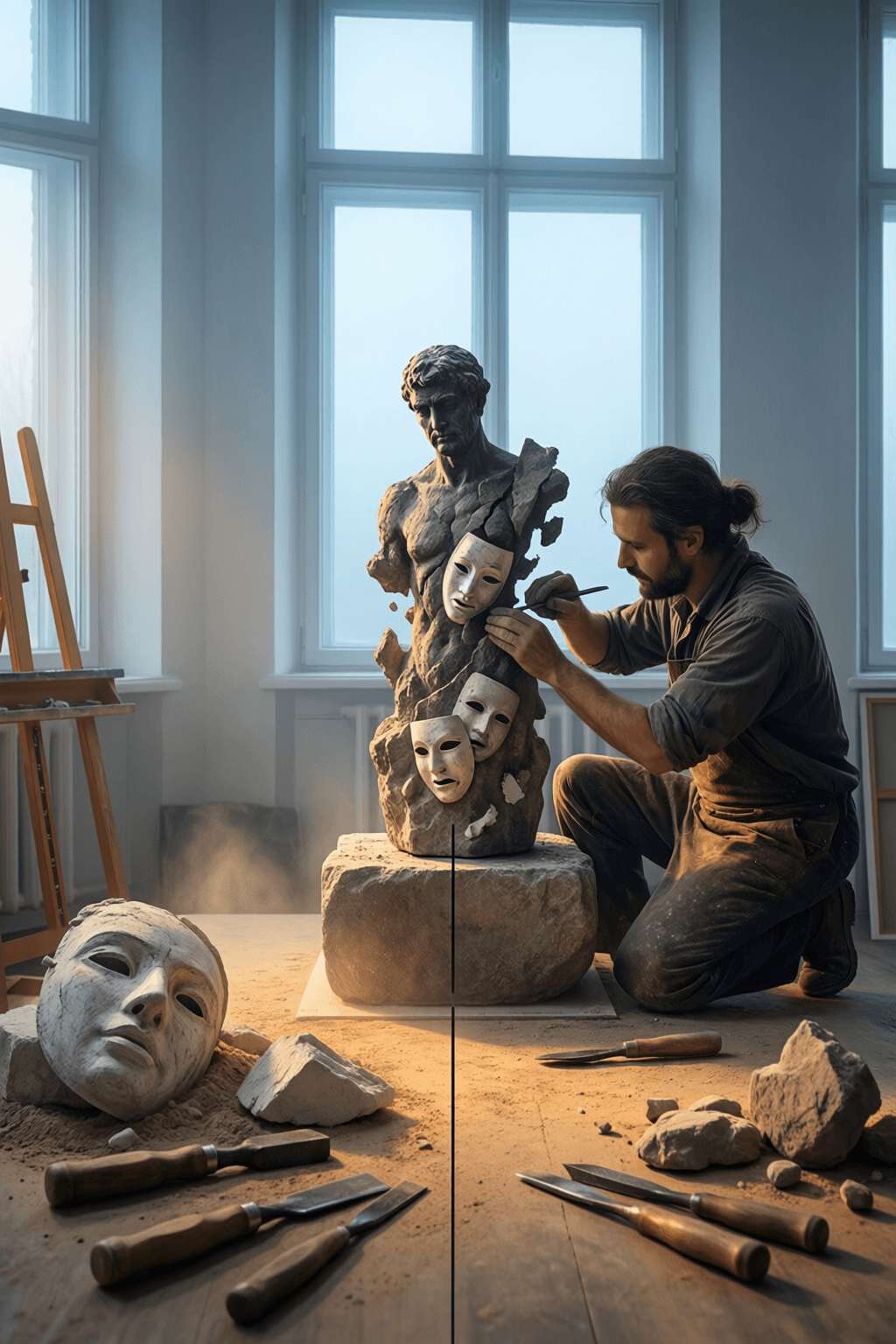
Every day you have to abandon your past or accept it, and then, if you cannot accept it, you become a sculptor. — Louise Bourgeois
—What lingers after this line?
A Daily Reckoning with the Past
Louise Bourgeois frames life as a repeated confrontation with memory rather than a single moment of resolution. Each day, she suggests, we must either let the past fall away or consciously make peace with it. In that sense, the quote is not merely about biography but about the ongoing labor of living, where identity is constantly shaped by what we carry forward and what we release. From this starting point, her words also imply that the past never becomes neutral on its own. It demands an answer. Either acceptance transforms memory into something bearable, or unresolved experience continues pressing inward, asking to be expressed in another form.
Why Art Begins Where Acceptance Fails
If acceptance proves impossible, Bourgeois says, one becomes a sculptor. This is not just a literal statement about making objects; rather, it suggests that creative work begins where emotional resolution breaks down. Art becomes a substitute process for reconciliation, a way of handling what cannot be neatly forgiven, forgotten, or explained. Consequently, sculpture stands here as an act of externalization. What remains jagged inside is given contour, weight, and presence outside the self. Bourgeois’s own work, including her monumental spiders such as Maman (1999), often turned private feelings about family, fear, and protection into physical forms, showing how art can materialize psychic tension.
Memory Made Physical
What makes Bourgeois’s image especially powerful is her choice of the sculptor, someone who works with pressure, removal, balance, and mass. Unlike fleeting speech, sculpture occupies space; it insists on being encountered. In this way, the quote implies that unaccepted memories are not airy thoughts but dense realities that must be handled almost like stone, clay, or metal. Moreover, this physical metaphor aligns with Bourgeois’s lifelong interest in the body and domestic memory. As scholars often note in discussions of works like Cells (begun 1989), she created enclosed environments that feel like rooms of recollection. Thus, memory is not simply remembered; it is built, carved, and arranged.
Transformation Rather Than Escape
Importantly, Bourgeois does not present sculpture as a heroic escape from suffering. Instead, it is a method of transformation. If the past cannot be accepted, it is still not denied; it is reworked. This subtle distinction gives the quote its depth, because it refuses both easy healing and total erasure. In that sense, her idea echoes broader artistic traditions in which making becomes a form of survival. Marcel Proust’s In Search of Lost Time (1913–1927) similarly turns memory into art rather than leaving it as raw pain. Yet Bourgeois is more tactile and severe: where Proust writes memory, she molds it, suggesting that some experiences require form before they can be faced.
The Artist as Someone Who Cannot Look Away
Seen another way, the quote defines the artist as a person unable to simply move on. While others may abandon or accept the past, the sculptor remains in dialogue with it, returning again and again until shape emerges. This does not make the artist weak; rather, it marks a particular sensitivity to what remains unresolved and a willingness to stay with discomfort. As a result, sculpture becomes an ethics of attention. Bourgeois’s statement honors the difficult truth that creativity often grows from persistence in the face of inner conflict. The artist does not solve the past once and for all but gives it form so that it can be seen, endured, and perhaps shared.
A Universal Message Beyond the Studio
Finally, although Bourgeois speaks through the language of art, her insight reaches far beyond artists themselves. Most people engage in some version of this sculpting whenever they journal, tell family stories, build rituals, or reinterpret old wounds through therapy. The medium changes, but the impulse remains the same: when acceptance is incomplete, we create structures that help us live with what persists. Therefore, the quote offers a compassionate view of human resilience. It suggests that unresolved pain need not remain formless or destructive. Even when the past cannot be fully embraced, it can be shaped into meaning, and in that shaping, a person begins to remake the self.
One-minute reflection
Why might this line matter today, not tomorrow?
Related Quotes
6 selectedTurn the heat of challenge into the furnace of creation — Frederick Douglass
Frederick Douglass
Frederick Douglass frames hardship not as a dead end but as raw energy waiting for conversion. By pairing “heat” with “furnace,” he suggests an intentional process: challenges generate pressure, and pressure—properly con...
Read full interpretation →Turn the ordinary into a story worth taking further. — Seamus Heaney
Seamus Heaney
Seamus Heaney’s line, “Turn the ordinary into a story worth taking further,” urges us to reconsider what we dismiss as mundane. Rather than waiting for dramatic events, he suggests that meaning emerges when we treat ever...
Read full interpretation →Create beauty from the ordinary and the ordinary will become extraordinary. — Alice Walker
Alice Walker
Alice Walker has long honored beauty that begins at home and in humble places. Her essay collection In Search of Our Mothers' Gardens (1983) celebrates creativity nurtured in kitchens, fields, and sewing rooms, while the...
Read full interpretation →Turn setbacks into sketches for a bolder design — Frida Kahlo
Frida Kahlo
To begin, Frida Kahlo’s life embodies the maxim that adversity can be drafted into artistry. After a catastrophic bus accident in 1925, she was immobilized and in constant pain; yet a mirror mounted above her bed and a m...
Read full interpretation →Sow imagination across the plain of habit, and watch new roads appear. — Paulo Coelho
Paulo Coelho
To begin, Coelho’s image invites us to see habit as a broad, well-trodden plain: stable, efficient, but barren of surprise. When we “sow” imagination—small questions, playful constraints, novel pairings—possibility germi...
Read full interpretation →When you shape your own tomorrow, you sharpen the world's edges into art. — Toni Morrison
Toni Morrison
At the outset, the line insists that agency is an aesthetic force: when you shape your own tomorrow, you are not merely planning—you are composing. Toni Morrison repeatedly ties self-authorship to language, reminding us...
Read full interpretation →More From Author
More from Louise Bourgeois →