
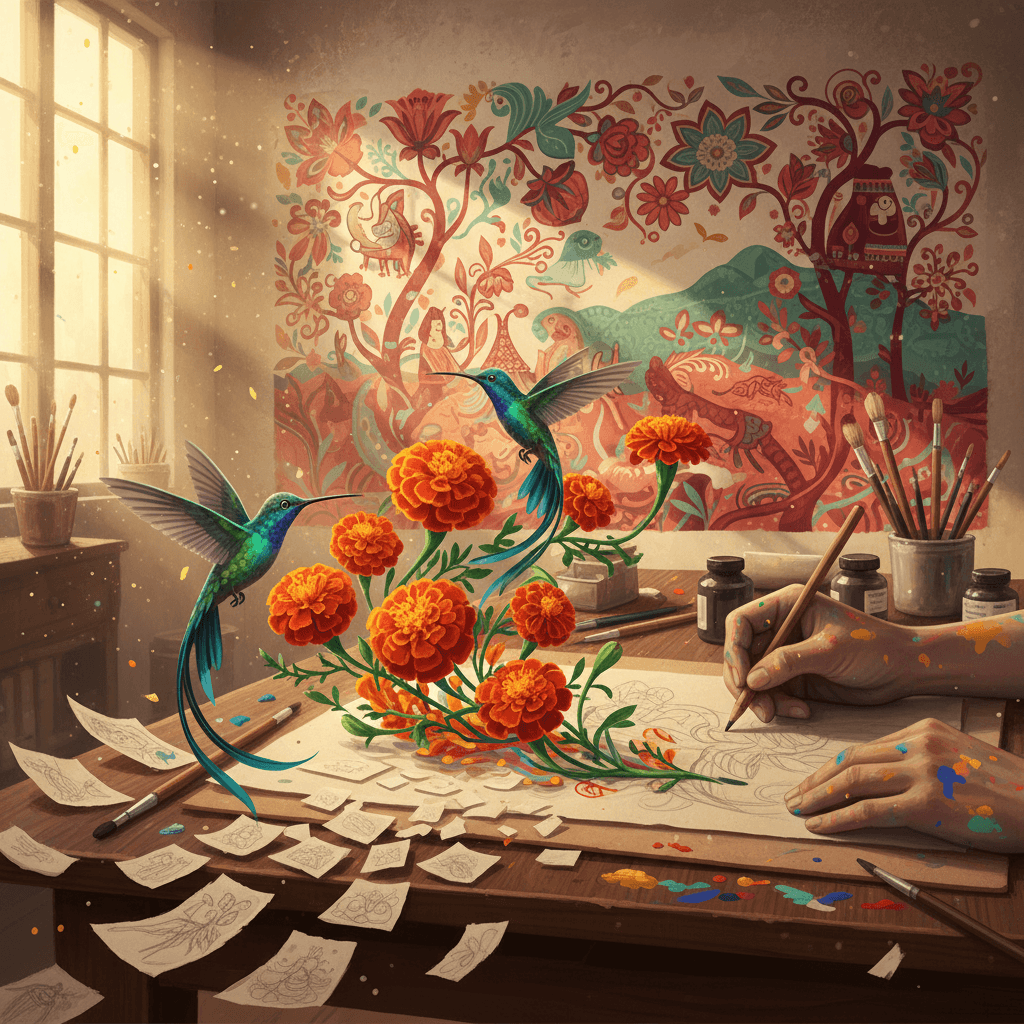
Turn setbacks into sketches for a bolder design — Frida Kahlo
—What lingers after this line?
From Wounds to Work
To begin, Frida Kahlo’s life embodies the maxim that adversity can be drafted into artistry. After a catastrophic bus accident in 1925, she was immobilized and in constant pain; yet a mirror mounted above her bed and a makeshift easel turned convalescence into a studio. Her early self-portraits—such as Self-Portrait in a Velvet Dress (1926)—translated physical trauma into visual inquiry, transforming limitation into line and color (Herrera, Frida: A Biography of Frida Kahlo, 1983). In this way, the setback became a sketch—an exploratory mark that didn’t deny suffering but redirected it toward form.
Lines on Plaster: The Sketch Habit
Building on this, Kahlo treated every surface as a draft of resilience. The Diary of Frida Kahlo (1995) shows pages where doodles, notes, and color studies morph into motifs later realized on canvas. Even her medical corsets became canvases—painted with symbols and flora—so that instruments of constraint turned into declarations of agency (V&A, Frida Kahlo: Making Her Self Up, 2018). In effect, sketching wasn’t merely preparatory; it was a survival method, a way to process pain in increments until an image—and a stance—took shape.
Prototypes of Courage in Design Thinking
In parallel, contemporary design offers a practical echo: prototypes are sketches that metabolize failure into learning. IDEO’s mantra to “fail early to succeed sooner” reframes missteps as data rather than defeat (attributed to David Kelley, IDEO). Tim Brown’s Change by Design (2009) urges teams to “build to think,” treating rough models as cognitive tools. Like Kahlo’s studies and altered supports, these prototypes invite feedback, expose hidden assumptions, and convert setbacks into structured iteration that accelerates bold, human-centered solutions.
The Beauty of Repair
Similarly, kintsugi—the Japanese art of mending broken ceramics with lacquer and gold—makes fractures visible and valuable. Rather than disguising damage, it elevates it, suggesting that repair can enrich an object’s identity (Christy Bartlett, Flickwerk: The Aesthetics of Mended Japanese Ceramics, 2008). Kahlo’s oeuvre often follows this ethos: The Two Fridas (1939) stages exposed hearts and arteries as narrative lines, while The Broken Column (1944) renders medical supports with luminous severity. The break, acknowledged and traced, becomes the gilded seam that reorganizes design and meaning.
Turning Pain into Process
In practical terms, converting setbacks into sketches benefits from a deliberate loop. Start by naming the failure clearly, then render it as a visual brief—diagrams, storyboards, or thumbnail studies that capture constraints without judgment. Next, test a minimal prototype to externalize the idea and invite critique, echoing Kolb’s experiential learning cycle of concrete experience, reflection, abstraction, and experimentation (Kolb, 1984). Finally, run a brief retrospective to extract principles, as in agile practice (Derby & Larsen, Agile Retrospectives, 2006). Thus, emotion becomes information, and information becomes form.
Boldness as Responsibility
Ultimately, “bolder design” is not just louder aesthetics; it is a moral clarity about what scars can teach. Kahlo’s Self-Portrait with Cropped Hair (1940) confronts gender norms, while works like Henry Ford Hospital (1932) give unflinching form to reproductive loss. By braiding identity, politics, and embodiment, she shows that boldness means rendering the hidden visible—so others can navigate it, too. In that spirit, every sketch born of a setback marks a route forward, guiding creators from private fracture to public meaning.
One-minute reflection
What does this quote ask you to notice today?
Related Quotes
6 selectedEvery day you have to abandon your past or accept it, and then, if you cannot accept it, you become a sculptor. — Louise Bourgeois
Louise Bourgeois
Louise Bourgeois frames life as a repeated confrontation with memory rather than a single moment of resolution. Each day, she suggests, we must either let the past fall away or consciously make peace with it.
Read full interpretation →Turn the heat of challenge into the furnace of creation — Frederick Douglass
Frederick Douglass
Frederick Douglass frames hardship not as a dead end but as raw energy waiting for conversion. By pairing “heat” with “furnace,” he suggests an intentional process: challenges generate pressure, and pressure—properly con...
Read full interpretation →Turn the ordinary into a story worth taking further. — Seamus Heaney
Seamus Heaney
Seamus Heaney’s line, “Turn the ordinary into a story worth taking further,” urges us to reconsider what we dismiss as mundane. Rather than waiting for dramatic events, he suggests that meaning emerges when we treat ever...
Read full interpretation →Create beauty from the ordinary and the ordinary will become extraordinary. — Alice Walker
Alice Walker
Alice Walker has long honored beauty that begins at home and in humble places. Her essay collection In Search of Our Mothers' Gardens (1983) celebrates creativity nurtured in kitchens, fields, and sewing rooms, while the...
Read full interpretation →Sow imagination across the plain of habit, and watch new roads appear. — Paulo Coelho
Paulo Coelho
To begin, Coelho’s image invites us to see habit as a broad, well-trodden plain: stable, efficient, but barren of surprise. When we “sow” imagination—small questions, playful constraints, novel pairings—possibility germi...
Read full interpretation →When you shape your own tomorrow, you sharpen the world's edges into art. — Toni Morrison
Toni Morrison
At the outset, the line insists that agency is an aesthetic force: when you shape your own tomorrow, you are not merely planning—you are composing. Toni Morrison repeatedly ties self-authorship to language, reminding us...
Read full interpretation →More From Author
More from Frida Kahlo →I paint flowers so they will not die. — Frida Kahlo
Frida Kahlo’s line reads like a gentle spell: by painting flowers, she resists the most ordinary tragedy—things fading despite our care. A bouquet wilts, a season ends, a beloved moment slips away; the canvas, however, o...
Read full interpretation →I tried to drown my sorrows, but the bastards learned how to swim. — Frida Kahlo
Frida Kahlo’s line opens with the familiar promise of escape—“I tried to drown my sorrows”—and then snaps into a punchline that refuses sentimentality. The sudden insult, “the bastards,” is more than comic shock; it’s a...
Read full interpretation →I used to think I was the strangest person in the world, but there must be someone just like me who feels bizarre and flawed. — Frida Kahlo
Frida Kahlo’s reflection begins in a familiar loneliness: the belief that one’s inner life is uniquely strange, even irredeemably flawed. That kind of self-story can make ordinary differences feel like permanent exile.
Read full interpretation →Embrace risk as the price of progress; comfort keeps the clock of your life frozen. — Frida Kahlo
Frida Kahlo’s line frames progress as a purchase: you pay for it with risk. In that sense, “embrace” is not a motivational flourish but an instruction to stop treating uncertainty as an error and start treating it as a t...
Read full interpretation →