
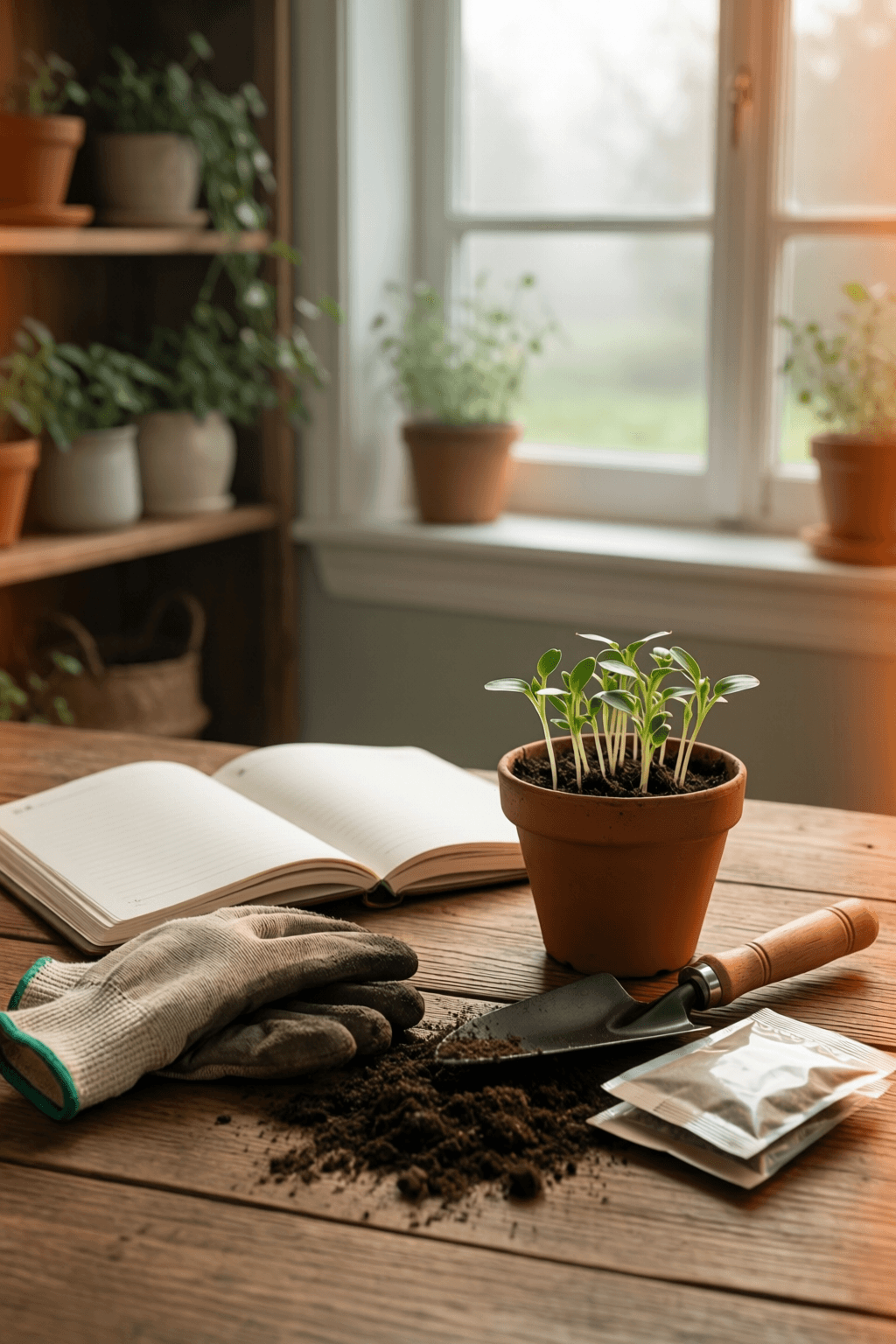
We are gardeners of our own resilience, tending to the soil of our minds with the quiet, persistent care that growth requires. — Robin Wall Kimmerer
—What lingers after this line?
The Garden as Inner Landscape
Robin Wall Kimmerer’s image begins by turning resilience into something living rather than fixed. Instead of portraying strength as hard armor, she imagines it as a garden that must be tended, suggesting that the mind is not a machine to be forced into performance but a landscape shaped by attention. In this way, resilience becomes less about sudden recovery and more about ongoing relationship with oneself. This metaphor matters because gardens respond to care, season, and patience. Likewise, our inner lives are affected by habits, environments, and repeated acts of nourishment. Kimmerer, whose Braiding Sweetgrass (2013) often joins ecological insight with human reflection, uses the natural world to show that growth is rarely dramatic at first; more often, it is quiet and cumulative.
Resilience as a Practice, Not a Trait
From that foundation, the quote gently challenges the common belief that resilience is something people either possess or lack. By calling us gardeners, Kimmerer gives us agency: we participate in shaping our endurance through daily choices. This shifts the conversation from innate toughness to learned practice, where rest, reflection, and emotional honesty become tools of cultivation. In modern psychology, this idea appears in research on adaptive coping and neuroplasticity, which suggests the brain can change through repeated experience. Thus, resilience is not merely heroic survival after crisis; it is also built in ordinary moments, when someone keeps a journal, seeks help, or returns to a stabilizing routine after disappointment.
The Importance of Soil Conditions
Yet no gardener thinks only about the plant; attention must also turn to the soil. Kimmerer’s reference to “the soil of our minds” implies that thoughts, memories, and beliefs form the medium from which resilience grows. If that soil is compacted by shame, fear, or exhaustion, growth becomes difficult, no matter how much effort is applied on the surface. For that reason, inner care may require loosening what has hardened within us. Practices like therapy, meditation, or honest conversation can work like compost, returning nutrients to places depleted by stress. Much as ecological restoration begins below ground, emotional renewal often starts in hidden layers before any visible change appears.
Why Quiet Persistence Matters
Kimmerer’s phrase “quiet, persistent care” deepens the metaphor by emphasizing method over drama. Resilience is often romanticized through grand acts of courage, but the quote honors repetition instead: watering, weeding, waiting. This suggests that the strongest forms of recovery may be almost invisible from the outside, unfolding through small acts that seem unimpressive until their effects accumulate. Here the rhythm of gardening becomes a lesson in endurance. A person who rises each day to continue healing after grief or burnout may not look triumphant, yet that steady return is itself a profound strength. In this sense, resilience resembles what Aristotle’s Nicomachean Ethics (c. 340 BC) describes in another context: character formed through repeated action rather than isolated intention.
Growth Requires Time and Season
Moreover, every garden teaches that timing cannot be rushed. Seeds sprout in their season, and even healthy growth includes dormancy, pruning, and apparent stillness. Kimmerer’s metaphor therefore resists the pressure to “bounce back” immediately, reminding us that resilience may involve pauses, setbacks, and unseen preparation before visible flourishing returns. This seasonal understanding is especially humane because it leaves room for tenderness during difficult periods. Winter in a garden is not failure; it is part of the cycle. Similarly, moments of fatigue or retreat need not prove weakness. They may instead mark the necessary conditions from which renewed strength will later emerge.
A Reciprocal Relationship With the Self
Finally, the quote suggests that self-care is not indulgence but stewardship. A gardener does not command growth; they cooperate with it, learning to observe, respond, and respect limits. In the same way, resilience grows when we stop treating ourselves as problems to conquer and begin treating ourselves as living beings in need of wise care. That idea also echoes Kimmerer’s broader ethic of reciprocity in Braiding Sweetgrass (2013), where care creates relationship rather than control. Applied inwardly, this means we build resilience by offering ourselves the same patience we would give a struggling plant: enough light, enough rest, and the faith that attentive tending, over time, can bring life back into bloom.
One-minute reflection
What's one small action this suggests?
Related Quotes
6 selectedResilience is not just enduring the storm; it is learning to harvest the rain to nourish the roots you've already planted. — Elizabeth Edwards
Elizabeth Edwards
At first glance, Elizabeth Edwards rejects the common image of resilience as simple endurance. To ‘endure the storm’ suggests gritting one’s teeth and waiting for suffering to pass, yet her metaphor quickly moves further...
Read full interpretation →When I hear somebody sigh, 'Life is hard,' I am always tempted to ask, 'Compared to what?' — Sydney J. Harris
Sydney J. Harris
Sydney J. Harris’s remark begins with an ordinary expression of fatigue: “Life is hard.” Yet his response, “Compared to what?” quietly turns complaint into inquiry.
Read full interpretation →Don't fight the challenges. Just find a new way to stand. — Germany Kent
Germany Kent
Germany Kent’s words begin with a quiet reversal of instinct: instead of treating every challenge as an enemy to defeat, she invites us to reconsider our posture toward difficulty. The emphasis is not on surrender, but o...
Read full interpretation →Optimist: someone who figures that taking a step backward after taking a step forward is not a disaster, it's more like a cha-cha. — Robert Brault
Robert Brault
Robert Brault’s line begins with a witty redefinition: an optimist is not someone who denies backward motion, but someone who interprets it differently. Instead of treating a setback as proof of failure, the optimist see...
Read full interpretation →A mind grows by staying with difficulty long enough for the experience to change it. — Mary Catherine Bateson
Mary Catherine Bateson
Mary Catherine Bateson’s observation begins with a quiet but demanding truth: the mind does not grow merely by encountering difficulty, but by remaining with it. Challenge becomes transformative only when we resist the u...
Read full interpretation →When you are friends with your storm, you dance, instead of getting blown away. — Michael Bassey Johnson
Michael Bassey Johnson
Michael Bassey Johnson’s line begins with a striking reversal: the storm is not merely an enemy to survive, but a force one can learn to understand. In this sense, the storm may represent grief, fear, conflict, uncertain...
Read full interpretation →More From Author
More from Robin Wall Kimmerer →In a consumer society, contentment is a radical act. — Robin Wall Kimmerer
Robin Wall Kimmerer’s line turns an ordinary virtue into a form of resistance: in a culture organized around wanting more, choosing “enough” disrupts the system’s rhythm. Contentment is not framed as complacency, but as...
Read full interpretation →The simpler we can make it, the more eloquent our life becomes. — Robin Wall Kimmerer
Robin Wall Kimmerer's observation urges us to consider simplicity not merely as an aesthetic, but as an approach to living deeply and meaningfully. In a world often crowded with distractions, clutter, and ever-increasing...
Read full interpretation →