
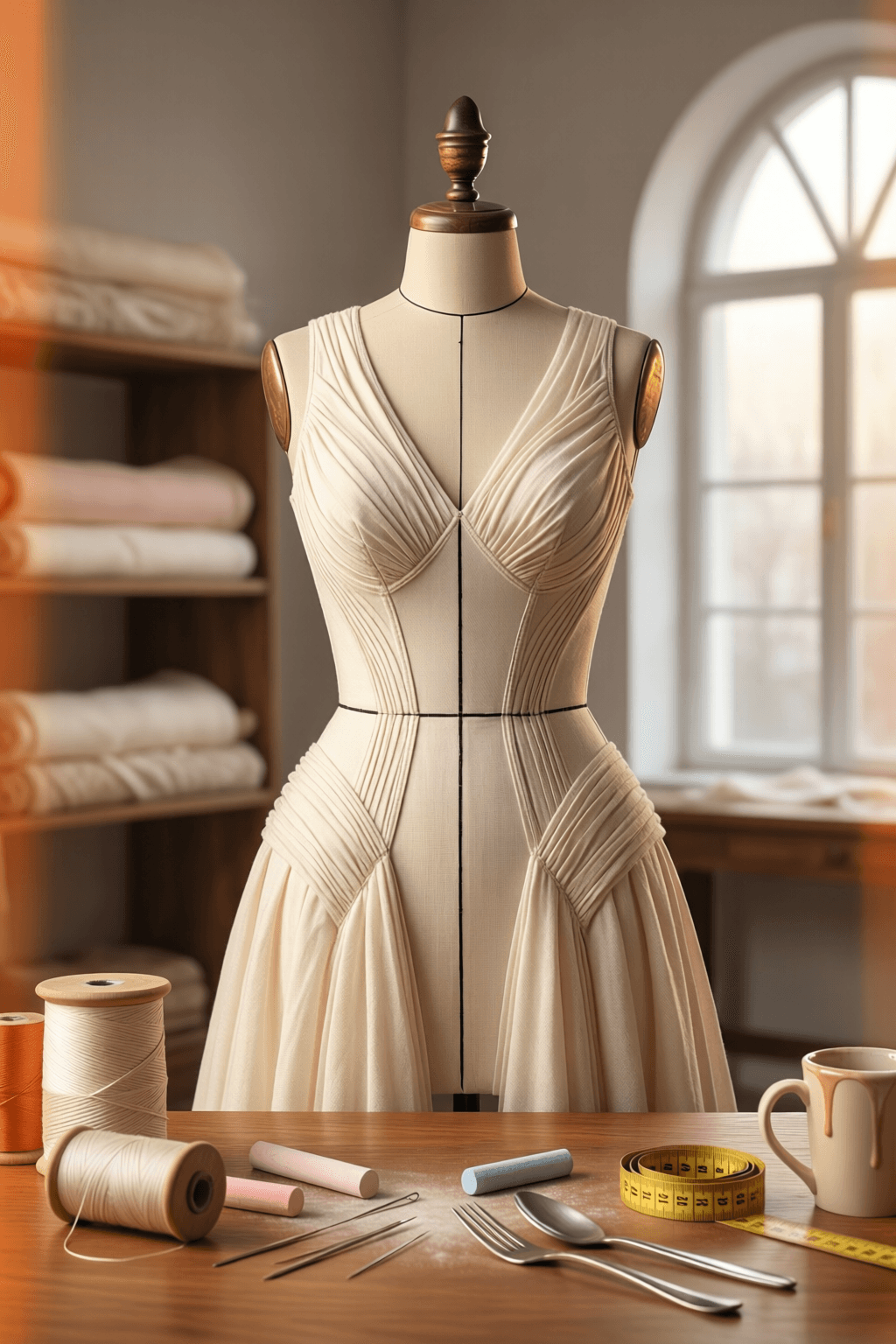
I wanted to be considered a good craftsman. I wanted my dresses to be constructed like buildings, molded to the curves of the female form. — Christian Dior
—What lingers after this line?
Craft Before Celebrity
At the heart of Dior’s statement is a striking humility: he did not first ask to be seen as a genius, icon, or celebrity, but as a good craftsman. This choice of words shifts attention away from fashion as spectacle and toward fashion as disciplined making, where beauty depends on structure, proportion, and exacting technique. In this sense, Dior presents couture as a serious manual and intellectual art. Like a carpenter, sculptor, or architect, the designer earns admiration through mastery of materials and through the invisible labor that allows elegance to appear effortless.
Dresses as Built Forms
From there, the comparison between dresses and buildings becomes more than a metaphor. Dior suggests that a dress must have internal architecture: foundations, supports, lines of tension, and carefully balanced volume. In couture, boning, padding, seams, linings, and hidden fastenings function almost like beams and scaffolding. This architectural imagination was central to Dior’s work after World War II. His famous “New Look,” introduced in 1947, used rounded shoulders, cinched waists, and full skirts to create a deliberate silhouette, as documented by Carmel Snow of Harper’s Bazaar, who reportedly exclaimed, “It’s such a new look!”
Molding the Female Form
Yet Dior’s architecture was not rigid in the manner of stone or steel; it was designed to move with the body. When he speaks of dresses “molded to the curves of the female form,” he describes a partnership between garment and wearer. The dress does not merely cover the body, but interprets it. This idea connects Dior to older traditions of tailoring and dressmaking, where fit was a form of respect. A well-made garment recognized individuality, transforming fabric into a second skin that could enhance posture, movement, and self-possession.
The Legacy of Couture Technique
Building on that idea, Dior’s emphasis on construction reflects the broader values of haute couture. The Chambre Syndicale de la Haute Couture, formalized in Paris in the nineteenth century, defined couture through custom fitting, handwork, and atelier craftsmanship. Dior inherited and renewed that tradition. His dresses often required many hours of skilled labor, not only from the designer but from petites mains, the specialized seamstresses who turned sketches into reality. Thus, the quote quietly honors a collective craft culture, where precision is shared across many expert hands.
Beauty Through Discipline
Dior’s words also remind us that glamour is rarely spontaneous. What looks soft, romantic, and feminine on the outside may depend on strict geometry underneath. This tension between discipline and delicacy gives his designs their enduring power. In this way, his dresses resemble great buildings that feel graceful precisely because their engineering is sound. The viewer may notice beauty first, but the beauty lasts because construction supports it. Dior’s craftsmanship made fantasy wearable.
A Philosophy of Fashion
Finally, the quote offers a philosophy of fashion that remains relevant today. In an age often dominated by branding, speed, and images, Dior’s statement returns us to the ethical dignity of making things well. He measures design not by novelty alone, but by how thoughtfully form, material, and human presence come together. Ultimately, Dior imagined fashion as architecture in motion: shaped by craft, animated by the body, and completed by the woman who wears it. His ambition to be a “good craftsman” was therefore not modest in scale; it was the foundation of his greatness.
One-minute reflection
What does this quote ask you to notice today?
Related Quotes
6 selectedPatience is not merely a virtue but a fundamental component of craftsmanship; it is the quiet companion that guides the steady hand. — Tadao Ando
Tadao Ando
At first glance, Tadao Ando’s words seem to praise patience as a moral quality, but he goes further by placing it at the center of making. Craftsmanship is not only skill with tools or mastery of materials; it is the dis...
Read full interpretation →In the end, you win through superior craftsmanship, not marketing. — Robert Greene
Robert Greene
Robert Greene’s statement cuts through the glamour of promotion by placing true advantage in the work itself. Marketing may attract attention, but craftsmanship earns trust, loyalty, and endurance.
Read full interpretation →The beauty of a finely worked object points to the beauty of the craftsmanship. — Paul Klee
Paul Klee
Paul Klee’s statement begins with a simple but powerful observation: a beautiful object does not merely please the eye; it points beyond itself to the intelligence, patience, and skill that shaped it. The object becomes...
Read full interpretation →Quality, manual labor, and a lot of time: that is the essence of craftsmanship. — Katarzyna Maniak
Katarzyna Maniak
At its core, Katarzyna Maniak’s statement reduces craftsmanship to three inseparable elements: quality, manual labor, and time. Rather than treating a finished object as merely a product, the quote frames it as the visib...
Read full interpretation →I would almost prefer the word 'craftsman'. He is like one of those old-fashioned ship builders who conceived the build of the boat in their mind and after that touched every single piece. — William Golding
William Golding
At first glance, Golding’s preference for the word “craftsman” shifts attention away from the romantic image of effortless genius and toward disciplined making. The term suggests someone who does not merely imagine a wor...
Read full interpretation →The object with visible human error, with a maker behind it, with time baked into its surface, is the luxury of the AI age. — Venkatesh Rao
Venkatesh Rao
At first glance, Venkatesh Rao’s line reframes luxury in a striking way: instead of rarity defined by price or exclusivity, he points to objects that visibly carry human touch. In an age when AI can generate flawless tex...
Read full interpretation →More From Author
More from Christian Dior →Doubt whom you will, but never yourself. — Christian Dior
Christian Dior’s exhortation to 'never doubt yourself' stands as a beacon in a world saturated with skepticism. While it is natural to question the intentions and reliability of others, Dior implies that the foundation o...
Read full interpretation →Doubt whom you will, but never yourself. — Christian Dior
Christian Dior’s statement, 'Doubt whom you will, but never yourself,' champions unwavering self-confidence. At its core, this idea underscores the necessity to maintain faith in one’s abilities and judgments, even when...
Read full interpretation →