
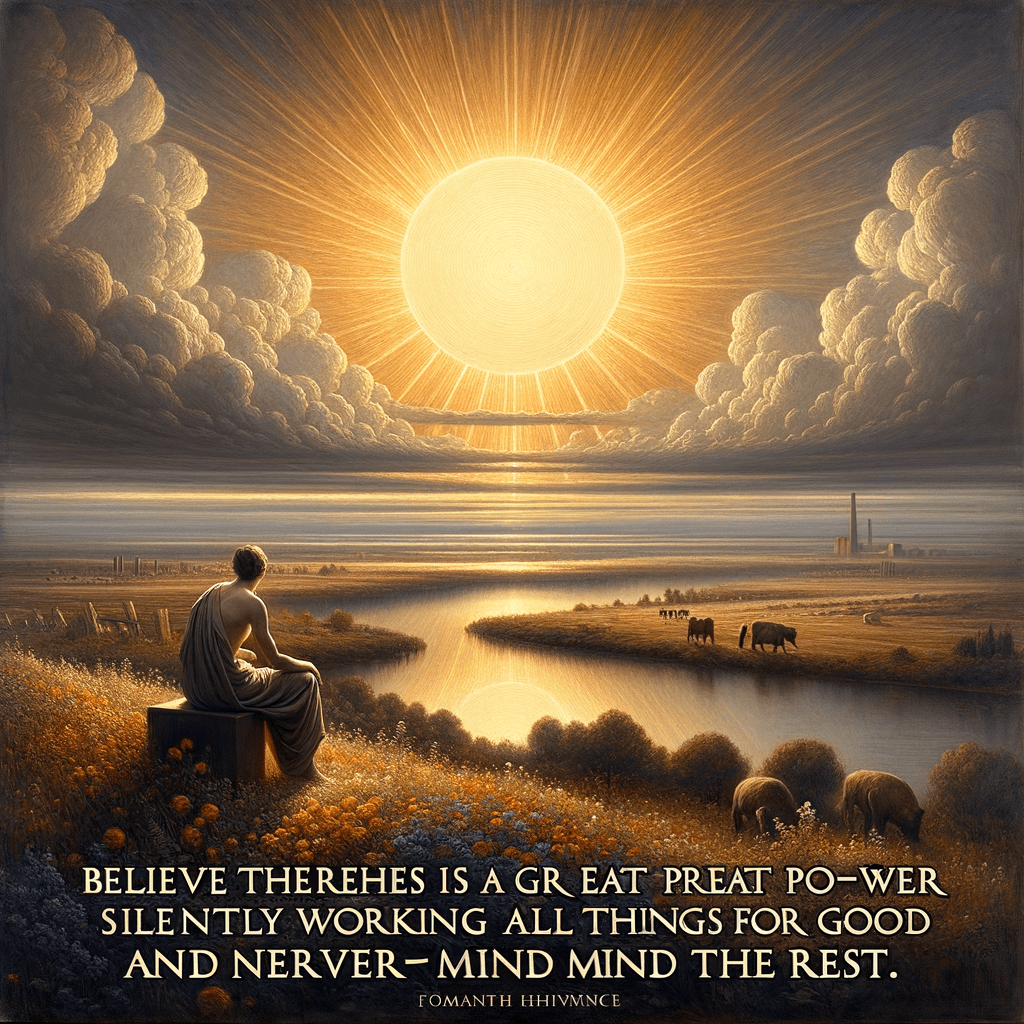
Believe there is a great power silently working all things for good, behave yourself and never mind the rest. — Beatrix Potter
—What lingers after this line?
Faith in a Greater Force
This quote encourages believing in a higher power or universal force that orchestrates events for the greater good, even if it operates silently and unseen.
Personal Conduct
It emphasizes the importance of personal behavior and morality, suggesting that how one conducts oneself is within their control and should be a priority.
Letting Go of Concerns
The phrase 'never mind the rest' advises focusing on one's actions and virtues while letting go of things beyond one's control or the opinions of others.
Inner Peace and Trust
Trusting in a benevolent force and focusing on one's conduct can lead to inner peace and reduce anxiety about external circumstances.
Beatrix Potter's Worldview
Known for her works as a writer and illustrator, Beatrix Potter often infused her stories with moral lessons and a deep appreciation for nature and simple, virtuous living.
Recommended Reading
As an Amazon Associate, we earn from qualifying purchases.
One-minute reflection
Why might this line matter today, not tomorrow?
Related Quotes
6 selectedEvery act of self-discipline increases your confidence, trust, and belief in yourself and your abilities. — Brian Tracy
Brian Tracy
Brian Tracy’s statement begins with a simple but powerful chain: when you keep a promise to yourself, you generate evidence that you are dependable. In that sense, self-discipline is not merely about control; rather, it...
Read full interpretation →The greatest victory is the battle fought against your own desire to quit when things get quiet. — Epictetus
Epictetus
At first glance, this saying shifts the meaning of victory away from public triumph and toward an inward contest. The hardest battle, it suggests, is not fought in dramatic moments but in silence—when excitement fades, r...
Read full interpretation →If you don't control what you think, you can't control what you do. Simply, self-discipline enables you to think first and act afterward. — Napoleon Hill
Napoleon Hill
Napoleon Hill’s statement begins with a simple but demanding premise: behavior does not appear out of nowhere, but grows from thought. If the mind is scattered, impulsive, or ruled by fear, then action will likely follow...
Read full interpretation →Self-discipline is when your conscience tells you to do something and you don't talk back. — W. K. Hope
W. K. Hope
At its core, W. K.
Read full interpretation →The secret to mastery is not intensity, but the grace to show up when you do not feel like it. — James Clear
James Clear
At first glance, James Clear’s line overturns a common myth: that greatness comes from bursts of passion or extreme effort. Instead, he places mastery in the quieter realm of consistency, especially on the days when enth...
Read full interpretation →We don't drift into good directions. We discipline and prioritize ourselves there. — Andy Stanley
Andy Stanley
Andy Stanley’s quote challenges a comforting illusion: that a meaningful life will naturally sort itself out if we simply keep moving. Instead, he argues that good directions are rarely accidental.
Read full interpretation →More From Author
More from Beatrix Potter →